Tag: literature

  • Muted

    Processed with VSCOcam with c1 preset

    The voice speaks to me, it is a deep voice. I understand some words and phrases that my brain fashions into patterns, as this is the essence of mankind’s relationship to its languages. Air emanates from the lungs, shaped by the throat and mouth. The human ear receives the sounds for the brain to form into recognizable patterns. The mouth, however, is the most offensive of communicatory vehicles. It transforms language into vulgarity, coarseness. Spit and odor often sour the experience for the listener. I prefer words written rather than spoken. Words on paper written by hands assembling symbols, again, in recognizable patterns, a process much more refined than speaking, much cleaner and more worthy of attention, the written word. For anyone can speak. A newborn begins speaking immediately, incomprehensibly. Unevolved man spoke in grunts and howls. The human being must learn to write legibly and coherently, a person must be taught to build cogent thought. Man can speak of an idea almost as fast as he can think it; writing (and reading, for that matter) take time, an effort required of the communicant.

    Is it not the duty of man and woman to think and apply the mind toward some purpose? Is it not our duty to wish to improve the life (and thereby, the ideas) of others? Is there no morality in keeping silent?

  • neo-enlightenment, text redacted

    Processed with VSCOcam with b5 preset

    [redacted] incarceration by emancipation. There are two initial steps in the process, the first being extraction of the bourgeois individual from common life and placement into isolation, sampling the good life at intervals for a year, providing the subject with controlled transgressions into common life to witness firsthand the fundamental incompletion of the subject’s former life in comparison to the good life.

    Subjects in this initial phase are isolated with study materials in multiple mediums to exercise and cultivate the intellectual spirit, prioritizing topics the individual has interest in engaging. [redacted] The instructors then diversify content so that soon the subject absorbs information faster and at greater depth, and the assimilation of refined themes begins.

    [redacted]

    The subject witnesses an imperative of the will to wish to strengthen and sharpen the mind, and he/she acknowledges that humans are inherently eager to seek information and structure it to the mind’s will. [redacted] The enlightenment project reinforces that eagerness, revives it from an entropic state and demonstrates its potential [redacted]

    […] is our primary goal, so that the subjects, once the initial phase of enlightenment is underway, will return to former life in an enlightened state of consciousness, one that engages the political, moral, and intellectual processes, without modifying the sovereign person’s nature of character. We strive to combine the intellect with a culturally relevant awareness that each human being coexist and freely give, take, and borrow knowledge from one another.

    [redacted]

  • Neurosis, gentleness, contempt

    IMG_1277

    They said that with an intellect advanced far beyond one’s years there will accompany it a cognitive malady or other neurosis equally advanced, because the universe must always balance its extremes. And the boy’s gifts were extreme. This is how he suffered adult phenomena at an early stage of maturity, due to this balance, or imbalance, if you will. He was so sick that he couldn’t translate his fears and feelings into language in order to articulate them to others. They said that because of this, the boy suffered through a debilitating anxiety throughout his childhood and adolescence while the few people who bore witness to his gifts had no idea of the struggle inside him, the strain and terror gnawing at his spirit.

    And it was due to this complicated element in his life that the boy, or the prodigy child, as they called him, grew into the world and into himself with a gentle disposition but also a deep contempt of the world that would accompany him unto death.

  • Old man, gun

    You put the pin in afterward, he said, twisting the pistol around so I had a better view of the barrel’s clean gash. Like this. The barrel snapped closed and he handed the pistol to me. The old man’s eyes were the color of bullets. Now you try, he said.

    The gun had the energy of an animal in my hand. I stared at it and moved it around and watched the light reflect in its chrome sheen and then I looked back at the old man and he was grinning at me.

    When I was your age we didn’t have fancy guns like that, he said, nodding at it. The first pistol I ever shot was a beat-up police-issue .38.

    His eyes darkened and focused on something distant for an instant before lighting back up. My old man stole it from some cop, he said.

    What did you shoot at? I asked. The old man shrugged and said, empty coffee cans in the backyard, targets we’d made from wood.

    I nodded and stared out from his garage to the street. It was quiet and bright.

    How old were you when you shot your first person? I asked him. He dropped his eyes to me and pulled a small cigar from his pocket. He lit it and blew streams of smoke out his nostrils.

    What makes you think I ever shot anyone?

    My dad says you used to shoot people, I said, staring down at the gun in my hands. He says you used to hit men. He says you killed a lot.

    Your old man said that? he asked, coughing out smoke. He looked out to the street and sighed deep in his barrel chest. I like your daddy, he said. He’s a good father to you kids. But he got no business telling you stories like that. Specially when they ain’t true.

    The old man’s eyes darkened again and he took the gun from me delicately, a softness in his bones.

    Let’s go inside and make you a sandwich, he said.

    I watched him lock the gun away in a black toolbox. A faded tattoo of a bulldog painted one of his forearms. I had the strange feeling that I’d hurt him, that I had sliced him with a knife and memories spilled out.

    I stared out to the street again and a strange wave of sadness slid over me just as a cloud passed across the sun.

    Come on, son, the old man said, and we went inside.

  • Phony writers

    Processed with VSCOcam with b5 preset

    He sat next to me at the bar and ordered a beer, introducing himself as the writer who does not write. I thought it odd that someone should say such a thing to a stranger, but then no one is a stranger in this city, in this world. I told him that I’m a banker, retired, which was a lie, because while I am retired I have never in my life been a banker. I detest bankers and banks and I despise most attorneys and writers though this is the first time I’ve met a writer who actually told the truth about anything, namely about how he did not write. Most people who claim to be writers talk a lot about writing and don’t write anything, instead twisting and distorting words toward some false point of light. This is something they’d never admit to. Liars, all of them, save one. I shook the man’s hand and said I’m pleased to meet you, I appreciate your candor.

    It’s not candor, sir, it’s the truth, he said, and drank his entire glass of beer down in two or three gulps. I’m not proud of it, he continued. Not proud at all. I’d much rather be working, writing with the immediacy of youth.

    I drank the rest of my scotch and sat in silence. The writer who does not write ordered another beer, a saison. A ballgame played silently on the TV behind the bar, the Braves were up on the Dodgers in the fourth.

    It’s a peculiar profession, I said to the writer who does not write. I imagine it has its ups and downs like everything else.

    I was never any good at baseball, he said, but before I could clarify what I’d meant, that I’d meant his profession was peculiar, not the profession of baseball, he lifted his beer and drained it again in two or three seconds.

    I haven’t seen anyone drink a beer like that in a long time, I told him.

    I’m a thirsty man, he said. A thirsty man who does not write. He put a bill on the bar and stood to leave.

    It was nice meeting you, he said, and shook my hand. Have a pleasant day.

    Same here. Good luck to you.

    Thank you. Maybe I’ll walk out of here and get hit by a bus.

    Then he was gone.

    I ordered another scotch and watched the rest of the game.


  • Another memory in algorithm

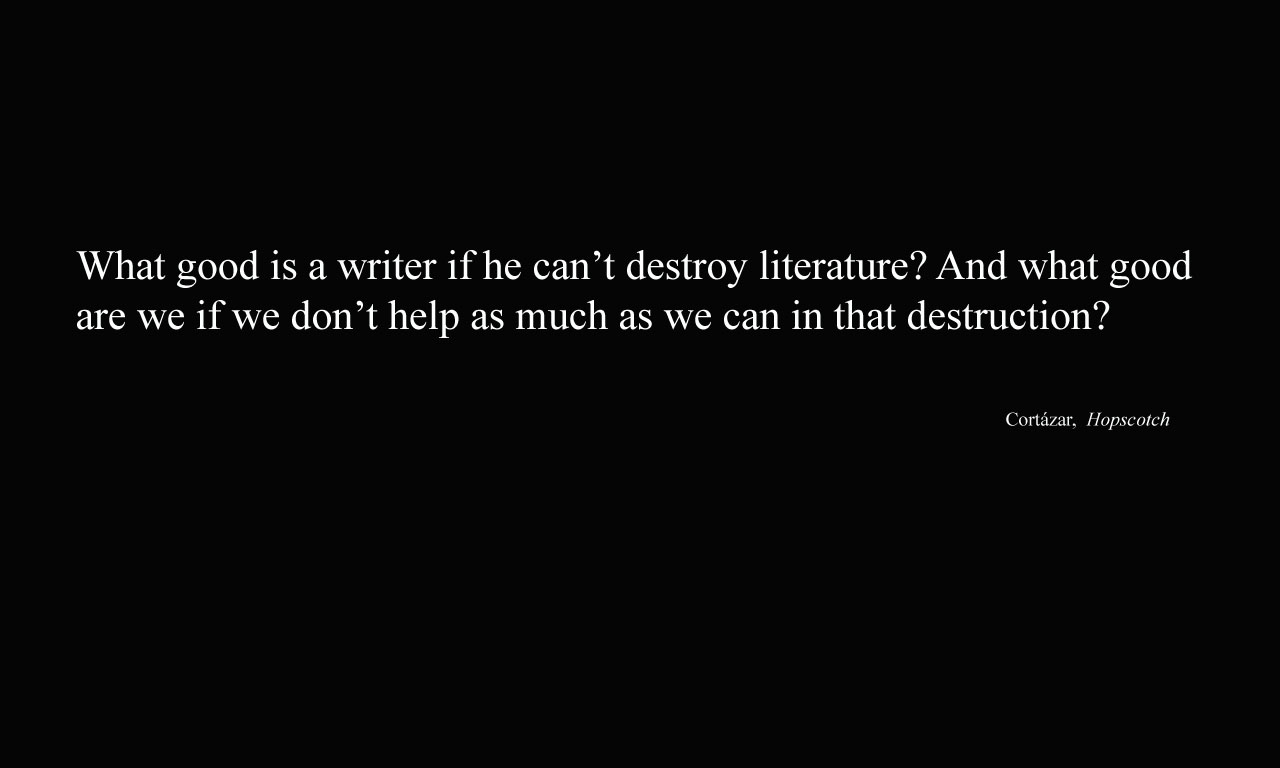
    Hopscotch

    Suburban life can be maddening for a man under pressure. On certain days he feels violated  by all the comparison. The people and things he sees spread up and down his street are like the people and things of his own life, only different, nuanced in ways he can’t quite explain. Fulfillment is replaced with longing. Time elapses in duty and rote obligation rather than days, weeks, sunsets, breakfasts.

    There is something subtle and devious about the way people communicate in the suburbs. Neighbors symbolize their lives through what they possess, the activity of their social lives. In the suburban community, a man’s value is measured by what he keeps and how he keeps it. Everywhere he looks is a form of qualitative comparison, a measuring stick of social value, a mirror under fleeting light.

    I sometimes wonder what my father saw when he looked at our neighbors. He was a man married to the pursuit of his own meaning, deeply and spiritually unhappy with his life. He hated everything about his life, most of all the man who was living it.

    I used to construct my calendar based on my parents’ work schedules. Thursday nights were a practice in tension. My mother worked late into the evening, my two sisters and I forced to endure the strain of a night alone with my father, his body teeming with living currents of pressure. His endeavors on those Thursday nights were struggles in simplicity, mere withdrawals of anything that might upset his self control. He listened to baseball games on the radio because this soothed him, it comforted him in the aging skin of his failures. He always cooked eggs and toast for his kids because that was what he knew. To try something else or experiment with his delicate routine would teeter the entire experience close to danger. He smoked cigarettes while he ate, one after the other.

    We would be at the table, the four of us deliberate in our silence, shoveling mouthfuls of runny eggs to thwart the hush. A baseball game droned in the other room, the innocuous soundtrack of our fragile safety. My father studied me as I ate, not just this night or other Thursday nights but always, judging me with every meal, each small bite, waiting for me to give him a reason. There was always a cosmic inevitability in those situations. I think back and wonder what my sisters thought while we ate, if they averted their gaze out of some mixture of compassion for me and respect for him, or maybe they measured him furtively, puzzled by the enormous weight of his thoughts. I wonder if they looked at me and couldn’t help but share my discomfort, a truth so deep that it became a part of who I was and still am. I don’t think they knew how close I always felt to death and how confusing it was to continually share that distinction with being a child.

    He would say something about my eating, I was doing it wrong, slow down, eat faster, chew with your mouth closed, open your mouth, look at me, don’t look at me. The words were meaningless, they could have been any words, any language or dialect. His words were the evasive filler of space and time, metaphysical snapshots of the moment before the moment. I always knew what to expect long before I cowered deep into myself in preparation, before the blow sent me sailing into the other room, his giant electric frame pouncing on me, eyes glittering mad, smoky breath comforting and familiar on my cheeks.

    I remember the red ember of cigarette fire in his fingers inching toward my eyes and I closed them, shutting out the animal light in his face, his eyes like mine in the years to come, and I felt the close burn just before he pulled the cigarette away, unable to whimper in entreaty or resist his rage by uttering the only name I knew to call him.

  • Cornucopia

    Processed with VSCOcam with se3 preset

    He spoke but I wasn’t listening, instead writing in the notebook in my mind but forgetting words, too many of them, a cornucopia of words pooling at my feet, flooding the office floor, words upon words piling to the desktop, I’m sinking in them, everything sinks.

    You must particularly peer into the recesses in your life, he said.

    I nodded.

    Recess, recess, he repeated, hissing, and walked out of my office.

    I wondered if he’d meant a fissure or some type of indentation, or if he’d thought I was slacking on the job, much like a child would take recess from class. I couldn’t help feeling defensive.

    I’m a leader, I shouted, but he was already down the hall in his own office. I said, I’ve always done what’s been asked of me, is this about the books? This must be about the books.

    In my mind, my boss walked back into my office and said, What books?

    The books I’ve been taking from the library, I said. I put them back, it’s not like I’ve been stealing them. I’m not a thief! I shouted. I’m not a thief!

    A voice from the hall, perhaps Sarah from accounting, asked if I was feeling okay. TJ? the voice said.

    Here I am now preparing for my death, I whispered.

  • Bulbous but strong

    Processed with VSCOcam with b5 preset

    My mother died when I was young, she drowned herself. I’ve written about this incident countless times, I know, but I’m writing again for myself. My mother died when I was young, she drowned herself. This is what they say. My father told me that she drowned herself because she was crazy but also because of me, she simply loved me too much or she was afraid of me, she couldn’t control the maternal bond with her son, she didn’t trust her body near mine, my father never really knew what, he only told me that she was crazy and it was because of me. She was crazy when he met her, he said. He told me once that she used to have nightmares, premonitions, she repeatedly endured the phenomena until she couldn’t live any longer, she just couldn’t take it, neither in this world nor the next. This is what my father told me. My father the hypocrite. My father told me this when I was seven, he hardly speaks to me at all but he told me this back when I was seven, he said my mother never mentioned to him what the dreams were about but only that they were terrible, our son is cursed, she told him, he’s awaiting some dark fate, some terrible future. I wake thinking of my mother and try to imagine that midnight pool she waded into, I try to find it in my mind. A moonlit expanse, a solitary woman exposed to the night, serene, a woman dwarfed by trees, awash in the light of the moon. This notepad is small in proportion to the desk and I’m hungry, I need to eat and I’m also thirsty, I remember the rotted bulbous tree root from my dream and my appetite is abated, at least for now, how is it possible to be alive and feel dead at the same time, I think of her, my mother, and I write in the notepad now fully aware of the scab on my hand, for it sets directly beneath the pen, a blister, each diagonal thrust of the pen reminds me of my mortality. Leaking and bulbous. I wake with my mother floating about the pool of my conscience and a bulbous tree root rotting, strong but rotting, a bulbous scab on my hand and a dark pool whereby my mother sent her last breath upward in a spring of slow bubbles up to her moon, itself just a bubble. I was seven. She was twenty-eight, and now I’m already half-past her final age. In some respects, a grown man. At this rate the scab will never become a scar, it will never heal, opened and reopened and reopened and reopened and the motherless child will never become a man despite his intellect but instead perhaps whittle himself away scab by scab, the image of my mother more like the dramatization of an image rather than the actual image, her body floats, I can’t remember what she looks like and I try to imagine what she wore that night, if she wore anything at all, bulbous tree root rotting but strong, what she wore floating dead in that lake, that secret pond in my mind. I see soft pink fluttering at the edges of the water’s surface, or perhaps the air’s surface, her hair too dark to see by moonlight, her hair shimmering equally with the water, the soft pink of her thin gown two shades paler than her skin, my mother, face down, forever, my mind’s eye directly above her, looking down, the eye of the moon. My father blames me, he’s always blamed me and I cannot hate him for it, I cannot blame anyone for blaming me for causing the quake, a bulbous tree root a scab a bulbous tree root seven a blame, a moon eye—