Tag: literature

  • At war with the blind

    Turns out the election of 2016 was a declaration of war. America is at war with itself and it’s not clear who is winning. We Americans didn’t recognize it for war at the time, but it’s clear now and clearer every day—with each childish act, each transgression by the populist president and the blind allegiance to him by those who turn the cheek to his lies, indecency, and hypocrisy. They’d rather not see the truth. It doesn’t conform to the reality they’ve invented.

    Instead, they make excuses. They claim that journalism is their enemy; and in a way, they are right. Journalism is a purveyor of news—news is the running narrative of the current state of the world. Most news organizations rely on facts and truth to inform the public, to check authority and keep it from running wild with abandon. But these people are not concerned with facts and truth. Perhaps they never were.

    They converse in small circles of their own, unable to communicate beyond their self-imposed borders. Their ideas are small; their speech hateful. To them, the mind is not a tool or weapon, but a liability. Their weapons of warfare: guns and faith in a god that would not recognize their warped idea of that god’s intended purpose or morality. Somewhere along the way, they decided their god had a white face and carried an assault rifle.

    The religious right got the president they think is a crusader for their religion. But he’s not—he’s lying about being a practicing Christian just as he lies about everything else. The Christians think they have god on their side. I am a reformed Christian, so I know their sad story well. It’s a story in which they have owned the last two thousand years. Yet history is not on their side.

    God and guns are their hallmarks, despite their lord and savior’s abhorrence to violence. If their Jesus were alive today they would not recognize him. They would ridicule him, persecute him, expel him, torture him, imprison him, murder him. Those on the Christian Right have deluded themselves. They look out at the world through veiled eyes and do everything possible to avoid seeing what’s really, truly there. They have the vision of a bat—their eyes do not work, and noise guides their focus. But whereas bats were cursed by nature with lack of eyesight, the blindness of the Christian Right is self-imposed.

    The two sides prepare for battle in opposite ways. I prepare by improving my eyesight—by reading the sages, by keeping myself informed through reliable, proven news sources (not commentary). Most importantly, I prepare by thinking. As a journalist, I feel the declaration of war more intimately or personally than most. This is a war on truth and decency. The president and his blind followers bring their guns, their anger, their certainty that they are right to the battlefield. Where I come from, only people who couldn’t fight carried guns.

    I bring the lessons of history and the sages who have lived through such battles and emerged victorious. Wisdom and open mindedness will always prevail against lies, intolerance, false patriotism, hypocrisy, violence, and indecency. I study the lessons of the past and sharpen my sword by lamplight every night. I urge you to do the same, and above all to participate in the civic discussion by spreading the truth you see all around you.

    —Your brother and rebel for truth.

  • Up the mountain

    Processed with VSCO with a5 preset

    The snow was more than a meter deep without drifts. Each step was a victory earned by the breath in our lungs, every muscle in the body straining up the spongy incline rutted with tree and rock. Quickly we discovered we would not make it unless we helped each other, provided leverage where man substituted tree, an outstretched glove covered in snow in a world fiercely against us, its gravity, calm, and vastness too much to meet alone. Lungs aflame and breaths before us like clouds where above there were none—a sky impossibly blue and vast just as our steps from the Jeep grew impossibly numerous. I looked back to our path up the mountain, a manmade seam in an otherwise undisturbed natural kingdom. Twice we stopped to rest. The exertion elevated my body temperature but my feet and hands felt frozen. Brandon stopped moving again but it wasn’t to rest. With the breath pumping in and out of him, he said: This is it.

    He looked down the mountain and up to the sky then pointed to the tree nearest me. Should be right there, he said, then knelt and began digging with his hands, shuffling the snow away from the base of the tree. A bird cawed. I knelt to help Brandon, keeping my eyes trained on him and the woods around us. The digging brought him to rustling plastic and he carefully extracted a bulky black trash bag, brushing the snow from it. It’s in here, he said, handing it to me. I could feel the contours of the boot box inside, heavy with paper. Hope it’s not damaged, I said.

    A doe startled me to my left. She watched us with interest, two tall figures limited by two legs, shrunken by their voyage up the mountain. She’d studied our journey the entire way, from our vehicles on the bluff to a point not halfway up the mountain, where the doe, amused and aware of our admiration for her combination of elegance and power, took leave swift and light to a place beyond the trees.

  • from Critchley

    firecube

    Notes from Simon Critchley’s Infinitely Demanding: Ethics of Commitment, Politics of Resistance:

    “The philosophical task set by Nietzsche and followed by many others in the continental tradition is how to respond to nihilism, or better, how to resist nihilism. Philosophical activity, by which I mean the free movement of thought and critical reflection, is defined by militant resistance to nihilism. That is, philosophy is defined by the thinking through of the fact that the basis of meaning has become meaningless. Our values are meaningless and require a Nietzschean ‘trans-valuation.’”[1]

    “The human being has a reflective attitude towards its experiences and towards itself. This is why human beings are eccentric, because they live beyond limits set for them by nature by taking up a distance from their immediate experience. In living outside itself in its reflective activity, the human being achieves a break with nature.”[2]

    “Ours is a universe where human relations have been reduced to naked self-interest, to unfeeling hard cash, and where all social life is guided by one imperative: conscience-less free trade; a life of open, unashamed, direct, and brutal exploitation.”[3]

    “Some wrote in the 1970s that capitalism was over. On the contrary, capitalism under the guise of globalization is spreading its tentacles to every corner of the earth. If someone found a way of overcoming capitalism, then some corporation would doubtless buy the copyright and distribution rights.”[4]

    “Politics is not rare or seldom, and to adopt such a position is defeatist. Politics is now and many. The massive structural dislocations of our times can invite pessimism, but they also invite militancy and optimism, an invitation for our capacity of political invention and imagination, an invitation for our ethical commitment and political resistance.”[5]

    “No revolution will be generated out of systemic or structural laws. We are on our own and what we do is what we must do for ourselves. Politics requires subjective invention, imagination and endurance, not to mention tenacity and cunning. No ontology or eschatological philosophy is going to do it for us.”[6]

    Critchley, Simon. Infinitely Demanding: Ethics of Commitment, Politics of Resistance. Verso, London, 2012.

    [1] 2

    [2] 86

    [3] 96

    [4] 98

    [5] 131

    [6] 132

  • Alley on F

    Processed with VSCO with c1 preset

    I decided to stop wanting cigarettes and bought a pack, smacking it in my hand like a ball into a mitt while vehicles swam past on F Street. Still the same plastic string to break, then the foil, still that unmolested, fecund first smell of a new pack. The sun high in its nest but past zenith. I lit the smoke with a match and inhaled, flooded with sensation, injected with memories as if from a dream. As if I’d never smoked but somehow in not smoking I’d smoked ten thousand times. An inhalation toward perfection. I took one pull for my lungs, bronchi stretched taut and sated, and one for the head, spinning slightly but controlled in mellow euphoria. The heart raced, vision was clear, sharpened. I inhaled the air around me.

    I didn’t know what else to do so I ate in a diner. The food was excellent but it made me sleepy. I ordered a coffee to go and called my wife. She was upset with work. I listened, reassuring her, and promised to call before bed. The waitress brought my coffee in a paper cup and took my payment. I left the diner to smoke in the alley next to it. The air smelled of burning wood from a stove. My wife was passionate about her work in music and perhaps sometimes too passionate but long ago I conceded that I’d rather have a passionate woman than the alternative. A thin trail of single-file footsteps cut through the icy drifts down the center of the alley toward Tenderfoot on the other side, drenched in sunlight. Even with the snow cover I could smell garbage, spoiled food, piss. Something moved to the right of me and I turned to see a woman seated on steps at the back door of a business, smoking. I smiled at her and she looked at me as if I wasn’t supposed to be there. Her eyes were brown and she wore a red knit cap. Her fingernails were trimmed and painted black. I drank my coffee. Like the town itself the buildings in the alley were old and I wondered how many drifters stood in my exact spot, how many starved cowboys, how many Kerouac copycats and rafting junkies stood here like me staring at the old masonry and pondering their next move. Cat prints laced the alley snow like scars. I inhaled again and the smoke and cold air were ice in my lungs. A tall figure entered the alley from the sunlight at the far end. It was bright but the daylight wouldn’t last. Nothing lasts, nothing endures. I heard steps on the snow close behind me but it was too late. He’d come from the sidewalk near the diner’s entrance and hit me with pepper spray. Daggers ripped my eyes apart. He kicked me into a drift and I sank deep into it, my back crashing into something like steel. I cursed and could open my eyes just enough to make out two of them. Hornets swarmed and stung my face, my ears. The woman in the red hat was gone. Where’s the case? one man said. I’d never heard the voice before. He must have been talking to me because when I didn’t answer I got punched in the face, but my attacker lost balance and fell into the snow next to me. I pounced on him, grabbing him by the neck and squeezing, his stubble digging into my palms. I reared back to hit him, my face ablaze, my eyes swollen closed and filled with crushed glass, sinking deeper into the snow with each movement. Then I was pulled from behind and tossed away like a child. I landed hard on my shoulder and attempted to see but couldn’t. The snow on my face and up my nose was heaven and I stood to fight but the big man pulled the other up with powdery dust flying off him. They had dark ski masks, both of them. The man I’d fought pulled a revolver up from beneath his snowy overcoat and said, Where’s the fuckin case?

    What case? I said, but the words were like saliva dripping out. My lips were burning, numb.

    Someone must have walked by on the sidewalk because they both looked in that direction. Their eyes were dark rimmed with white beneath the masks.

    I said: I don’t know what the fuck you’re—

    Shut up! shouted the man with the gun, thrusting it toward me. His eyes were mean. The big man put his big arm out to try and quell the other man’s rage, or intent, or boldness.

    Then the man with the gun said: Let’s go.

    They took off running down the alley toward Tenderfoot, stumbling and breathing heavily in the deep snow. I put my face in the drift and just lay there. That asshole got me good, right on the nose. I was close enough to smell his coat. It was him—he’d been in my room at the motel the day before.

    I felt a soft hand on my back. Someone said: Are you all right?

    Someone else: Is he dead?

  • Deconstructionist pt. V


    IMG_1460.JPG

    The wall opposite the hearth pulses light, my head and shoulders cut sharply in shadow. I am a man, former architect. Everything else is mystery. Warmth from the fire marches over me, into me. I stare into it, captivated by its light and color, its disorder. In the next room a harsh rectangle of silver light is etched into the wall. I rise and walk toward it. The glass is cold and fogged. Beyond are white-capped trees and snowy rooftops, glinting particles of light. Bookcases dominate the wall opposite the window and I stand before them as if naked before strangers. They know me but I don’t know them. I don’t even know myself; the books are supposed to remind me. I take down a large, handsome volume: Frank Lloyd Wright, Architect. I open to a random page by the light of the window and begin reading.

    Page 161: Throughout his life as an architect, Wright attempted to relate the spaces and forms of his designs to the structures and materials with which they were made. Wright believed this was essential if his buildings were to be edifying for those who inhabited them: aedificare, the ancient word for building, means both to edify (instruct) and to build (construct) with an ethical intention. Wright engaged in a constant search for a comprehensive order that would encompass both composition and construction, an order similar to the fusion of structure, material, form, and space that he found in his studies of nature.

    I remember nothing of my career, my creations. Reality is dreamlike. Events and situations unfold then wash away entirely. A warm breath on the window fogs it. Nearby a radio plays a man’s voice. Twenty-eight degrees, he says. The book is filled with large photos and I admire them. I am often angered by the memory loss, saddened, fatigued, but fortified by the notion that I might uncover the hidden jewel to unlock everything. The answers are buried inside me, inside the books.

    Page 87 – As we have seen, Wright’s public buildings invariably focus on introspective, top-lit central spaces, protected by solid walls that deny eye-level views outwards. Introverted at ground level with their closed exteriors and open centers, these buildings are vertically oriented, opening up and out, directed towards the sky.

    Trankworth—I remember the name but nothing else. I built it. Perhaps it was a success. It does not matter. It’s a ghost that haunts. Surrounded by ghosts, I am also a ghost. I stopped writing when days passed after adding nothing to the pages. Nothing to recall into print. I often smile but not in moments like this, by the window with a book, nor at the hearth, watching the flames. The souls of the ancients remain alive in the flames, and to flames I shall also go.

    Page 63: With his statements, and more importantly with his own design works of this period (c.1908), Wright sought to reclaim ancient architecture for those who would examine it analytically, searching for the underlying principles that shaped it; to accomplish this he could not allow ancient architecture to be claimed and defined by those merely seeking models for copying.

    A man’s legacy is his contribution to history. His history is what he leaves behind. The world of light beyond the window seems an abstraction. So much history. I once moved through that world a claimant. The weight of the world belongs to each inhabitant. I don’t remember why I built but there was a purpose. The man on the radio says, probably a good day to stay inside

    Page 225: Approaching [Taliesin West] through the desert, we first see it silhouetted against the low mountains immediately behind, its materials and colors drawn from the material site itself, and its broken, serrated profile intended to merge with the desert.

    The window is cold, my legs are tired from standing. I return the book to the shelf. My arms sigh in relief. I revisit the hearth and poke the logs. I know how to do this. I watch the fire and merge with it. Silence and stillness weave a path and time escapes me.

    The wall opposite the hearth pulses with light, my head and shoulders cut sharply in shadow. I am a man, former architect. All else is mystery. Warmth from the fire marches over me, into me. I stare into it, captivated by its light and color, its disorder. I am tired. In the next room a harsh rectangle of gray light is etched into the wall. I rise and walk toward it. The glass is cold and fogged. Beyond are white-capped trees and snowy rooftops, glinting particles of light. Bookcases dominate the wall opposite the window and I stand before them as if naked before strangers. They know me but I don’t know them. I don’t even know myself; the books are supposed to remind me. I take down a small, neat volume: The Poetics of Space, by Gaston Bachelard. I open to a random page by the light of the window and begin reading.

    Page 43: There is nothing like silence to suggest a sense of unlimited space. Sounds lend color to space, and confer a sort of sound body upon it. But absence of sound leaves it quite pure and, in the silence, we are seized with the sensation of something vast and deep and boundless.

    I know silence. I know it in spaces and in myself. I am a house, my life is a home that has been rearranged beyond comprehension. A light burns eternal in its attic-a sole occupant there hard at work. Papers and debris scatter the floor endlessly. The worker is confused and loses time. He loses focus. Again he is lost.

    Page 15: The house we were born in is more than an embodiment of home, it is also an embodiment of dreams. Each one of its nooks and corners was a resting place for daydreaming. And often the resting place particularized the daydream. Our habits of a particular daydream were acquired there. The house, the bedroom, the garret in which we were alone, furnished the framework for an interminable dream, one that poetry alone could succeed in achieving completely.

    Beyond the window men and women move about the world with their memories intact, accessible. Perhaps they take their memories for granted. I don’t remember if I did or not. Perhaps Bachelard can tell me, or one of the others. Shapes and angles, those were my life. Principles, ideals, realism—and their invaluable synthesis. Now what is my life? The enduring change of the seasons, the endearing breath of night. Absence populates most everything. Biology is my only schedule.

    Page 41: Winter is by far the oldest of the seasons. Not only does it confer age upon our memories, taking us back to a remote past but, on snowy days, the house too is old. It is as though living in the past of centuries gone by.

    The window is cold and my back is tired. I return the book to the shelf, my elbows sigh in relief. I revisit the hearth and carefully add a log. I know how to do this. I watch the fire and merge with it. Time escapes me.


    Works
    Bachelard, Gaston, The Poetics of Space, Beacon Press, Boston, 1958.
    McCarter, Robert, Frank Lloyd Wright, Phaidon Press Limited, London, 1997.


  • Institutionalized

    Processed with VSCO with a4 preset

    …I’ve stayed in all types—fancy hospitals, but mostly non-descript hospitals of ill repute. Most are run by condescending men and women dressed as business executives, with methods to match. Hospitals are not all the same, and I’ve slept in them all. There are big, airy, clean places, and there are the opposite. Places with cigarette butts swept into corners, rats and roaches under the bed, human shit on the walls. Some hospitals allow pets. Those places are privately owned. Many places you’ll see the patients and nursing personnel all drugged beyond words, and if you watch closely you’ll see facility staff jaunting tiled corridors they’ve just swept to perfection only to sneak about rooms they shouldn’t. I knew nurses who’d arrive at work some days gentle and tender and other days gritting teeth and grabbing patients roughly, with meanness. I’ve seen all kinds of meanness. One place I lived brought in a clown with a cartful of iced cream every summer. The patients lobbied to allow the clown and his cart year-round, a request the director denied outright. He wouldn’t hear of it. The patients orchestrated clandestine meetings at night by candlelight and organized in solidarity against the director. Patients who otherwise bickered and hated one another united to subvert the director, to sabotage his hospital. Then suddenly the director was transferred to another hospital as often happens and a new director was installed in his place. As a sign of good will from the director to his new patients, the clown was immediately allowed to peddle from his cart even in winter. Gone was the focus of the patients’ anger and frustration. The energy that unified them was replaced again by boredom, pettiness, lassitude, and the banality of living each day of one’s life in a hospital, where the pulse of life is one of military or prison-like rigidity. Doors open and close and people move through them. Voices scatter and retreat. You only know what day of the week it is by the smell emanating from the kitchen. I’ve slept in government-owned hospitals where people buy and sell drugs in plain sight. Staff, patients, visitors. The patients sometimes disappear from those places. They exit unseen in the night or they don’t wake in the morning because someone put them to sleep. I don’t want to be one of them and that’s why I write this, that’s why you’re reading these words. My story is like all others: it requires a voice to tell it, to leverage my life in the eternal war against the abyss. How do I mean? One hundred years is about as long as a person can expect to live under the most favorable circumstances. Earth is about four-point-five billion years old, and that’s just a fraction of what astronomers estimate to be the age of the universe. O, the brevity of our existence! The clock on the wall and the device in the pocket are constant reminders of how soon you’ll depart this place and how insignificant you are. Each day the sun rises and you’re older than you were—another giant step toward the vast expanse. In a house broken by violence I was a slave to time, conscious of its brutal inflexibility, its moments of intolerable duration. It’s the same in all the hospitals I’ve lived since. Only reading and writing eliminate time from my awareness. Only through reading and writing I can learn about the world and my purpose. Why bother to live without purpose? Knowledge and creation buoyed me up above the depths. I had to understand why I was the way I was but more importantly, I had to create something to speak for me following my departure.

  • Zero K: The Master Speaketh

    IMG_2883

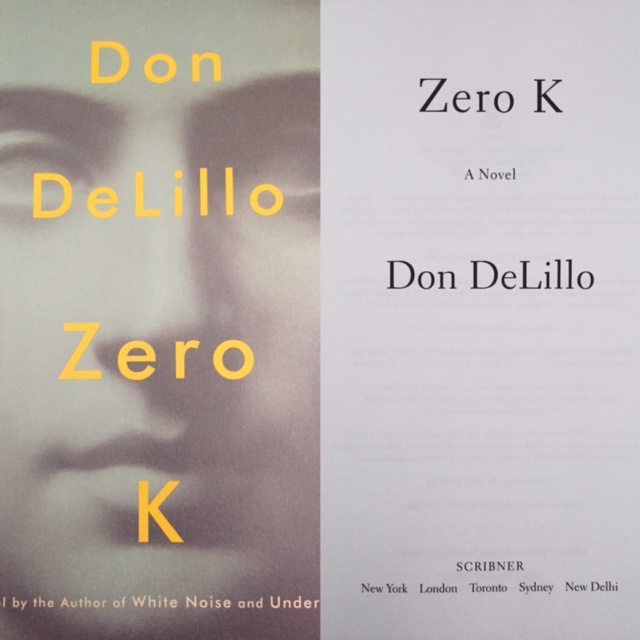
    Every time another Don DeLillo novel is published I wonder if it will be his last. He is 79 this year, the author of 16 masterful novels, three plays, and a story collection. I eased into his latest novel Zero K with the master’s age in mind, reading gingerly at first, cautious; it pains me to imagine DeLillo’s mighty pen reduced by the erosion of age. But soon I’m reading at that familiar tempo that lives in his novels, a pulse of language that carries the reader through, slowly, returning over almost every sentence to examine the breadth and beauty of them.

    Just as the pulse of language runs through each novel, there’s also a feeling, an ethos of paranoia, intelligent detachment, but also something unique to each work. White Noise makes us afraid and self-aware, Great Jones Street isolates us. We are particles adrift in the great expanse of Underworld. All DeLillo’s works carry an electric hum, Kubrickian overtones, post-modern antiseptic, and the desperate search for perfection. Zero K is no different. What makes it unique among DeLillo’s works is its ability to pull humanity from inhuman subjects and abstract space. It’s largely a novel about science, or cryogenics, in particular. From the book jacket:

    Jeffrey Lockhart’s father, Ross, is a billionaire in his sixties, with a younger wife, Artis Martineau, whose health is failing. Ross is the primary investor in a remote and secret compound where death is exquisitely controlled and bodies are preserved until a future time when biomedical advances and new technologies can return them to a life of transcendent promise. Jeff joins Ross and Artis at the compound to say “an uncertain farewell” to her as she surrenders her body. 

    “We are born without choosing to be. Should we have to die in the same manner? Isn’t it a human glory to refuse to accept a certain fate?” 

    These are the questions that haunt the novel and its memorable characters, and it is Ross Lockhart, most particularly, who feels a deep need to enter another dimension and awake to a new world. For his son, this is indefensible. Jeff, the book’s narrator, is committed to living, to experiencing “the mingled astonishments of our time, here, on earth.” 

    Don DeLillo’s seductive, spectacularly observed and brilliant new novel weighs the darkness of the world—terrorism, floods, fires, famine, plague—against the beauty and humanity of everyday life; love, awe, “the intimate touch of earth and sun.” 

    But as with all DeLillo’s novels, it’s about so much more. It might not be his final novel but it is one of his best. DeLillo masterfully weaves readers through themes of suspension (physical and metaphysical), re-immersion, immortality, and our growing dependence on technology. But there’s also something soft at work here, burrowing, delicate as human flesh. There is love and grief and human sacrifice. The novel cuts but kisses our wounds. And I’ll probably not forget it for months.

  • virtual voyeurism

    Processed with VSCO with b5 preset
    “Bite the serpent’s head off!- so it cried out of me; my horror, my hatred, my loathing, my pity, all my good and bad with one voice out of me.” – Nietzsche, Zarathustra

    *

    Today’s video games are hyperrealist and meticulously designed cinematic experiences. The first-person shooter (FPS) is the second-most popular video game genre[1] among gamers, and FPS games possess some of the most profound examples of hyperrealism. The violence in these games is astounding. One of the gentlest people I know freely heaps bullets onto her virtual enemies as often as her personal schedule allows. A woman who wouldn’t hurt a fly in non-virtual reality eagerly awaits loading her latest game to dissolve her enemies with an impossible array of virtual gunfire. It’s fun, this recklessness. It’s also morbid. I eagerly seize the control, wondering why I enjoy playing these games or watching others play them. What instinctive horror does this virtual violence satisfy?

    [1] https://www.statista.com/chart/3599/americas-favorite-video-game-genres/