Category: writing

  • Luna silenciosa

    IMG_0383

    The moon is full and white and he watches it hang static and alone in the sky like a beacon to worlds ancient and afar. A breeze warm and comforting carries the cigar smoke away from his face and he breathes in the night air, floral, dense, fecund. Wade is at relative peace, adrift in the cosmos. Crickets and other night insects shriek in rhythm from the shadows. Direll jumps over the back fence and ambles toward Wade in the moonlight, his hand raised in greeting.

    How’s your eye? Wade says.

    Still cain’t see shit out of it.

    Direll sits next to Wade and exhales deeply. He takes a plastic lighter from his shirt pocket and lights a joint. Wade puffs his cigar and the men sit silent listening to the crickets and also sounds they can’t hear.

    Pretty moon tonight.

    Reminds me of when I was a kid, Wade says.

    How so?

    Not sure. Stimulates something vestal, I think.

    Vestal?

    Maternal, maybe.

    The men are silent.

    Beautiful, though, Wade says.

    Yeah.

    Seen your Comanche pal tonight? Direll asks, smiling. He puffs long and deep on the joint and blows out what appears to Wade to be an impossible quantity of smoke, a long uninterrupted ribbon.

    He’s Patwin. And no.

    Insects resound in the thicket of brush to their left. The sky is open to everything. The sliding door slips open and the boy peeks out at them.

    Can I play one more before bed? he asks.

    Say hello to Direll.

    Hi Direll.

    Hello champ.

    One more round of what? Wade asks.

    Death Membrane.

    Death Membrane, Direll repeats, looking out over the yard as if out at sea or as if he could see the words there in the half-light. As if the words or the game itself fashioned up from the underworld or vapor. The joint is tucked away out of the boy’s view.

    One more round, Wade says, and the boy is back inside.

    The men are silent and the moon glows as if from within and Direlle exhales sharply and says, You watch that game tonight?

    Wade looks at him and puffs his cigar. No, he says. I was reading.

    What you reading now.

    Wade puffs on the cigar and says, Fukuyama.

    Fukuyama, Direll repeats, nodding, staring at the yard again and the shadows therein.

    Then they’re silent for many minutes, both of them chasing certain and uncertain thoughts. Direll tosses the roach into the grass and sighs. He says, Brother, I got to be going.

    Wade watches his neighbor walk to the fence and climb over. He looks up at the moon and stares at it, wondering about it. He tamps out his cigar and stands and walks inside, the crickets announcing his departure.


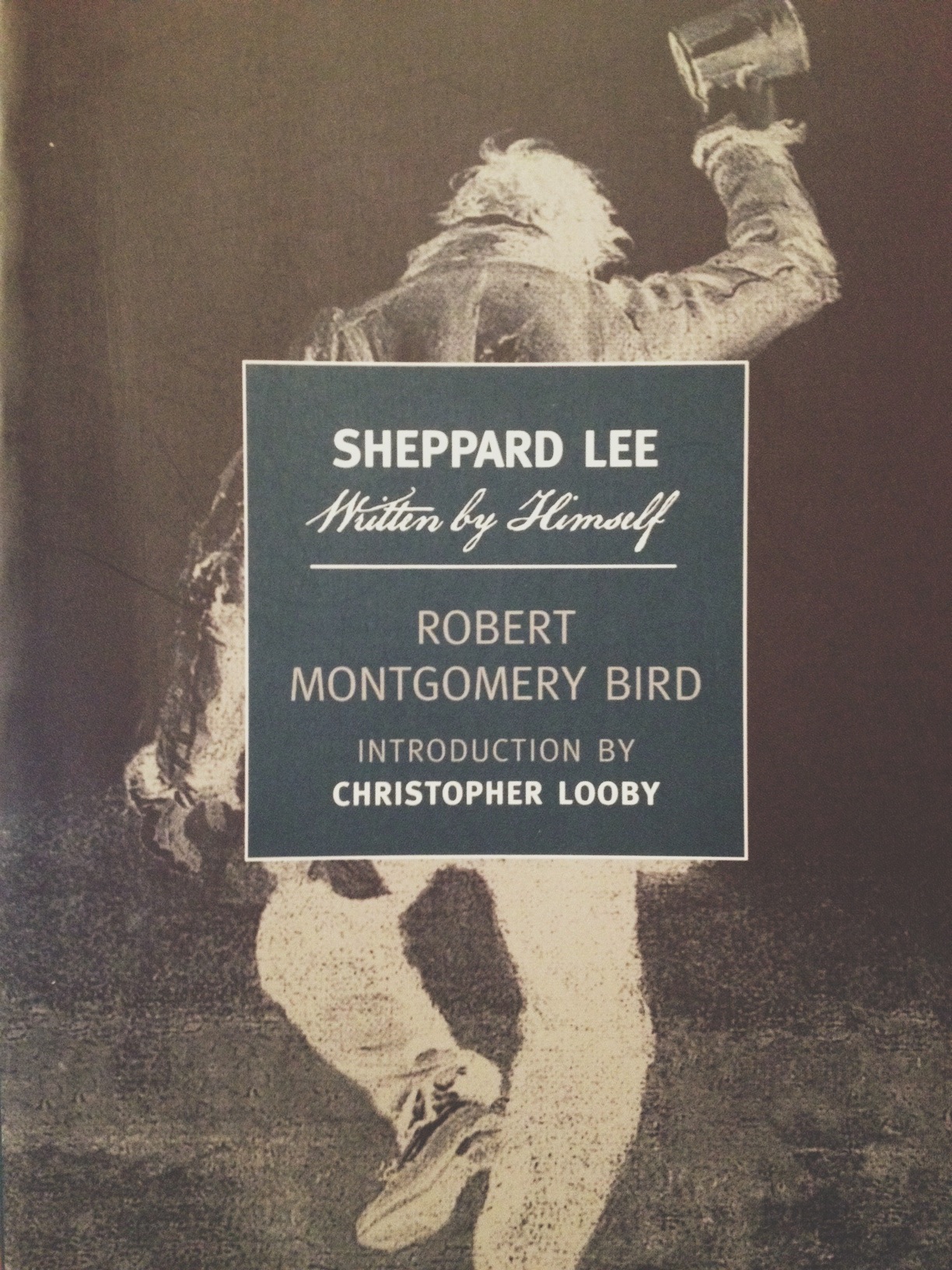
  • Sheppard Lee: A study in Contradiction [Review]

    Image

    We hold these truths to be self-evident: that all men are created equal; that they are endowed by their creator with certain inalienable rights; that among these are life, liberty, and the pursuit of happiness …[1] 

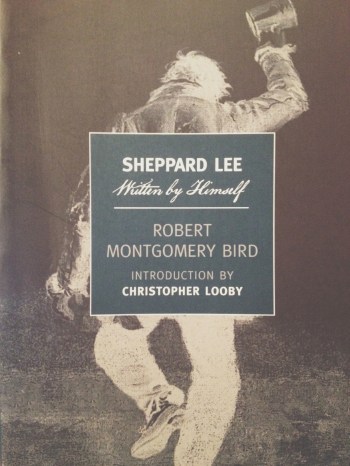
    Robert Montgomery Bird was 30 years old when Sheppard Lee was published. He’d had plenty of time to scrutinize the human condition, its psychology, and its reaction to and formulation of political structures. He observed the American men and women of his time, the deep social rifts between them, rampant envy and resentment resulting from their differences. He saw the social division as a natural reaction to the American structure, an inherent flaw in the ideals of the Constitutionalists. What resulted, according to Bird, was a society of longing, a desire to strip away one’s identity in search for another. In Sheppard Lee, Written By Himself, published by the acclaimed NYRB Classics, Bird explores these topics and castigates them with comic, satirical brilliance.

    When Thomas Jefferson penned the Declaration of Independence, he and the Constitutionalists had in mind a particular end for the individual in a democracy. The idea was to give each individual the right to become their own end via the means they chose for themselves. The rich and the poor alike were given the political freedom to follow their dreams, to self-sustain beneath the umbrella of U.S. government protection. These were the ideas wrought from the Enlightenment, from hundreds of years of political and moral theory, and it was considered to be the best government structure—in principle and practice—in the history of the world. The policies were meritocratic and experimental in nature, molded from the idea that there is no nobler role of government than to allow its citizens the opportunity to safely and responsibly forge their own path in the world.

    But what Jefferson and the other Constitutionalists failed to account for was the huge rift that would be created between the rich and poor, “a political complexion […] founded in, and perpetuated by, the folly of the richer classes.”[2] The economic structure was fashioned from the principle of equal opportunity, but what resulted was the rich becoming richer and the poor becoming poorer. Soon the opportunities of the wealthy greatly outnumbered those of the impoverished. This great division among people that were supposed to share an equal place in society created disparate perceptions: “The poor man in America, feels himself, in a political view, as he really is, the equal of the millionaire; but this very consciousness of equality adds bitterness to the actual sense of inferiority, which the richer and rather more fortunate do their best […] to keep alive.”[3]

    This situation cultivated a deep and pervading sense of longing unto the poorer classes, the immigrants, the African-Americans. It was a hypocrisy that spawned indignation, for certain injustices were happening in America, the land where every man was supposed to be self-evidently equal, where this sort of unfairness ought not to have been happening. Citizens on the unfortunate side of the socio-political structure were cast further out, excluded from the decision-making process, left only to appeal, “Why should the folly of a feudal aristocracy prevail under the shadow of a purely democratic government?”[4] They found themselves wishing more and more to inhabit the lives of the privileged, hoping to inherit their advantages. The character of Sheppard Lee finds a cosmic loophole where this is actually possible for him, and what results is an absurd waltz into the American psyche where nothing, including the principles of his country, is what he thought it would be.

    Slavery was obviously another American hypocrisy. In a land where all men were supposed to have legitimate opportunities for freedom and the American ideal, certain men and women were being bought and sold, treated sub-humanely, their happiness stripped from them before they had a chance to obtain it. To be a slave was to be “the victim of fortune, […] the exemplar of wretchedness, the true repository of all the griefs that can afflict a human being.”[5] These are not descriptions of equality. Bird was aware of the hypocrisy around him. He knew that the real America was a blatant contradiction to the ideals penned in the Declaration of Independence and the Bill of Rights. Sheppard Lee is Bird’s response to what he observed. It’s an attack on the life around him, highlighting the absurdities in order to draw attention to them, a picaresque adaptation of reality.

    e He The hypocrisy of the political structure birthed a certain behavior in its citizens. It provoked lasting looks of envy from the poor onto the rich, from the slave unto the free man, it widened the gap between neighbor and friend. It forced people into constant comparative qualification. Equality of opportunity naturally evolved into a sort of Darwinian culture where the weaker or less qualified individuals were exploited by those gaining power with each business day, each acquisition. The character of Sheppard Lee is a symbol of the common American man. He is constantly in pursuit of curing what ails him, namely his imperfections, his insecurities. He feels that the only way to do this, once he has figured out his ability to occupy the bodies of the dead, is to seek out those unfortunate dead whose lives seemed to be better or happier than his. Lee is thus vicariously the jolly hunter, the playboy, the rich man, the morally perfect human being.

    As the philanthropist character in Book V begins to see his life of charity and compassion unravel before him due to the ingratitude of his fellow men, he states rather profoundly that “man is an unthankful animal, and of such rare inconsistency of temper, that he seldom forgoes the opportunity to punish the virtue which he so loudly applauds.”[6] One could read this passage straightforwardly as it applies to the narrative, or they could also read it as an analogy about the duplicity in the principles of the United States that Bird observed and attacked. At this point in the book, the reader is well aware of Bird’s pattern of disappointing Sheppard Lee’s efforts at finally becoming content with who he is, whoever that may be. The fact that he is repeatedly upset in his effort to find happiness by infiltrating the body of the most morally pure dead person he could imagine leaves him to believe that, “I had experienced in my present adventure  […] doubts as to the reality of any human happiness.”[7]

    Bird had keen observational skills to see the contradictions between those engraved in the United States Constitution and the actual daily social rigors in young America. But these things could have been seen even by those who chose to turn their attention from them. I might even make the argument that the rift between the haves and the have-nots is today considerably wider than in Bird’s America.

    The novelist’s value in a society is his or her ability to shape and influence the culture. Bird did this by drawing attention to the inconsistencies in his society, pointing the finger at the innate hypocrisy in American idealism. He saw the way social stratification affected the individual in society and diluted their notions of identity, how it forced them to look at others in either envy or disgust. In Sheppard Lee, Bird exercised his acute understanding of the impractical democratic experiment and its effects, primarily the “political evils which demagoguism, agrarianism, […] and all other isms of vulgar stamp [it] brought upon the land.”[8]

    What we see in Sheppard Lee, through Bird’s narrative about the blurred notion of identity, is a man chasing his preconceived notions of happiness, jumping from social status to social status in the pursuit of happiness, only to find something wrong, something to lament about his new body and personage with each new identity. It is a narrative both funny and sad, both audacious and absurd, and at times a promotion of prejudice as equally contradictory to the truth as Bird’s America.


    [1] Jefferson, Thomas, in Koch, Adrienne. The American Enlightenment. George Brazillier Press, New York, 1965, 378. [2] Bird, Robert Montgomery. Sheppard Lee, Written By Himself. New York Review of Books, New York, 2008, 305. [3] Bird, 306. [4] Bird, 306. [5] Bird, 332. [6] Bird, 271. [7] Bird, 304. [8] Bird, Robert Montgomery, 306.
  • Yearning

    IMG_0942

    When I left the library rolling skies befell the world and rain boiled downward from molten clouds sending pedestrians and anyone not under cover of shelter skittering into shadows beneath dripping awnings or back into campus buildings to avoid the onslaught of water and hail the size of human eyes hard as rock and jaggedly imperfect. I made it to the car gasping and wild in the eye with the books stuffed up into my jacket to keep them dry or as dry as possible with water pounding the roof of the car and sliding down the windows in cascades of prismatic light and sound. A strange sense of isolation and security overcame me and it was warm in the car, the windows began fogging almost immediately from the moisture in my clothes, in my hair. I sat there a long time listening to the rain reclined in my seat, eyes closed, trying to immerse myself into the water, trying to imagine myself in each ounce, in each drop of water and ice from the sky and the storm would surge and then taper off, surge and taper off, rhythmic serenity, a paroxysm of peacefulness. I could die right now, I thought, even though it was the first time all day I hadn’t yearned to die. The rain slowed and eventually stopped and again I felt part of the world, less secure, exposed afresh to the discrimination of energies and of the minds of all the people of the world and I started the car and pulled into traffic.

  • New memory in algorithm

    IMG_0033

    His laugh transformed his face. I remember his hands and how strong they were. We’d play catch when I was just a kid and he’d launch the baseball at me as hard as he could. If I showed any sign of fear he’d yell at me or quit and walk away, leaving me standing alone in the street.

    I often thought about stabbing him while he was asleep. Even as a four-year-old, I thought it inevitable that my father would kill me, that I’d die violently and his face would be the last I’d see. I grew resigned to the idea and waited.

    He bought us tickets to minor league baseball games when I was a kid. We’d go and eat stadium dogs and now and then a foul ball would come our way. Those were the best memories I have of spending time with him, even though I was still afraid. Years later, I got us tickets to a baseball game for his 49th birthday and it was a disaster. He was terribly ill and no longer had strength enough to climb or descend the stadium steps. He didn’t enjoy himself and we left early.

    The year before he died he chain-smoked Marlboro Lights. Sometimes I’d sneak down and steal one, ripping the filter off before smoking it. There was never any booze or even beer in his house. He used to listen to Steely Dan and I didn’t appreciate the music until I got older, long after he was gone. It’s a shame we could never really talk about music together, we never got a chance to share our indebtedness to the music we loved.

    He only talked about death twice, the first when I asked why he always seemed so depressed. I’d just turned eighteen and graduated high school. I’m dying, he said. Days later he told me to leave, that he wanted to spend time alone with his wife before he died.


  • From the notebooks of T.J. McAvoy

    What do the notebooks say about me? The notebooks I’ve discarded, full of words and ideas, the notebooks I’ve kept to stow away in the shadows? They garner dust, the pages yellow and grow brittle. I keep them for no reason, perhaps to prove to myself that my obsession isn’t imaginary, it produces something physical, tangible. And why throw some away and not all of them? What makes me keep a notebook I’ve carried with me for a month, two months, spilling thoughts into it at each available moment, the notebook stained with all attitudes of those stolen moments lost in thought, my hands stained with ink, black, just as the notebook, black, becomes for me the only enduring proof that I have lived this life, here, with everyone else, a walking ghost among the living? What do the notebooks say about me?

  • An Excerpt from the Enlightenment Project [revisited]

    Destruction

    I imagine I’m a slave in ancient Rome during the early reign of Octavian. I’m approaching middle age but in fine shape, and my meager education allows me to work as an accountant for a quite reasonable and beneficent consul. I do not know any other life or situation, for I was born into servility and have demonstrated strength and aptitude in my duties. The respect I display and the ethic with which I perform my work has awarded me a sense of freedom and respect from my master and in my community. The Republic is in disarray with the separation of Antony to the Egyptians and the whore Cleopatra. The consuls and the local population all fear the worst, that a total breakdown of the Republic is inevitable. Octavian has begun recruiting a vast naval army and I volunteer, resigning my work as a clerk in hopes of being completely freed after military service. For months I train as the tension tightens and war becomes more of a certainty.

    I have no wife, no children, and no family in a world that makes little sense to me. The machinations of man seem to govern all rules of the Earth, for we have truly become rulers of the land. There are no gods and the Republic is full of imbeciles who have nothing better to do than believe in mystic flattery. We are the true gods; the world is a hostile place where men encourage this hostility through politics and war and the perpetuation of enslavement. If I die in Agrippa’s war at least I’ll finally be absolved of this systematic separation of those with privilege and those without. The world is a cruel and barbaric place and the Republic is an ornate façade. I have studied Cicero and believe that a man stripped of the ability to govern his own fate is a gross injustice. So I will fight for my own freedom and nothing more; I shall not grieve if the Republic perishes.

    Most other slaves have it far worse than I. They toil and bleed and are murdered for no other reason than for the powerful to assert its control. I observe in silence, grateful for my luck, but am aware that it is luck and only luck that separates the diseased slave from me, only luck that separates the servile from the privileged. Is not man in his status as god the most cruel and unjust?

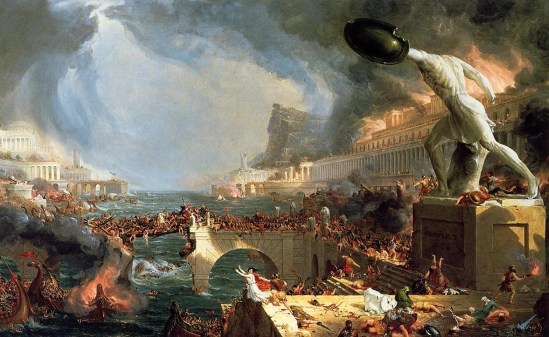
    [painting by Thomas Cole]

  • Voices of the damned

    I dreamed that I couldn’t do anything right. A recurring theme lately. I worked at a warehouse, lately I’ve been working at warehouses and I don’t know why, warehouses of anonymous and chaotic purpose, I’m up high in the warehouse either on the high shelves or floating up near the ceiling, helpless, I don’t know what it means if it means anything at all, I’m working at a warehouse and there are managers there, I fuck up every job they give me, the female manager is about my age and she’s not nice, not nice at all, she tells me to punch some holes in reams of paper but she doesn’t tell me her method, she doesn’t tell me that the warehouse has a fool-proof method to use and they have been using it for years, so she tells me to punch holes in some paper and walks away and I start punching holes in the paper and naturally it’s all wrong, I’m doing it wrong, the holes don’t match up, they’re uneven and obviously punched arbitrarily. I screw up the job in every aspect. The female manager returns and looks at the work I’ve done. You’re doing it all wrong, she tells me, maybe this isn’t the job for you, perhaps you’re not qualified to work here. Then she tells me to follow her, she might have something else for me to do in the warehouse, and I start following her but then I start floating, I start floating as I so often do in dreams, helpless, I float up to the warehouse ceiling and it’s difficult to move in any direction, I can’t build any momentum and soon I’m floating up and away from everyone, I float myself into another area of the warehouse where no one works, it’s a secret area with motion sensor alarms and naturally I begin to set off those alarms, adding to my discomfort and the sad state of my employment in the warehouse, embarrassed, and I want more than anything to settle back down to terra firma and continue working without any attention focused my way. This worsens my situation as management can’t find me and I try to hide, an action that only sets off more motion sensors, a terrible predicament, and then finally I descend slowly back to the ground and reenter the main area of the warehouse, I’m greeted by a different member of management, a young man with blonde hair who says, We’ve been looking for you, I might have another job for you if you can manage, if you can actually perform it without screwing it up, and I follow the young prick to some type of sheet metal press and conveyor and on the way there I see Bob Costas at a paper hole puncher, bent over a huge stack of papers and Costas says, Hey, come here. I walk over there and he says, Let me show you how to do this the right way, even an imbecile can do this. Then he proceeds to show me what an imbecile I am, so I thank him and follow the prick manager to the sheet metal press, he tells me to cut the sheet metal in even strips, but then he walks away without telling me how or what size strips, and soon the conveyor starts sending large slices of sheet metal my way and I’m immediately overtaken by the material coming at me on the conveyor and there’s a great crash and whir and catastrophe from the press and the male manager runs over to me and slaps the emergency shut-off button. I’m incredibly embarrassed, obviously, and all the people, all the workers in the warehouse watch me, the place is silent in the wake of the alarms and the blaring madness of the breakdown, and the female manager is there now with the prick manager, and he says, I don’t think this is the right job for you, and the female manager says, I don’t think we have a job in this warehouse that’s right for you, and they walk away from me, I’m embarrassed, but I decide to take a break from the station I’m at and I walk away, I want to go outside, I want to get away from all the managers and workers and motion sensors and I want to give up but I need the job, I don’t understand why I’m failing at the job, I don’t fail at anything, but surely I’m failing at this job, it’s a goddamned shame, really. I find myself trying to find the outside break area or whatever but I’m back in an empty spot in the warehouse, floating, floating yet again, and the dream repeats itself like this two or three more times, I don’t know what the fuck is happening, usually by this time I wake from the dream, I stir, I shift positions in the bed, which wakes me and reminds me that I’m dreaming, it’s all just a dream, a magnificent ruse, I shouldn’t feel so ashamed and upset, it’s all just a dream and I don’t float, I don’t try in vain to swim through the air, it’s all just a dream, but no, I was locked into it without escape, and as I floated back down to the surface of the warehouse for the final time I tried to bypass the motion sensors so as not to draw attention to myself and there was a dark office set off to the side or the corner, rather, of the warehouse and I guided myself toward that office, the shadow and emptiness, but rather than help my situation, I made it worse, of course, the office turned out to be the room where all the company’s confidential materials were held, I set off yet more motion sensors, and when I emerged from the dark office all the managers stood there watching me. It was excruciating, I was so embarrassed, I couldn’t believe it, and the managers were on the verge of just telling me to leave, just leave our warehouse, you’re worthless and you’re screwing up every job, you’re destroying our machines and materials, you can’t do anything right, they say. And of course I know they’re right, it’s true, I can’t do anything right in this warehouse, just look at my record, you gave me two jobs to do and I’ve failed at both, plus I’ve set off the motion sensors, I’m worthless, you’re right, but then the dream shifted, perhaps I did stir in my sleep, unconsciously, what I mean is that in the dream I wasn’t aware of any type of any consciousness infiltrating the dream, the dream was still self-evident as a dream, but I was a different person, I had a different identity, it was strange, everything that had happened to me in the dream had still happened but I was different, it happened to me but it had happened to the different me, a young Jewish man, perhaps twenty, the son of the warehouse owner, the company owner, and I was still a failure but I was a different person with a different character, and as this young Jewish man I harbored a deep turbulent revenge for the way the managers and the other workers made me feel, I hated them for making me feel like a failure, because as the inheritor of the company and a rich person, I’ve spent my whole life with my parents telling me I am not a failure despite what everyone says, I’m no failure, my parents ingrained this in my head, no matter how often I fail, I am no failure, but I’ve transformed that ideal of positive reaction into some militant type of hatred against the managers and the workers and everyone in the world, actually, the hatred and the violence consumed the person I might have been, and I see myself as this other person in the warehouse, protected, as it were, by the ownership status of my mother or father or both, and the managers know that I can’t do anything right and yet they permit me to linger about the warehouse, which I do quite successfully, I linger around the place watching the progress of the work and think about how I’m going to destroy them and everyone I know and the world as well, I prefer to hang out on the top shelves of the inventory placed up high near the ceiling where I once floated, but I float no longer, as I am a different person, I am a jew who does not float, but soon I remember my plan, I find myself telling everyone in the warehouse, management and workers all, perhaps two hundred people, that I am leaving early, yes, my plan, I must go join my father and mother or father or mother or both, I have work to complete, I am a busy young man, inheritor of a company, I have something to do (which I do, of course, in secret), and I leave beneath one of the massive overhead doors to the surrounding industrial area beneath a pale sun, I have work to do, and I travel about a quarter of a mile away to a neighboring lot and I extract the mobile phone from my pocket and press a button and watch the warehouse of my dreams explode, one second later feeling the shockwaves of the explosion on my skin and hearing the voices of the damned in my ears.

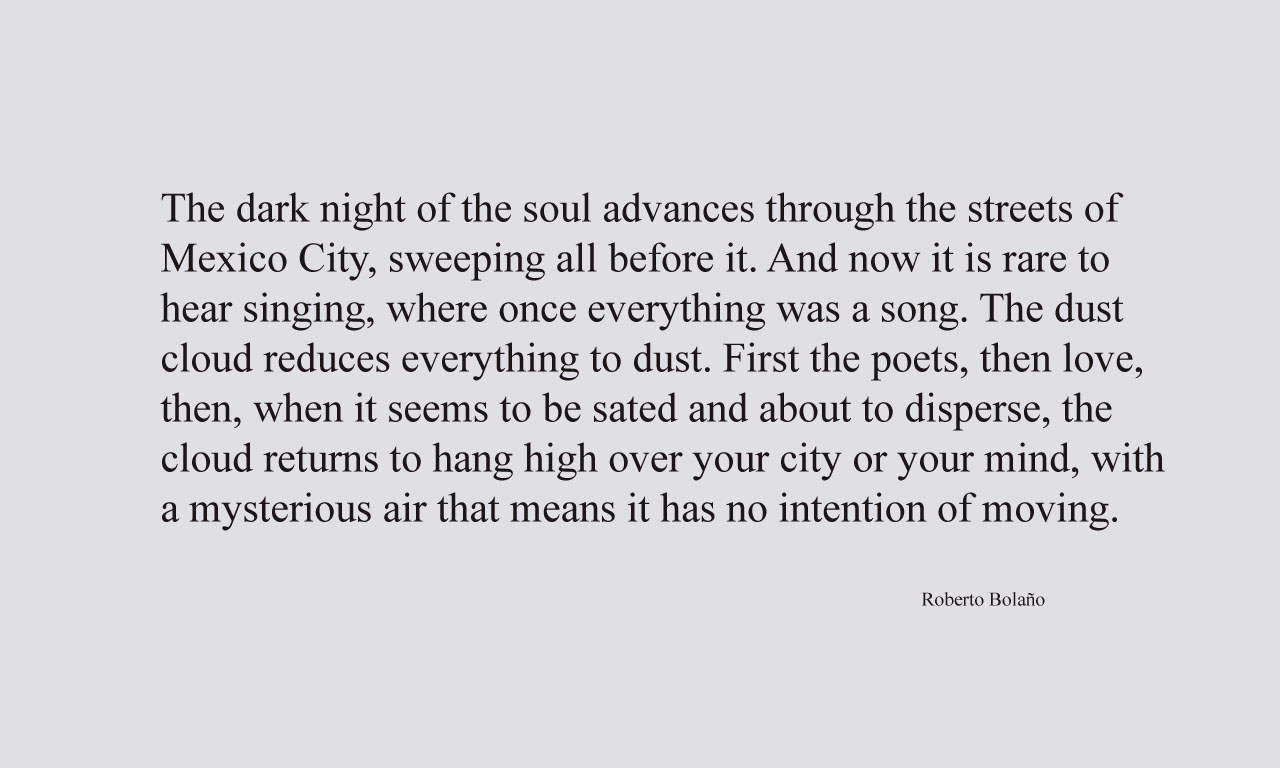
  • Silhouette

    Walking through the streets, I thought. When I wanted to write about something, maybe I was stuck in a creative block, I was thinking too acutely or not acutely enough, I would always imagine someone walking through the streets. Downtown, at night. Someone alone, a man wearing a hat, a dark hat with a wide brim and dark coat, his hands thrust deep into his pockets, shoulders hunched. Because he’s cold, that man. He’s cold, living in perpetual winter, and in this man’s mind is a tempest of grave designs, and he walks swiftly, with a dignified purpose. It’s an unfamiliar city, where the man walks. The streets are all strange to him and yet he knows where he’s going, it’s as if he’s equipped with a detailed map or maybe a wireless receiver or other phonetic device nestled in his ear, a voice on the other end guiding him through the streets with names like glyphs etched into steel signs or else there are no names at all, avenues and boulevards empty and desolate save for heaps of trash piled up in their dark alleyways. Yes, walking through the streets, this is what I thought, these four words, as if their sequence were significant or as if my own history was sketched somewhere therein. But then again my own story is irrelevant, worthless, for I know as well as anyone (better than most) that the value of a tale always lies in the tale itself, never he who tells it. The story has always existed and will always exist regardless of who happens to translate it into language, it lives eternal upon a current of energy or thought (selfsame) and only requires someone to intercept it, some poor, afflicted, receptive soul to translate and enumerate it, to unleash it from its shackles deep in the cavern wherein it stews and stews.

    Walking through the streets this man has his hands in his pockets to protect them but also to cradle something else, something buried in there, something like papers crumpled in his sweaty palms, because despite the cold blowing in from Lake Michigan or the Hudson or the North Sea or wherever our man happens to be, his palms sweat, which tells us, the writer and the reader, that he is either a nervous man or he is nervous at this particular moment. Or, of course, it could be none of the above. Perhaps his palms are not sweating at all and it’s not crumpled papers buried in his pocket but some sort of charm, a lucky coin, a religious talisman.

    And then beneath a streetlamp our man’s erect figure is ablaze, lit up for the world to see, or perhaps lit up just for us, perched here on this building ledge (or studying him from an apartment window), awake, aware, watching as our man (or his outline) exudes a plume of steam (or smoke) from his mouth and then continues his easy stride through the light spectrum and then out of it, drenched in shadow yet again, with us still watching, and as we see him we cannot be completely certain that the figure we saw in the glow was indeed a man and not, say, a woman, or just as plausible, an apparition, for just as quickly as he had appeared beneath that bone white glow he has moved out from under it, walking through the streets alone, our only evidence of having seen him the image burned residually into our brains and the clicking of his shoe soles on the concrete.