Tag: prose

  • excerpt: on breeding

    On breeding: Human beings in the post-quake world should breed more conscientiously and take all necessary precautions so as not to confuse natural sexual action with the carelessness of rampant population. Men and women in the pre-quake world proved how quickly the human germ could spread and cover the surface of the globe. The growth was so fast and uncontrolled that the allocation of resources became problematic and, some would argue, eventually led to the ruination of the human race. The great quake’s antithesis wiped clean much of the Earth’s human population (among other creatures, now extinct), and has left the post-quake synthesis for human beings to ruminate exactly what our responsibilities are when considering breeding. Does a particular person need one child or seven children? How should that person address his or her sexuality according to those needs?

    The post-quake human must hold him or herself accountable for all actions, including sexual behavior; without surrendering our natural sexual appetites, surely we can find a way to better manage our reproductive volume. Each man and woman should be conscientious and personally liable, and we must discover a way to incorporate this principle into the individual ethical framework; for sexual conscientiousness is a matter of the individual and of no other other authority.

  • Outlaw

    IMG_0942

    How many of you would die for literature, he asked them.

    All ten of them raised a hand. It was warm in the room and the man stood at the front, pacing slowly with his hands clasped at the small of his back, as if bound there. His eyes were wide and cast down to the tile before him.

    The students in the room watched, waiting, a few of them nervous but the rest empowered by the speaker’s words and intensity. In that room they had a common bond, they shared warmth and their love of free expression, the exchange of ideas. They shared the homeland and they shared respect for the professor, the ex-professor, fugitive, translator of banned works, outlaw and dedicated man of letters.

    Before you join us you must submit to losing everything, all that you have, everything you’ve built.

    The room was silent. The man paced, his head down.

  • adj: Borgesian

    photo

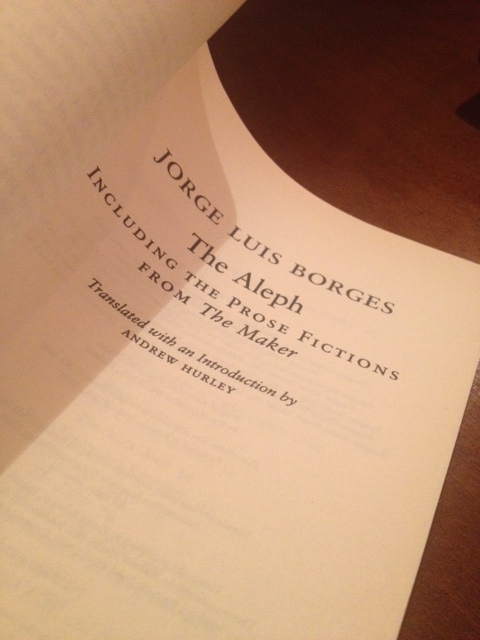
    I felt, on the last page, that my story was a symbol of the man I had been as I was writing it, and in order to write that story I had to be that man, and in order to be that man I had to write that story, and so on, ad infinitum. (And just when I stop believing in him, “Averroës” disappears.)

    Borges, from The Aleph

  • More than words

    Focus

    I woke in a dark room, sore down to a place deeper than any I’d known, for soreness is much more than a word; soreness is, at its heart, an intimate physical breach, an invasion of what we take for granted, a fire and resonating pain where before there was nothing, or what felt like nothing. Mute neutrality pervades as the body does its job, and only after sudden pain do we awaken to a place contrary to that quiet, neutral state. 

    I thought I was dead but those are also just words. Words hardly convey the existential paradox of such moments, of being there and not being there simultaneously. Surely I was dead, I thought, and this is what comes after death. My adoptive parents were both wrong and right. A woman approached from the shadows with a sponge and dabbed my chest and then I knew I was alive, the pain was no longer pain as a word or in the theoretical sense but something alive and howling in protest, my reflexes seismic. The pain seemed more a part of me than me, as if it were the true self and I an imposter.

  • Deconstructionist pt. I

    crack_up

    I was always certain that one day I would become a great builder. I never questioned or discarded the idea as unreasonable or romantic, but rather thought of it as the natural progression of my experience. I began constructing objects out of clay and mud at such an early age that I didn’t recognize the shapes wrought of my hands as anything but extensions of my physical self, as ordinary as other children kicking a ball. My grade school art teachers began to take note of this advanced understanding of architecture, and my parents attended closed-door meetings with school administrators to discuss my potential.

    By the time I finished the fourth grade I had fashioned a replica of the city’s most infamous bridge on sight and memory, adding curative modifications to mend impractical flaws in the original composition. My model was constructed of clay and sticks and stood four feet tall. Word of the feat soon reached the bridge’s original architect and found him forced to defend his aesthetic approach. It was with that particular project that I gained my first enemy. By the end of that year I began sketching plans, also with ability beyond my years, and received my first commission — a horse stable and adjoining three-story shed for grain storage.

    My parents thrust me into accelerated courses in order to maximize my creative potential. I graduated high school at fourteen and enrolled in the local university’s architecture program. Forced to decline commissions throughout my adolescence due to academic policy, I made promises to those daring enough to employ the skills of a boy, a child whose work was unproven but notable for its rigid and cost-efficient use of material and time. News outlets and marginal media representatives began to call. I was young but already the focus of nationally syndicated news interviews. My parents became de facto representatives, and ultimately exploited my talents and alchemized them to their own schemes.

    I honored my promises and flourished professionally but was reputedly difficult to work with. I became solitary, abrasive, evasive, and though the work was always world-class and completed on deadline, I retreated into myself, building secrets and cities of my own. By the time I reached my late-twenties, I’d alienated myself from my parents and the world, only speaking through an agent, myself now a recluse, frightened of the world and angry at it. I was alive in my work and nowhere else.

    A group of financiers commissioned me to build the renowned Trankworth Center, a sprawling subset of office buildings and condominiums spread beneath their centerpiece, a twenty-eight-story tower made of glass and steel in downtown Los Angeles. The project took three years and over two thousand men to complete. It was considered a masterpiece at the unveiling, a ceremony I did not attend. Magazines, books, television shows, my contemporaries and critics all lauded the Trankworth as an achievement in North American architecture. My name soared to inconceivable heights; I was undoubtedly respected in my field. Heralded as the new face of American architecture, I received commissions from each continent.

    After the Trankworth, I turned them all down.

    Suddenly and inexplicably I no longer found value or identity in building. For the first time in my life, I stopped working. It was as if the Trankworth had drained my resources, wrung them out, pulverized them. I retreated further into seclusion, searching in vain for symbols of life where it actually existed, not where I fashioned it. I wanted to feel alive but I also knew life would be something of a revelation to me, something not previously experienced. My parents died in an auto accident, and though I maligned them for taking advantage of my younger self, I couldn’t help but feel pain and loneliness when they passed away.

    While meditating on a small tussock on the afternoon of my thirty-second birthday I had a revelation whereupon my ideas abandoned me, I fell weightless in the void. Soundless light rather than darkness. My ideas returned to me broken into elements, the elements into molecules, into smaller fragments yet. I entered back into waking consciousness compounded, condensed, my body shrinking incrementally, collapsing upon itself, as though in a centrifuge.

    I emerged from the experience more aware than ever. Climbing from the depths of self into which I’d retreated, the world had either grown embittered at my estrangement or forgotten about me entirely. I was offered not a single commission. Again I disappeared into worker’s solitude, armed with sketches and plans and perhaps salvation.

  • fireworks

    IMG_0864


    —the explosion occurred downstairs. Breaking glass and bursting wood, heavy thud. I thought about Siobhan in those frantic moments while I dressed and descended the stairs. I thought she might have done it, the old woman may have accidentally blown up part of the house, or maybe it wasn’t an accident at all but a spiteful outburst. She stood in the far sitting room on the main floor, wide-eyed and watching the flames dance about the room, an orgy of heat and snapping light. She looked at me and we extinguished the fire, her grabbing blankets and me fetching water from the kitchen tap. Someone had thrown a homemade grenade through the window and fire scattered in the room, blackening the carpet and much of the furniture. Siobhan wasn’t hurt. She must not have been in the room when the bottle came through the window. The smell of gasoline, acrid and nauseating. Siobhan called the security police but they never arrived, far too busy elsewhere in the city. I climbed upstairs to my notepad and attempted work on the project but was unable to focus. I heard small rockets detonate beyond the city and I thought, it’s hopeless, the end is nigh. An invisible circle closed tightly about me.

    I focused my mind elsewhere, writing about the voice inside, writing about my mother and how I woke this morning thinking of her despite not having dreamed of her. I woke this morning (thinking of my mother) assessing the scab on my hand, acknowledging that one day I’d die violently, alone. I’ve always known it and my mother knew it too, she knew and refused to understand. If only I could have saved her, if only I could have said to her, Mother, do not worry. I woke thinking of my mother, yearning to read something, and then it was dusk with sirens swirling in the city. The shelling or the sounds of shelling then drowned out the sirens (along with all sense of time) and I was startled when the old woman opened my door and quietly walked to the bed behind me. She smiled but did not look at me, a small hand up at the side of her head to wrap strands of hair around her ear. Again I thought of Annalise despite my irritation at having just been startled, and it was bright outside despite the smoke. Siobhan had never come into my room during daylight. I could smell her perfume from the bed behind me and I closed my eyes, thinking of Annalise, my Ophelia, engulfed at once with longing and sadness. I needed to be close to her. I stood with my eyes at the window and walked to the bed, my arms out to her as she pulled me in. I stood there for a while, cradling her head in my arms. The world was fireworks and she sat weeping on the edge of the bed and I stroked her head, my eyes closed.

  • Muted

    Processed with VSCOcam with c1 preset

    The voice speaks to me, it is a deep voice. I understand some words and phrases that my brain fashions into patterns, as this is the essence of mankind’s relationship to its languages. Air emanates from the lungs, shaped by the throat and mouth. The human ear receives the sounds for the brain to form into recognizable patterns. The mouth, however, is the most offensive of communicatory vehicles. It transforms language into vulgarity, coarseness. Spit and odor often sour the experience for the listener. I prefer words written rather than spoken. Words on paper written by hands assembling symbols, again, in recognizable patterns, a process much more refined than speaking, much cleaner and more worthy of attention, the written word. For anyone can speak. A newborn begins speaking immediately, incomprehensibly. Unevolved man spoke in grunts and howls. The human being must learn to write legibly and coherently, a person must be taught to build cogent thought. Man can speak of an idea almost as fast as he can think it; writing (and reading, for that matter) take time, an effort required of the communicant.

    Is it not the duty of man and woman to think and apply the mind toward some purpose? Is it not our duty to wish to improve the life (and thereby, the ideas) of others? Is there no morality in keeping silent?

  • neo-enlightenment, text redacted

    Processed with VSCOcam with b5 preset

    [redacted] incarceration by emancipation. There are two initial steps in the process, the first being extraction of the bourgeois individual from common life and placement into isolation, sampling the good life at intervals for a year, providing the subject with controlled transgressions into common life to witness firsthand the fundamental incompletion of the subject’s former life in comparison to the good life.

    Subjects in this initial phase are isolated with study materials in multiple mediums to exercise and cultivate the intellectual spirit, prioritizing topics the individual has interest in engaging. [redacted] The instructors then diversify content so that soon the subject absorbs information faster and at greater depth, and the assimilation of refined themes begins.

    [redacted]

    The subject witnesses an imperative of the will to wish to strengthen and sharpen the mind, and he/she acknowledges that humans are inherently eager to seek information and structure it to the mind’s will. [redacted] The enlightenment project reinforces that eagerness, revives it from an entropic state and demonstrates its potential [redacted]

    […] is our primary goal, so that the subjects, once the initial phase of enlightenment is underway, will return to former life in an enlightened state of consciousness, one that engages the political, moral, and intellectual processes, without modifying the sovereign person’s nature of character. We strive to combine the intellect with a culturally relevant awareness that each human being coexist and freely give, take, and borrow knowledge from one another.

    [redacted]