Tag: literature

  • Subtle differences

    I sat alone at the bar contemplating life and the bartender’s bare legs and everything else swept past without my knowledge, without my understanding, for I was lost on that current and was happily lost, pleased with myself and contented in thought without restraint and the world continued to pass me by for an hour, two hours, three or four drinks, I’d lost count, there is nothing so noble (nor elucidating) as losing count and yet not feeling the effects of the alcohol, not absorbed in anything save the self and rumination and the paths upon which the self propels me. Two years ago I sat in the same bar on the same day thinking different thoughts (drinking different drinks) and my appearance had changed and yet not. On that day I’d had four or five drinks (I forget now), I was still that person with the twitching eye and the black hat and the sore muscles and what the fuck. But the bartender was there just as she always is (just as she is now) and the lights in the place are dim enough for me to see clearly, without regard for my appearance, for all that matters is thought and contemplation and deep labored breaths and the thirst I always feel for a beer or two or perhaps three (I’d prefer to lose count) and those smooth legs beginning down at the soiled ground and rising to a place warm and unseen and no doubt soft and salty, but then again I should probably refrain from such thoughts, as I’m married, and I lied just now, there is no bartender, or there is a bartender but it’s a male bartender wearing pants rather than a female in shorts (as I’d imagined) and so I must come clean, I must admit my lie and restate the obvious fact that nothing is what it seems, either for a reader or a writer, nothing is ever what it seems. In the future I’ll discard such nonsense as it swirls about the canopy of my mind, I’ll write about something that matters, I’ll feel inspired and the inspiration will cast me to a place far and clean and clear and thus my mind will follow, I’ll write about important matters and I’ll explore the hardships that plague others or the hardships I’ve encountered through the years and the infinite whispers, the hardships and the methods I’ve discovered to combat them, and if not combat them then accept them, and if not the hardships then the malaise, the depression (though I despise that term), the melancholy. I appreciate music but only a select few types of music (whatever marks the soul of the listener with the scars of he or she who’s created the music, just as with all forms of art), and thankfully an example of those scars plays from the speakers overhead and it all reminds me of another winter in another time but at this same bar with a different bartender and someone else’s legs (different drinks) and I sit here thinking of that other time and how there have been so many other times in this particular bar, I’ve carried the torch for this place for a decade or better. My typewriter (wireless computer) is like an instrument, I weave chords and percussive rhythms in haste and one of these days I’ll write something meaningful again, I’ll have nothing to worry about and my words will immortalize me (different words). When the future arrives I’ll know it, it will be too stark and recognizable to pass me by, unlike the present, which flings past like so much molecular warfare, down there in the trenches, literal and figurative, and now I’m not entirely sure in which direction my destiny points. Words fling past and ricochet far too quickly for my taste or my comprehension of them (different words) and I try to capture the words before I can no longer, I do not want to be left behind by the words and perhaps my attempt at understanding fails me because I’m simply not capable, I don’t have the strength or intellect nor the fortitude and so I must refine my game, if I must call it that, refine my skills and sharpen my sword, so to speak. Nobody will read this, and that’s fine with me, perhaps it’s not meant to be read except only by a select few, just like my novels (different stories), or such is the fate the novels thus far, a select few prone to thought and fear and trembling and all attitudes of despair, no, give them a bit more credit, find a current for them to ride that doesn’t include me, for they are different and have paid their own fare on this route, they are perhaps more capable of living a life without self-disgust, self-disregard, capable of reading many things that inspire and provide sustenance of some kind, when the same should be said about my novels (different flavors), if only other people could read them, for I do not waste my time and I do not feel a need to justify my life via any means other than in the words, for it is always and only in the words, it is in the peculiar pattern of words on the page in which I exist, solely on the page where the breathing occurs (different breaths) and the dreams live and die and tomorrow will be a better day and the blood that courses finds reason to continue its course just as I continue to read to breathe to write to continue living this farcical dance. 

  • The fear begins

    Roots

    I wake thinking of my mother, just as with every morning, no matter the haze or the rain, no matter the cold, I wake with the birds outside the window and air chilled taut seeping through the crack, I wake thinking of my mother though I hadn’t dreamed of her. I dreamed instead of a bulbous tree root, rotting yet strong, predictable, nothing exceptional other than its existence, a bulbous tree root deep in the ground where a faint seedling hatched long ago, springing upward toward the world of light and air, a seedling burst open like a cellular flame into the high day. On my right hand is a scab and I don’t remember how or when the wound was received and yet there it is, about the size of a small coin, scaly and maroon by the light of the window in morning repose. I lick the scab and it is dry and salty, its saline scales bulbous like the tree root of my dream, bulbous and asymmetrical. I pick at the scab, I study it, I try to understand. Is not the human body remarkable? Does not the world seem as though it were made for man alone? 

    I wake thinking of my mother and continue thinking of her until I force myself up out of bed with the birds singing somewhere outside, bleeping, chanting, a coded gesture of communion, I force myself up out of bed and to the desk, looking down at it, the clutter of papers and three books, all rented from the library and thoroughly read, my current notepad nearly full of words, a glass of water from last night, just a few hours ago, an apparition, myself a walking apparition. I think of my mother just as I do each morning despite not having dreamed of her and I don’t know what to believe, none of us really knows what to believe, we’re all apparitions, or the memories we so tightly clutch are all apparitions. Apparitions of apparitions. This desk, the books and notepad, the finger-smeared glass of water, this is my life. This is my life now as I know it. I sigh and sit down to write, the chair so familiar beneath me:

  • An excerpt from Esperanza’s story

    IMG_0383

    For the stone throwers and the sword wielders are as primitive as their ancestors and the ancestors of their ancestors, toiling in seas of blood and upon rolling hills of flesh to remain alive, to survive, which is their ultimate state-of-being, their highest conceivable honor, an achievement, but ultimately their most enduring failure. Man is a mortal creature; this is one of the few things we can attest to knowing. So while the stone throwers and the sword wielders ache and kill and burn the people of the world as well as the world itself, the thinking men resurrect the spirits that came before and also failed, the spirits with blood on their shadow-hands and in the ducts of their eyes, blood in the hair and caked upon their faces, blood forever adrift in their guts, for they as killers and hunters were largely unable to translate into language the narrative of those innumerable hunts and kills, their bloody and authentic histories, their failures, and so those spirits must now rely on a spare population of posterity to conjure them back into the realm of the living so as to pass on their bequests to equally indifferent hunters and killers and the few enlightened souls who must transcribe for them.

  • Color of night

    IMG_0706

    City soundscape, don’t pressure me into anything. I came here for peace and noise and that’s all I want. Relieve me of the silence. Cold wind burns through me. Lights on the fortieth floor and those at ground level coursing the city’s veins. What exactly is the color of night? People in coats walk swiftly, a man runs. Caterwaul of the light-rail train, chatter and laughter, tinned music. Wussup, my brother, my brother, can you spare some change, god bless. Idiopathic. A seam of brake lights weave about the steam and fog. Bass rhythms thunder from select establishments and beckon me inside, my hand at my wallet. Not now, not yet, there’s plenty of time. I was so wasted, a voice says, and I nod, a bus roars past. Men and women hold phones at their ears, more attentive to the sound on the wire than the world in front of them. Marijuana on the air, vehicle exhaust, perfume, spice, fragrant meats. The homeless bundled in the shadows, discarded. I hear the word church and I agree, this is it. Truck brakes screech and whine, a shout, bells. Are there no children in the city? Steam from the sewer grates, all that cliché shit. Jazz, but not enough of it, Pardon me, sir, pardon me, sir. Restaurants with candles lit on tables. A female cop on horseback, her radio hissing. People walking dogs, I never realized how many dogs. Lobby doors open and tenants emerge and I look up wondering what floor they live on. Desmond Paul, Desmond Paul, the name rings a bell, he said something once about cities but I forget. I smell shit somewhere nearby. A taxi van stops next to me, two pairs of shiny legs emerge then the women attached to them and everyone watches. People up ahead hold signs and instead of avoiding them I approach, THREE EVILS, one signs reads. GOVERNMENT BIGOTRY LaSALLE. Another sign: LaSALLE RUINED ME. The intersection holds me snug in a blanket of fumes. Flashing orange light shaped as a human hand, telling me not to stop yet but to prepare to stop. I count each flashing hand and imagine the centuries of dead buried beneath me, five, or perhaps who lives below, in the sewers, as old as the city itself, and the urge to smoke a cigarette overtakes me, a dog sniffs my pant cuff, four, what exactly is the color of night, cyclists charge past, breathing heavily, laughter, bad rap music from a parked car, three, teens across the way, shouting, always shouting, a bus downshifts, attenuates, turns right, two, dual sedans dash madly across, as if made of air, as if compelled by the city light and shadow, one, angles of action and repose, angles upon angles as if on a draftsman’s table somewhere, perhaps a suite high above, a hundred floors up, zero, green to yellow to red and brief quiescence endures just enough to push me onward with the flow of human heat and purpose, seeking howls and clamor and my own footfalls and the mystery of night.

  • Sixteen years

    father1

    Sixteen years ago today I held your hand when you exhaled a final time, and maybe you felt my hand on yours just as I felt the current of life slip from you. But I doubt it. Then again, that’s something I could never know. You’re gone or maybe you’re still here or you’re somewhere else. It’s not important. Your hand was cold even before you died. It wasn’t supposed to be that way. I should have hated you. But instead I found a way to love you, it was me who held your hand in those final moments, and now I know that says more about me than about you. Life will break your heart and death will reaffirm the wreckage, a necessary measure in order to reassemble justly, deliberately, categorically, completely. Sixteen years is but a fraction of a fraction of time but a lot can happen to a human being in sixteen years. I moved away from the child I was programmed to be and fashioned myself into a man of my own design. I wrote about you, at length, and still do. I studied and studied and studied and wrote and wrote. I made friends and a few enemies who could not agree with the strange intensity with which I approach life. Perhaps I owe some of that to you. Perhaps the intensity proves to me that I’m nothing like you, or maybe just a little like you, sometimes charming, as you were, and also funny, but mostly serious, a seriousness deadly enough to have nearly cost me my life on a few sober occasions. I owe some of that to you as well. I graduated near the top of my class at an internationally respected institution. I have loved and will always love and because of you I will always try to show love the way it’s supposed to be shown. Married now. You weren’t there. I dream of you often and in the dreams I’m usually forced to correct one of your mistakes, just like in waking life. You were only human. We won one pennant, but it was a fluke. You missed out on all your grandchildren except for one, and he probably doesn’t even remember you. Not your fault. Sixteen years and your father’s gone now. He lived through your illness and your death and it took most everything out of him. Your mother’s still alive; she’ll probably live forever. She likely dreams of you, too, but I’d wager her dreams are nothing like mine. Sixteen years. I’ve written two novels and begun a third and you’ll never get to read them. We never had a beer together. We hardly ever shared a genuine laugh, or shared anything, for that matter. Sixteen years transforms blame into acceptance, and it’s true that I look like you and yet…not. Your stamp still bleeds through every letter of my life. Sixteen years for me to fall, and I have, many times. Yet here I stand. You had nothing to do with that. My age has nearly doubled since then. Sixteen years of wondering how different my life would be if you were alive. Sixteen years of learning that it was supposed to be this way.

  • Call to action

    Processed with VSCOcam with b1 preset

    Dreams with at least two or three separate but connected pornographic situations/episodes, or more like explicit masturbatory behavior on my part, publicly, in front of acquaintances or family members. Horrifying events. I remember one specific episode in which my brother and his wife sat watching a drama or more like an aircraft display while I lay supine behind them trying (and somehow succeeding) to masturbate with a common household item made of hard plastic. It was like an old camera or something and despite the discomfort I enjoyed it, working toward that familiar light behind the eyelids, intensely aware of my surroundings: a dim planetarium with real (but small) aircraft flying around the stadium (perhaps it was out of doors and the theatre was the world itself), and when I looked up or opened my eyes I saw my brother gazing down upon me over his seat with an expression of ridicule and intense enjoyment and his wife’s expression of satisfaction (not to be confused with nor meant as gratification) for she understood and could identify with perversity despite being wholly rational while I was obviously crazy, purely and openly crazy, and her expression also betrayed a tinge of respect for my having the balls to boldly masturbate around so many people with a foreign object not at all intended for sexual use. I felt extreme embarrassment and the realization that I was caught in the act, my deeds were irreversible and my legacy as a mad pervert firmly cemented, and also that I had painfully shredded some of the skin from my penis during the act and  lie there bleeding, mortified. The dream then shifted and I was part of an army and thus had to ensure the safety of the aircraft flying about the theatre, or something like that, which moved the dream into completely different emotional terrain. But for the purposes of this particular moment on this particular page I will adhere to the theme of sexuality, or subconscious masturbation, to be precise. Even aged four years I knew what sexuality was, though there was no word for it, and no words at all, at least those of the read and written varieties. I dreamed often of women three times my age, which made them about 20 or thereabouts, and I particularly dreamed of bare women’s asses. Nothing special about them, no strutting or tail-wagging or any of the other abundant desires wrought of man’s maturity and experience, just women’s asses, bare, by moonlight. Those are the most premature sexual thoughts I can remember having, and I remember they came from dreams and I’d wake up feeling an intense need to do something but not knowing exactly what. Instincts told me that an action had to follow the dream but the act eluded me until few years later. Perhaps those early dreams were a microcosm of or metaphor for all of my dreams, then and now, threatening or otherwise. All dreams force me into one action or another, whether it be choosing to protect a theatre full of airborne aggressors or mutilating my most intimate anatomic module.

  • De la Pava’s greatness

    Singularity

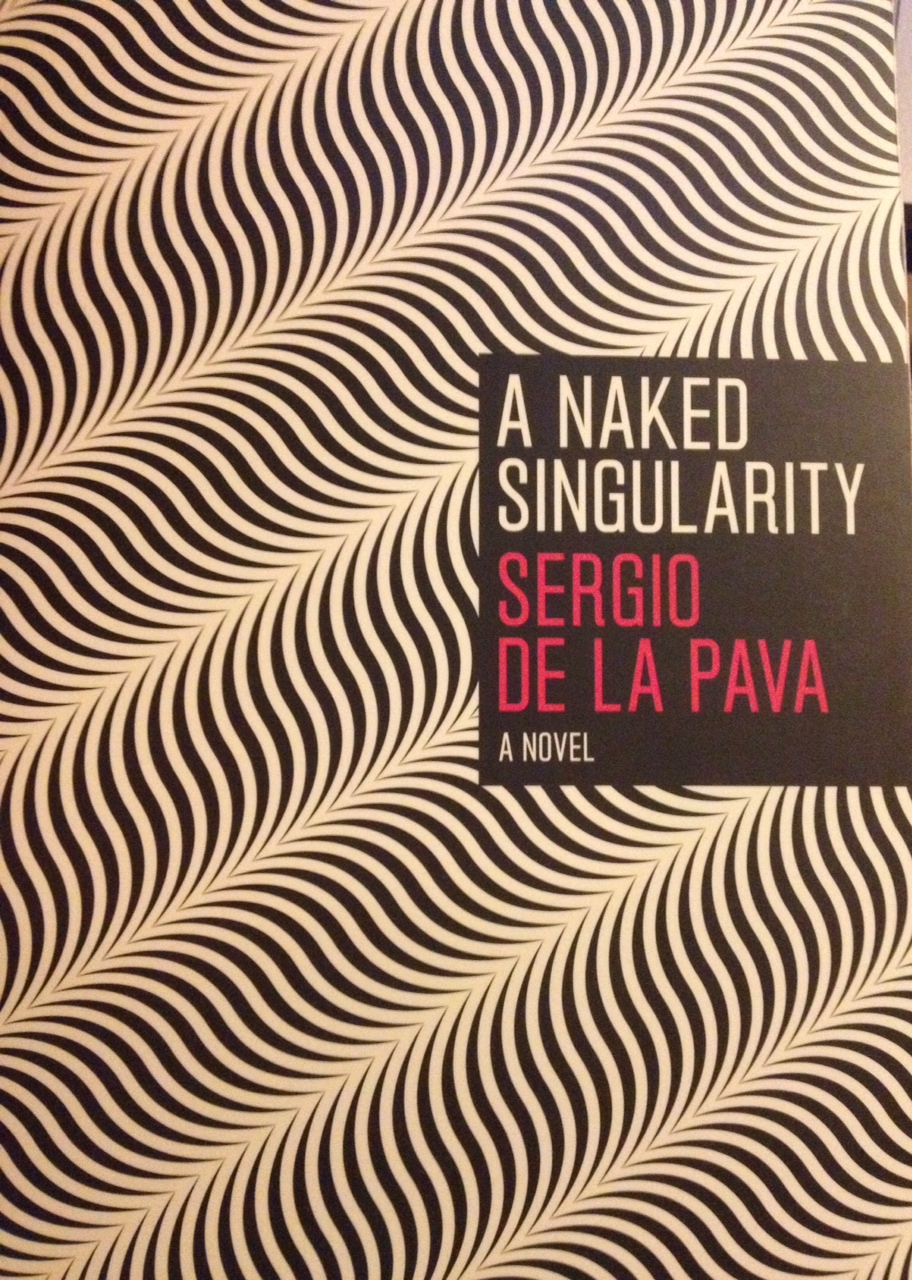
    Sergio de la Pava is a New York attorney. Attorneys don’t normally set out to write novels, and certainly not great ones. Or so it seems. And yet that’s what de la Pava has done. His novel A Naked Singularity, winner of the 2013 PEN/Bingham prize for a debut work, was written in 2008 and published by de la Pava himself. His second novel, Personae, also self-published, was picked up by the University of Chicago Press along with A Naked Singularity after people began to read Singularity and notice how good it was/is.

    Writers like de la Pava (I know of none) are anomalous. Publishers and the major houses in particular have created an archetypal (and exclusive) environment based on a specific business model. Literary agents act as middlemen between writers and publishers and it works well enough for the publishers to be able to publish books and still make a profit. Booksellers get paid and the writer gets paid and thus the agent gets paid and everyone is happy. Unless writers object to this model and choose to wade into the publishing world alone and self-publish, which creates all sorts of problems for publishers and sellers.

    Naturally the publishers and agents (and even some established authors cemented neatly in the archetypal model) abhor self-publication. It renders their role in the process irrelevant and removes their share. Thus, when a self-published novel written as well as A Naked Singularity comes along and threatens to sell a load of copies, the major houses cry foul and either look to evolve the business model or continue to crusade against artists. Self-published novels are most often unread and become obscure and nonexistent. With A Naked Singularity, Sergio de la Pava has written a novel so undeniably good that he’s managed to circumvent the business model adopted by the major houses, and he’s the first major voice to do so since the model’s metamorphosis into its current state.

    De la Pava is a serious talent whose voice commands attention. He’s earned the PEN/Bingham award, and Personae firmly establishes what readers of A Naked Singularity thought to be true: that de la Pava is the rarest of literary surprises, a writer who doesn’t appear to have set out to write a great novel but has, and a writer who can’t help but make his contemporaries envious of his lexicon, his acute intelligence, and his exemplary storytelling ability. He’s a previously unheard-of writer (he’s an attorney, for god’s sake) who puts his contemporaries to shame and whom, if the major houses had their way, wouldn’t have been discovered, wouldn’t have sold nearly as many copies, and wouldn’t have received the attention his talents warrant. At least not yet.

    The publishing world would like readers to believe that there are two types of North American writers: those whose works are worth reading, and those whose aren’t. I posit two completely different classes: Writers who aspire to be great, and writers who ARE great. De la Pava is now entrenched in the latter category. His works give hope to readers who also write literature and likewise aim to challenge the limits of ambition, consciousness, and the status quo.

  • Re: Person I never knew

    IMG_0186

    I write letters to people and then forget that I wrote them, only to write them again, obviously in the same hand and with similar affect but with diverging themes and words. I write letters and send them via standard mail, paying twice, sometimes three times for postage and I send letters via electronic mail and forget all of it, as if it never happened. I re-write letters and read them just to ensure that what I’ve written is comprehensible and also to ensure that the words resemble the ideas I wished to portray. Two letters addressed to the same person sit before me and I worry if one of the letters isn’t perhaps mis-addressed. I open the letter and it’s addressed to the correct recipient so naturally I have to check the other letter as well, also addressed to the intended reader. I set the letters next to each other and read through them at the same time sentence by sentence. It’s remarkable, the slight change in ideas I sought to portray, a metamorphosis from inchoate to discernible, the relationship at first solely visual via the symbols on the page. Same hand, same voice, different writer. Different thinker in a different time. The eye and brain form a symbiosis and thus a narrative is traced and if not narrative then the expression of thought and perhaps emotion as illustrated carefully by the author of the letter specifically for its intended recipient. Non-formulaic salutations end in nearly the same fashion (though not quite) and the signatures are mismatched just enough for a shrewd reader to question that both letters were written by the same man, the same hand, the same writer. I fold the letters to re-seal them in envelopes and send them on their way so as to begin to focus on all the letters I still have to write.