Tag: excerpt

  • The accident [revisited]

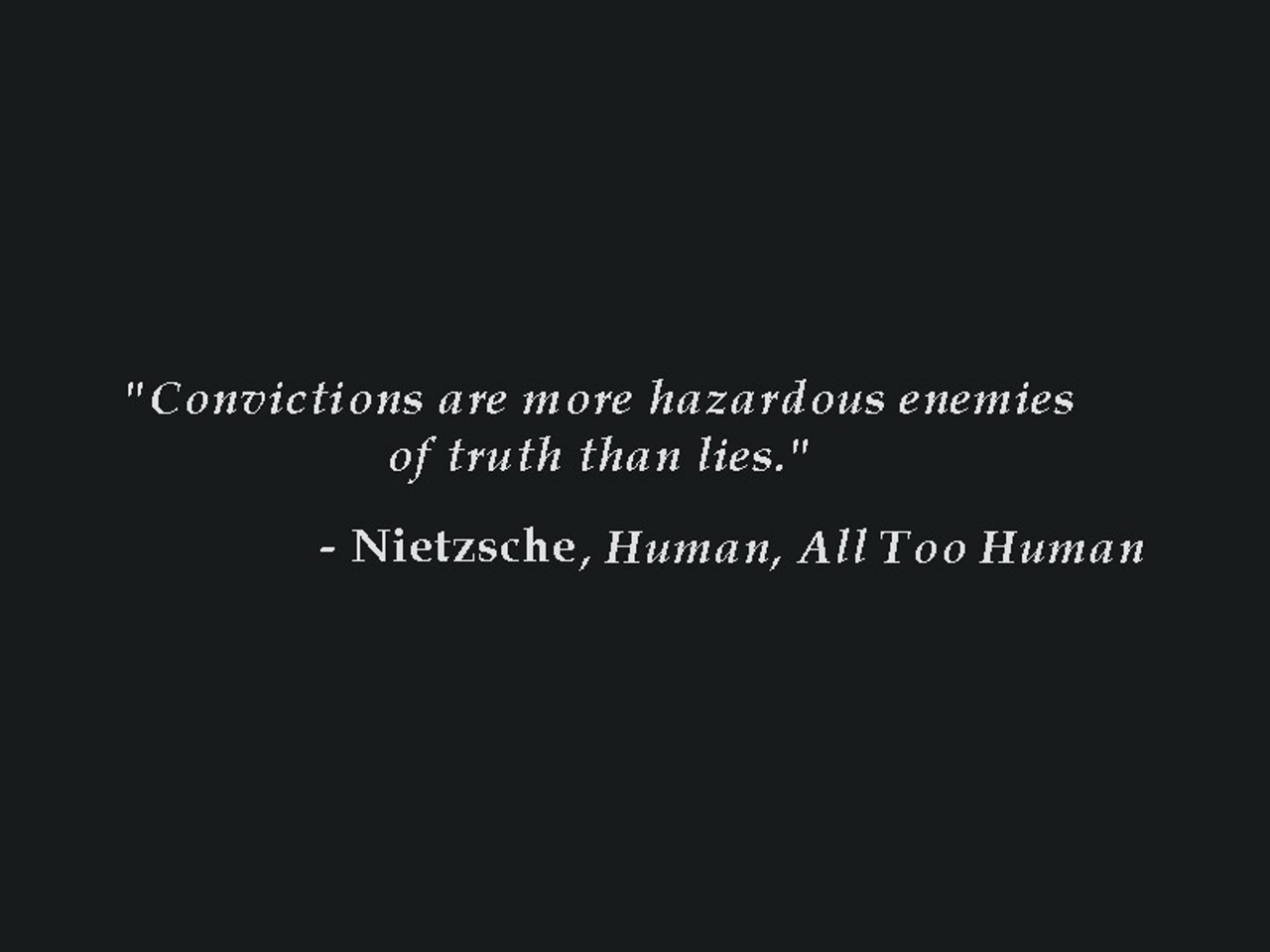
    Nietzsche1

    An early evening sky redolent with smoke and the sun’s reddish pall greet Wade when he leaves the library, and there it is, immediately, without warning or preamble, a pedestrian on the far side of the lawn near the physics building bent over and beating a dog (presumably his own, though there is no justification for Wade’s assumption) with closed fists, as if it were an enemy or threat, as if the man—no older than Wade but certainly not younger—must beat the dog to defend himself from it, as if the dog had attacked him and the man has no other choice but to become the aggressor, he has no other option than to punch the dog in its head, repeatedly, right fist after thundering right fist into the dog’s neck and body, the man’s left hand tugging on the leash tethered about the animal’s neck to keep it from fleeing but also to maneuver or situate the dog’s head for a more suitable location for the next blow. Wade doesn’t understand at first, he thinks he’s hallucinating, he shakes his head and stares at the man beating the dog and he walks toward the event, for that’s what it has become for him, an event, equal to any other catastrophe or unexplainable episode of violence he’s experienced in his forty years. It can’t be, he thinks, walking across the lawn toward the man and the whimpering animal, it can’t be, I’m seeing things, my mind is playing tricks on me, it can’t be a man beating a dog—again, presumably his own—they must be playing with each other, rough-housing, wrestling on the grass, performing some type of esoteric ritual or physical exercise, so intimate must be their companionship. Confused, Wade ambles over pale grass covered in goose shit, and something’s happening in Wade’s brain, the event before him has triggered unfamiliar and uncommon neural activity and Wade’s thinking it must be the odd copper glaze of the sun over everything, it’s the light and it’s the heat playing with his mind. Closer he approaches the man and dog and his mind confirms what his eyes see, it is indeed a man beating a dog with the full bearing of his right arm and with a stifled yelp the dog ceases its squirming and slumps on the ground unconscious, still and incapable of either fighting back or fleeing, perhaps even dead. This man just beat that dog to death! Wade says aloud, his voice a whisper or slightly more than an exhale, and the man, grunting and heaving short barks of his own, his eyes nightmarishly wide and focused down on his target, continues to pummel the animal’s head, the blows a bit more spread apart now as the man wearies, the dog’s body absorbing each rhythmic blast. The man suddenly registers Wade’s presence and stops beating the animal to stand erect, his chest heaving with exertion. He sees Wade and stands with fists down at his sides but still clenched, he says to Wade smiling but with his eyes mad, Fucking animals!

    Wade feels the liquid-electric spasm originate somewhere in his neck or at the base of the skull and shoot down through the shoulder blades toward the small of the back and reach the pelvis all at once and then he collapses face-first onto the lawn, eyes wide, the right side of his mouth pulled back in a tight rictus, surreal and garish. Wade’s spine snaps audibly straight and his hands crack into claws and he convulses from each muscle in his body all at once, or so thinks the dog-beater, bending down to assist Wade as he lay facedown. Mister? the man says. A redbird overhead circles about the incident peering down indifferently and then the bird tires of the scene and shits mid-air to fly westward into the receding light.

  • excerpt: on breeding

    On breeding: Human beings in the post-quake world should breed more conscientiously and take all necessary precautions so as not to confuse natural sexual action with the carelessness of rampant population. Men and women in the pre-quake world proved how quickly the human germ could spread and cover the surface of the globe. The growth was so fast and uncontrolled that the allocation of resources became problematic and, some would argue, eventually led to the ruination of the human race. The great quake’s antithesis wiped clean much of the Earth’s human population (among other creatures, now extinct), and has left the post-quake synthesis for human beings to ruminate exactly what our responsibilities are when considering breeding. Does a particular person need one child or seven children? How should that person address his or her sexuality according to those needs?

    The post-quake human must hold him or herself accountable for all actions, including sexual behavior; without surrendering our natural sexual appetites, surely we can find a way to better manage our reproductive volume. Each man and woman should be conscientious and personally liable, and we must discover a way to incorporate this principle into the individual ethical framework; for sexual conscientiousness is a matter of the individual and of no other other authority.

  • Outlaw

    IMG_0942

    How many of you would die for literature, he asked them.

    All ten of them raised a hand. It was warm in the room and the man stood at the front, pacing slowly with his hands clasped at the small of his back, as if bound there. His eyes were wide and cast down to the tile before him.

    The students in the room watched, waiting, a few of them nervous but the rest empowered by the speaker’s words and intensity. In that room they had a common bond, they shared warmth and their love of free expression, the exchange of ideas. They shared the homeland and they shared respect for the professor, the ex-professor, fugitive, translator of banned works, outlaw and dedicated man of letters.

    Before you join us you must submit to losing everything, all that you have, everything you’ve built.

    The room was silent. The man paced, his head down.

  • More than words

    Focus

    I woke in a dark room, sore down to a place deeper than any I’d known, for soreness is much more than a word; soreness is, at its heart, an intimate physical breach, an invasion of what we take for granted, a fire and resonating pain where before there was nothing, or what felt like nothing. Mute neutrality pervades as the body does its job, and only after sudden pain do we awaken to a place contrary to that quiet, neutral state. 

    I thought I was dead but those are also just words. Words hardly convey the existential paradox of such moments, of being there and not being there simultaneously. Surely I was dead, I thought, and this is what comes after death. My adoptive parents were both wrong and right. A woman approached from the shadows with a sponge and dabbed my chest and then I knew I was alive, the pain was no longer pain as a word or in the theoretical sense but something alive and howling in protest, my reflexes seismic. The pain seemed more a part of me than me, as if it were the true self and I an imposter.

  • Departure

    Ancient seabed

    The elders warned us to remain in the village, to never wander beyond the invisible village boundaries unescorted because we were young and innocent, we hadn’t yet been exposed to danger, the world was full of suffering and violence and the temptation to wander into the woods would tug at our hearts. Children are curious, they said. God’s enemies prey on curiosity. Don’t walk into the forest alone, they said. There are people in the woods and people hurt other people, that’s what they do, that’s what they’ve done since god created them and that’s what they’ll always do. We don’t understand this world any more than god wants us to, they said. We keep close to each other, we protect each other. We love and provide for each other and put our trust in god and that’s how we know everything will be okay. 

    Even as a child I knew their life would not be my life. Their god wasn’t my god, their rules didn’t apply to me. I held no enmity. With few exceptions, the village granted me a sense of community and inclusion. I loved those people who’d taught me the values of hard work and self-reliance. But even invisible boundaries are eventually breached. The elders spoke of salted deserts and wide plateaus upon which incredible creatures roamed, they mentioned clear waters and giant cities of stone and glass for the eye to behold. It was a vast and wild world that even the most wondrous dreams couldn’t simulate. 

    It took years to gather courage enough to leave. I feared the outside world and I feared the loneliness. I feared the danger of the unpredictable and tried to consolidate my limited knowledge and lifetime of legends into an immediate framework. I was afraid to leave my adoptive parents, who had done nothing but love and provide, nurture and behold. I endured countless meditations and hundreds of starlit discussions with Jennifer, fostered with love yet lost and alone in a remote world. It was inevitable. As difficult as it would be, I had to depart the only community I’d ever known to venture into a supposed dream and its unspeakable counterpart.

  • fireworks

    IMG_0864


    —the explosion occurred downstairs. Breaking glass and bursting wood, heavy thud. I thought about Siobhan in those frantic moments while I dressed and descended the stairs. I thought she might have done it, the old woman may have accidentally blown up part of the house, or maybe it wasn’t an accident at all but a spiteful outburst. She stood in the far sitting room on the main floor, wide-eyed and watching the flames dance about the room, an orgy of heat and snapping light. She looked at me and we extinguished the fire, her grabbing blankets and me fetching water from the kitchen tap. Someone had thrown a homemade grenade through the window and fire scattered in the room, blackening the carpet and much of the furniture. Siobhan wasn’t hurt. She must not have been in the room when the bottle came through the window. The smell of gasoline, acrid and nauseating. Siobhan called the security police but they never arrived, far too busy elsewhere in the city. I climbed upstairs to my notepad and attempted work on the project but was unable to focus. I heard small rockets detonate beyond the city and I thought, it’s hopeless, the end is nigh. An invisible circle closed tightly about me.

    I focused my mind elsewhere, writing about the voice inside, writing about my mother and how I woke this morning thinking of her despite not having dreamed of her. I woke this morning (thinking of my mother) assessing the scab on my hand, acknowledging that one day I’d die violently, alone. I’ve always known it and my mother knew it too, she knew and refused to understand. If only I could have saved her, if only I could have said to her, Mother, do not worry. I woke thinking of my mother, yearning to read something, and then it was dusk with sirens swirling in the city. The shelling or the sounds of shelling then drowned out the sirens (along with all sense of time) and I was startled when the old woman opened my door and quietly walked to the bed behind me. She smiled but did not look at me, a small hand up at the side of her head to wrap strands of hair around her ear. Again I thought of Annalise despite my irritation at having just been startled, and it was bright outside despite the smoke. Siobhan had never come into my room during daylight. I could smell her perfume from the bed behind me and I closed my eyes, thinking of Annalise, my Ophelia, engulfed at once with longing and sadness. I needed to be close to her. I stood with my eyes at the window and walked to the bed, my arms out to her as she pulled me in. I stood there for a while, cradling her head in my arms. The world was fireworks and she sat weeping on the edge of the bed and I stroked her head, my eyes closed.

  • Muted

    Processed with VSCOcam with c1 preset

    The voice speaks to me, it is a deep voice. I understand some words and phrases that my brain fashions into patterns, as this is the essence of mankind’s relationship to its languages. Air emanates from the lungs, shaped by the throat and mouth. The human ear receives the sounds for the brain to form into recognizable patterns. The mouth, however, is the most offensive of communicatory vehicles. It transforms language into vulgarity, coarseness. Spit and odor often sour the experience for the listener. I prefer words written rather than spoken. Words on paper written by hands assembling symbols, again, in recognizable patterns, a process much more refined than speaking, much cleaner and more worthy of attention, the written word. For anyone can speak. A newborn begins speaking immediately, incomprehensibly. Unevolved man spoke in grunts and howls. The human being must learn to write legibly and coherently, a person must be taught to build cogent thought. Man can speak of an idea almost as fast as he can think it; writing (and reading, for that matter) take time, an effort required of the communicant.

    Is it not the duty of man and woman to think and apply the mind toward some purpose? Is it not our duty to wish to improve the life (and thereby, the ideas) of others? Is there no morality in keeping silent?