Category: literature

  • Unimagined world

    —you can imagine a world where churches and libraries are sanctuaries rather than targets, where bombs are made and stockpiled only to be categorically destroyed in controlled environments, where perpetual violence is a fantasy rather than the reality. But you do not live in an imagined world, no, you are forced along with your contemporaries into a particular type of reality, unless, of course, reality as your contemporaries know it differs dramatically from your singular experience, unless you’ve been lucky enough to live apathetically rather than with feeling and concern. I digress—you do not live in an imagined world but instead in an unimagined world wherein occur the most agonizing circumstances and events imaginable. You live in a world where a better world is continually hinted at and/or promised, both prior to and following this current world, and so this unimagined world seems as if it were the worst of all possible worlds, or at least one of the worst possible worlds imaginable. It is a world where imagined horrors are realized while imagined joys and elations and tranquilities are but imaginary—imagined but not realized, conceptions that you were born too late to experience and enjoy, conceptions equally as prohibited and impossible as that salvation long ago promised to you. It is no secret among the living that you are sick with envy, nauseous when you imagine the generations that preceded you, before the quake, and you envy them not only for the world they were privileged to inhabit but also because, quite simply, they are dead. If what you have heard and read is true, people in the pre-quake world were lucky and different from you but then perhaps it is likely they were much the same: they were ungrateful creatures that harbored inherent antagonists—creation and destruction, with destruction, for whatever reason, appearing to have the advantage, to lead by example.

  • Dancing on the hill of the dead

    The creative process is a curious ebb and flow, a seductive dance with the part of the self least known, least attached to identity. Most days you don’t have it; you slog through because you must, knowing your ideas are paralyzed by impotence, enervated, without a substance you can’t quite find to round them out. And then there are days when everything rushes forth like crystalline waves, the ideas profound and the language exacting, sharp. Of course you prefer the latter, but you cannot possibly get there without the former.

    I woke up today and the new novel is at about 65,000 words. There’s at least another 15K words somewhere inside, undrafted, and I imagine this new project will fall a bit short of the 100K-word mark, which was the tally on the previous novel. What’s strange is when I undertook this new project I imagined it to be much larger than The Novel Paradox, my previous novel. The ideas were bigger, the landscape was bigger, the characters were bigger. But essentially it’s likely to be a shorter project, in terms of volume.

    That’s not to say that after the first revision I won’t encounter some substantial holes that need attention, which will almost certainly add to the length. Or that the first draft itself is just one large hole that must be plucked from the Earth and tossed angrily down some dark, fiery recess. But these large projects are like children: we never know what they’re going to look like or how they’re going to behave when they’re born. We look on amazed as they take shape.

    Paradox was written longhand in notebooks during the day while at work or whenever I was away from the typing machine, whole passages sometimes written twice by hand before sitting down to typeset them. This new novel is much different; whereas with Paradox I’d go through about one notebook each month for the two years it took to write the novel, this project largely unfolds outside the physical space of the notebook. The story unfurls like jazz, an improvised process on the machine, without the organic feel of a human interacting with a pen and paper. I’m wondering how that’s going to affect the reading of the novel and what it’s going to mean when comparing the two projects from a reader’s standpoint.

    In the interim, I create. Some days I’m tormented, challenged to get through a paragraph of acceptable content, while other days I spray out whole pages easily, a battle tested artist fighting off all challengers, a statue atop the hill of my dead. I do not concern myself too much with how the novel’s going to read, because first I have to write the thing, and second, it’s not guaranteed that anyone will ever read it. What’s important is the creative process, that dance with the self unseen, that self I try so desperately to make the real me.

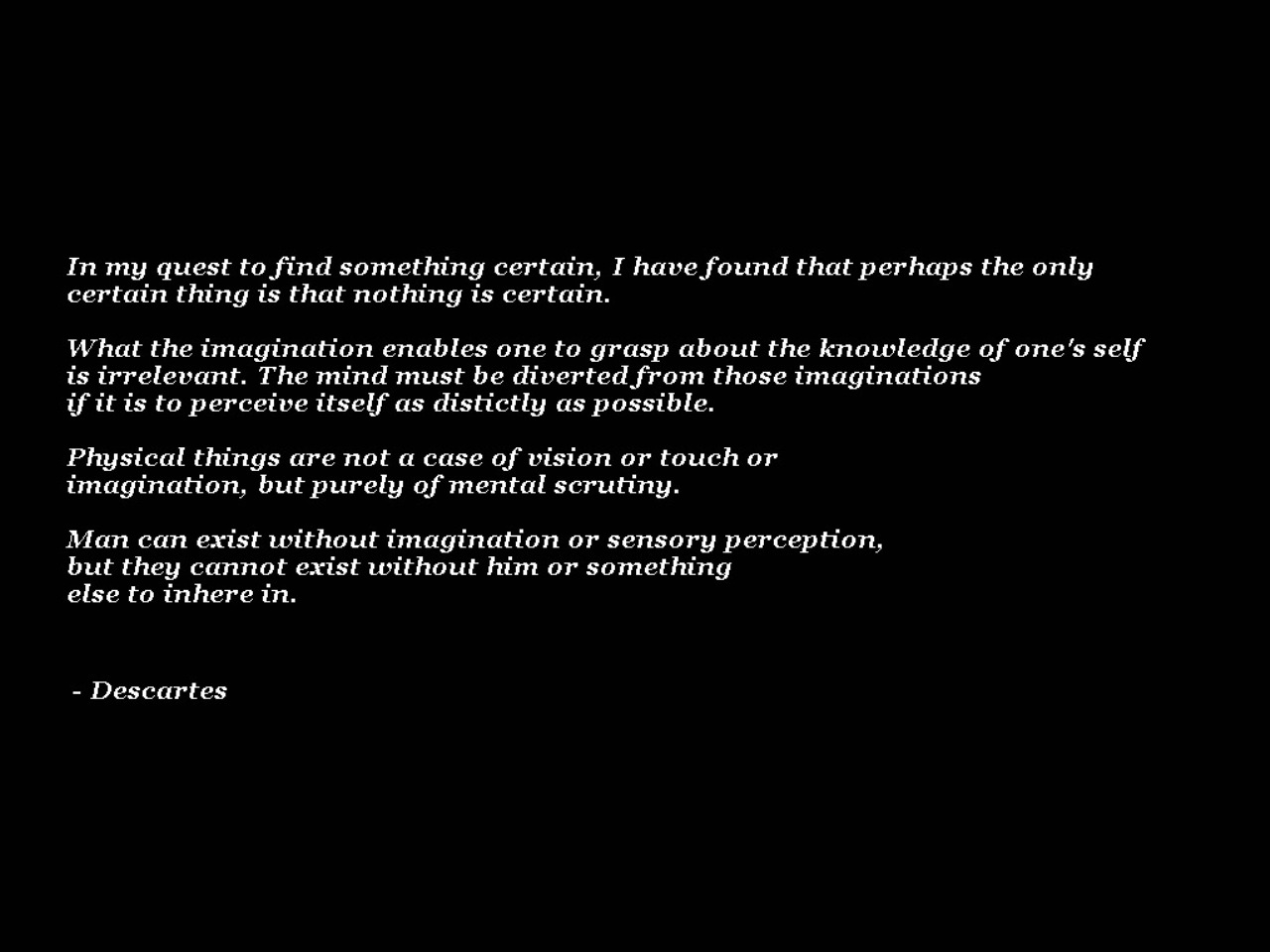
  • Cartesian slumber

    —I read Descartes’ Meditations last night, I read it twice, I hardly slept, having dreamed of my paternal grandmother and how she used to tell me, after my mother died and my father abandoned me at the old woman’s doorstep, she used to tell me that I was a special child to her but that the world was complicated and the quake had changed everything and I probably wouldn’t ever seem too special to anyone else but her.

    But don’t be upset, she said. It happens to us all. This is what it means to be human.

    Then she would hug me and look at me with her milky irises and she’d say, My child, I am blind, and even I can see how special you are, and that is all you need to know.

    I woke up and looked over at the desk and I knew at that moment that I both hated and loved Descartes, and I didn’t know why.

  • An excerpt from the storyteller

    I wake early in the morning with the lamp on between Lilly and me. I know it’s late because I don’t remember falling asleep. I hardly ever remember where I left off in the story. I usually close the book and turn off the lamp and leave Lilly alone with her breathing and walk across the hall to my room, the room that feels so empty without Lilly’s mother. I lie in bed staring at the ceiling or the walls until the sun crawls up and I fall asleep for an hour or two until the nurse knocks on the door and wakes me.

    The nurse changes Lilly’s clothing and refills the liquid packs of vitamins and checks all the life sustaining elements. She leaves and I make a few calls for work, just to be doing something. I’m useless. I make myself something to eat and get down maybe two or three bites before I can’t eat anymore. I feel sick. At the bathroom mirror I don’t look like the same person. I lean into the image and see the stubble, the dirt in the cracks of my skin, the clogged pores. Each individual hair protrudes outward to the world I inhabit. I stare into my eyes, I try to numb myself. After a while I start the shower and get in, the water steaming hot.

    Everything is different when you’re grieving. A newfound microscopic significance inhabits the mundane. All actions and all thoughts are weighed down and replete with meaning. Values are assigned to inanimate objects. Light is no longer just light, a bar of soap isn’t just a bar of soap. Grief is a process, a deeply emotional response, an imbalanced characterization. I read the ingredients on the shampoo bottle six times in a row, silently annunciating each chemical. There is an odd comfort in grief because the grieving person feels so close to the recently departed, holding onto their memory with everything, as if it were the waning force of life or as if even the memories would also soon be gone. What’s difficult is maintaining a firm grasp on one’s identity; do not confuse the life force of the dead or dying for your own, for no matter how intimately entwined you might have been, no matter the volume and significance of what you shared with them, one’s will to live will always be one’s own.

    The towel is my friend, the shower helps clear my head. I decide that everything’s going to be okay. I walk into Lilly’s room and sit next to the lamp and open the book. I start reading aloud again.

  • At the publisher’s house

    I dreamed last night of a local book publisher. The contact there was a blond young man a few years younger than I was, and I sent him my manuscript eagerly, which he awaited with likewise eagerness, to my surprise. It was cold out and dark and the roads were very icy. I didn’t recognize where I was, or what city, and I was driving the old car I drove when I first began driving so many years ago.

    Cars drifted on the ice and crashed into other cars, many of them already parked. I stood on the sidewalk watching the chaos and destruction and did not feel optimistic about my journey back home. I thought of my wife in the dream, but she was never present.

    I was at my grandfather’s house and once again it was very dark. It was dark outside his house as well as inside. My mother was there and my grandfather was about 20 years younger; he was able to move about with relative ease. Nobody spoke, but there was a sense of restlessness or turmoil or danger just beyond our reach. The neighbor across the street had been implicated in something, a rape or beating. Then I was back at the book publisher’s place across town, a very old building with creaky floorboards and a few old bookish people lingering about.

    The young man at the publisher’s house told me he’d read the manuscript and liked it very much. He handed me a large plastic zip baggie with three antique style keys inside. Here are the keys to our special luncheon, he told me, smiling. Be very careful with them, obviously, he added, and then he disappeared into one of the old rooms. I smiled and walked out into the cold, wondering if it meant that he was going to publish my novel.

    A dark sedan tried to turn the corner but its tires just spun on the ice. Another car was stationary in the middle of the road and I noticed it beginning to slide toward me. It slid on the icy road without any catalyst to propel it and I thought there was no way my old car was going to make it home without crashing into something. The sliding car began to pick up speed and luckily for me it changed direction and continued to slide down the street, slamming into a pickup truck parked at the curb. I pitched my cigarette, because in cold dreams I’m always smoking, and crossed the street to my old car and got in, starting it up. I put some music on, feeling very happy about what the publisher told me, even if I didn’t know what it meant.

    The night chilled me so deeply that nothing would ever warm me again, but it was okay. The lights of the city shimmered, and I drove back to my grandfather’s house.

  • An Excerpt from the Enlightenment Project

    At times the post-quake man must forcibly defend his life and property and is thus compelled to dictate the fate of others. For the principles we must follow we need not look any further than Aquinas. We live in a world where libraries have burned to the ground and many of the old texts are gone forever. Here I will spare the reader of this treatise that tragedy and sum up Aquinas’ principle of double effect. Aquinas wrote that in defense of one’s self and property, one is justified in the killing of one’s assailant if and only if the killing of the assailant is necessary to the survival of one’s self. The killing of the assailant can only occur if the intention is to save one’s own life (or the life of his or her immediate community or property), and the amount of violence used against the assailant was the necessary amount and nothing more.

    Based upon Aquinas’ principle, killing another as a means of self-defense isn’t necessarily prohibited. But the killing of another for reasons other than stated above is unlawful and unethical. The health of the social apparatus depends on this. Certainly it is obvious that warfare contains its own rules and codes that fall outside of the principle of double effect, though the principle of double effect does still, and always must, apply.

  • A living excerpt

    And the child’s first year in its new home continued primarily in this regard, with celebration and solidarity among the people of the village and the child began to walk of its own power, its plump and shaky legs moving deftly from the rearing mother and her arms outstretched to other women in the candlelight of the hut, for the child hardly left its abode, it was brought to it all essentials including food and drinking water as well as gifts from the people in the village, gifts piled up in its hut as signs of respect and offerings not only to the child but whom the people of the village trusted as the child’s true father, the everlasting, and so the child hadn’t too much room to maneuver upon its quivering legs, but maneuver it did, smiling at the odd sensation of muscle and bone and other tissue at work in its small body. As was customary in the village the rearing mother would cradle the child in her arms and feed the child milk from her breast until the child’s constitution was mature enough to eat solid foods and the rearing mother did this well into the child’s second year, and also customary among these people was to settle the child during lamplight by softly rubbing the child’s genitals, a gentle massage that the rearing mother found arduous, for not only was their holy child dually equipped but as it continued to grow its genitalia grew and matured along with it, the penis in particular which seemed at times to the rearing mother to be obscenely large and dangerous, especially as it reacted to the mother’s soft stroking and stimulation of it, for the penis secretly frightened her in many ways, not only for its sheer size and virile nature, its unspeakable power, but also because she knew it would continue to grow as the child grew in years and it would doubtlessly become a product of gossip among the young women in the village and ultimately the focus of their licentious weakness, just as she was afraid the same might happen to herself, for she could not admit in all honesty that she massaged the child’s erection simply out of motherly love alone.