Category: Excerpt

  • neo-enlightenment, text redacted

    Processed with VSCOcam with b5 preset

    [redacted] incarceration by emancipation. There are two initial steps in the process, the first being extraction of the bourgeois individual from common life and placement into isolation, sampling the good life at intervals for a year, providing the subject with controlled transgressions into common life to witness firsthand the fundamental incompletion of the subject’s former life in comparison to the good life.

    Subjects in this initial phase are isolated with study materials in multiple mediums to exercise and cultivate the intellectual spirit, prioritizing topics the individual has interest in engaging. [redacted] The instructors then diversify content so that soon the subject absorbs information faster and at greater depth, and the assimilation of refined themes begins.

    [redacted]

    The subject witnesses an imperative of the will to wish to strengthen and sharpen the mind, and he/she acknowledges that humans are inherently eager to seek information and structure it to the mind’s will. [redacted] The enlightenment project reinforces that eagerness, revives it from an entropic state and demonstrates its potential [redacted]

    […] is our primary goal, so that the subjects, once the initial phase of enlightenment is underway, will return to former life in an enlightened state of consciousness, one that engages the political, moral, and intellectual processes, without modifying the sovereign person’s nature of character. We strive to combine the intellect with a culturally relevant awareness that each human being coexist and freely give, take, and borrow knowledge from one another.

    [redacted]

  • Neurosis, gentleness, contempt

    IMG_1277

    They said that with an intellect advanced far beyond one’s years there will accompany it a cognitive malady or other neurosis equally advanced, because the universe must always balance its extremes. And the boy’s gifts were extreme. This is how he suffered adult phenomena at an early stage of maturity, due to this balance, or imbalance, if you will. He was so sick that he couldn’t translate his fears and feelings into language in order to articulate them to others. They said that because of this, the boy suffered through a debilitating anxiety throughout his childhood and adolescence while the few people who bore witness to his gifts had no idea of the struggle inside him, the strain and terror gnawing at his spirit.

    And it was due to this complicated element in his life that the boy, or the prodigy child, as they called him, grew into the world and into himself with a gentle disposition but also a deep contempt of the world that would accompany him unto death.

  • Another memory in algorithm

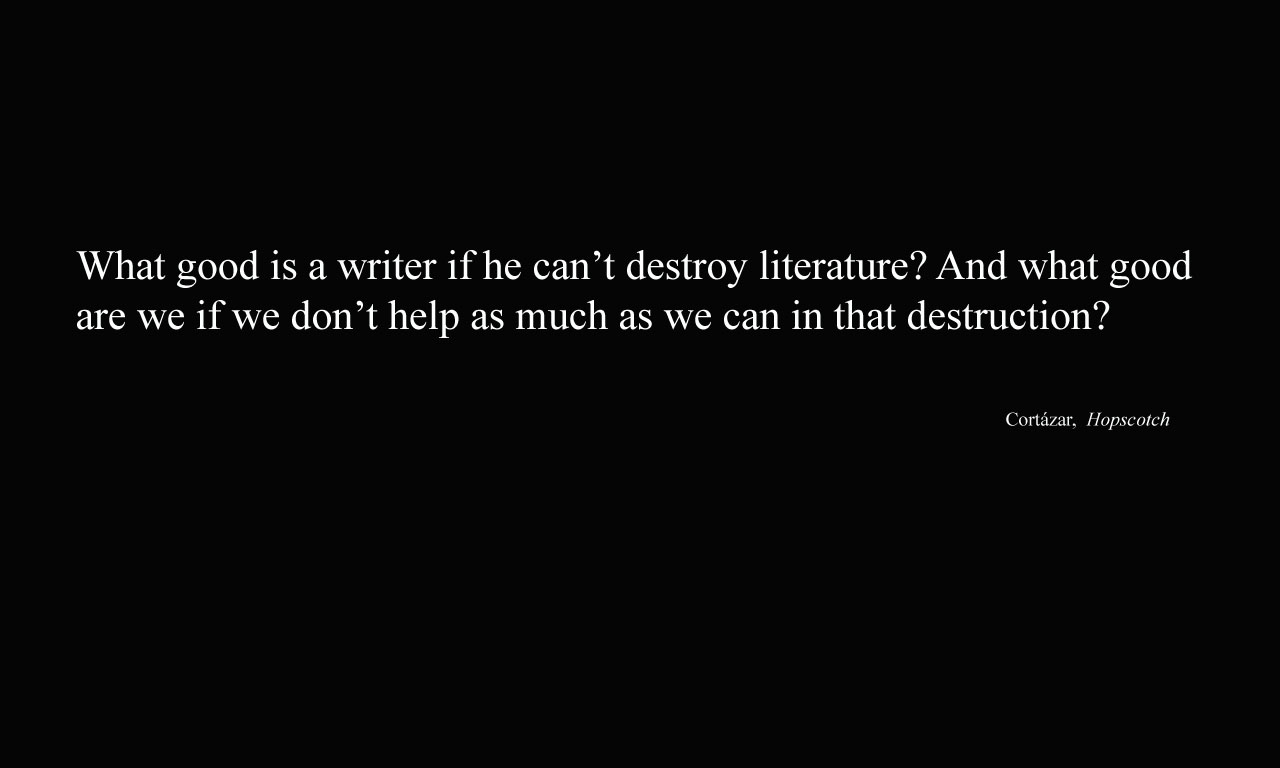
    Hopscotch

    Suburban life can be maddening for a man under pressure. On certain days he feels violated  by all the comparison. The people and things he sees spread up and down his street are like the people and things of his own life, only different, nuanced in ways he can’t quite explain. Fulfillment is replaced with longing. Time elapses in duty and rote obligation rather than days, weeks, sunsets, breakfasts.

    There is something subtle and devious about the way people communicate in the suburbs. Neighbors symbolize their lives through what they possess, the activity of their social lives. In the suburban community, a man’s value is measured by what he keeps and how he keeps it. Everywhere he looks is a form of qualitative comparison, a measuring stick of social value, a mirror under fleeting light.

    I sometimes wonder what my father saw when he looked at our neighbors. He was a man married to the pursuit of his own meaning, deeply and spiritually unhappy with his life. He hated everything about his life, most of all the man who was living it.

    I used to construct my calendar based on my parents’ work schedules. Thursday nights were a practice in tension. My mother worked late into the evening, my two sisters and I forced to endure the strain of a night alone with my father, his body teeming with living currents of pressure. His endeavors on those Thursday nights were struggles in simplicity, mere withdrawals of anything that might upset his self control. He listened to baseball games on the radio because this soothed him, it comforted him in the aging skin of his failures. He always cooked eggs and toast for his kids because that was what he knew. To try something else or experiment with his delicate routine would teeter the entire experience close to danger. He smoked cigarettes while he ate, one after the other.

    We would be at the table, the four of us deliberate in our silence, shoveling mouthfuls of runny eggs to thwart the hush. A baseball game droned in the other room, the innocuous soundtrack of our fragile safety. My father studied me as I ate, not just this night or other Thursday nights but always, judging me with every meal, each small bite, waiting for me to give him a reason. There was always a cosmic inevitability in those situations. I think back and wonder what my sisters thought while we ate, if they averted their gaze out of some mixture of compassion for me and respect for him, or maybe they measured him furtively, puzzled by the enormous weight of his thoughts. I wonder if they looked at me and couldn’t help but share my discomfort, a truth so deep that it became a part of who I was and still am. I don’t think they knew how close I always felt to death and how confusing it was to continually share that distinction with being a child.

    He would say something about my eating, I was doing it wrong, slow down, eat faster, chew with your mouth closed, open your mouth, look at me, don’t look at me. The words were meaningless, they could have been any words, any language or dialect. His words were the evasive filler of space and time, metaphysical snapshots of the moment before the moment. I always knew what to expect long before I cowered deep into myself in preparation, before the blow sent me sailing into the other room, his giant electric frame pouncing on me, eyes glittering mad, smoky breath comforting and familiar on my cheeks.

    I remember the red ember of cigarette fire in his fingers inching toward my eyes and I closed them, shutting out the animal light in his face, his eyes like mine in the years to come, and I felt the close burn just before he pulled the cigarette away, unable to whimper in entreaty or resist his rage by uttering the only name I knew to call him.

  • Bulbous but strong

    Processed with VSCOcam with b5 preset

    My mother died when I was young, she drowned herself. I’ve written about this incident countless times, I know, but I’m writing again for myself. My mother died when I was young, she drowned herself. This is what they say. My father told me that she drowned herself because she was crazy but also because of me, she simply loved me too much or she was afraid of me, she couldn’t control the maternal bond with her son, she didn’t trust her body near mine, my father never really knew what, he only told me that she was crazy and it was because of me. She was crazy when he met her, he said. He told me once that she used to have nightmares, premonitions, she repeatedly endured the phenomena until she couldn’t live any longer, she just couldn’t take it, neither in this world nor the next. This is what my father told me. My father the hypocrite. My father told me this when I was seven, he hardly speaks to me at all but he told me this back when I was seven, he said my mother never mentioned to him what the dreams were about but only that they were terrible, our son is cursed, she told him, he’s awaiting some dark fate, some terrible future. I wake thinking of my mother and try to imagine that midnight pool she waded into, I try to find it in my mind. A moonlit expanse, a solitary woman exposed to the night, serene, a woman dwarfed by trees, awash in the light of the moon. This notepad is small in proportion to the desk and I’m hungry, I need to eat and I’m also thirsty, I remember the rotted bulbous tree root from my dream and my appetite is abated, at least for now, how is it possible to be alive and feel dead at the same time, I think of her, my mother, and I write in the notepad now fully aware of the scab on my hand, for it sets directly beneath the pen, a blister, each diagonal thrust of the pen reminds me of my mortality. Leaking and bulbous. I wake with my mother floating about the pool of my conscience and a bulbous tree root rotting, strong but rotting, a bulbous scab on my hand and a dark pool whereby my mother sent her last breath upward in a spring of slow bubbles up to her moon, itself just a bubble. I was seven. She was twenty-eight, and now I’m already half-past her final age. In some respects, a grown man. At this rate the scab will never become a scar, it will never heal, opened and reopened and reopened and reopened and the motherless child will never become a man despite his intellect but instead perhaps whittle himself away scab by scab, the image of my mother more like the dramatization of an image rather than the actual image, her body floats, I can’t remember what she looks like and I try to imagine what she wore that night, if she wore anything at all, bulbous tree root rotting but strong, what she wore floating dead in that lake, that secret pond in my mind. I see soft pink fluttering at the edges of the water’s surface, or perhaps the air’s surface, her hair too dark to see by moonlight, her hair shimmering equally with the water, the soft pink of her thin gown two shades paler than her skin, my mother, face down, forever, my mind’s eye directly above her, looking down, the eye of the moon. My father blames me, he’s always blamed me and I cannot hate him for it, I cannot blame anyone for blaming me for causing the quake, a bulbous tree root a scab a bulbous tree root seven a blame, a moon eye—

  • Thus begins the renaissance

    Knob Tree

    When a small band of the United Dog Soldier Brigade finally caught up with my father, he was meditating on a small tussock overlooking the northern California Pacific. He had abandoned his security detail, as he did every evening at sunset, to hike up into the nearest hills when the detachment confronted him with their M-16s. They beat him with the butts of their rifles before marching him to a remote spot on the northwestern edge of Humboldt County, stripped naked, for the entire world to see his wounds. They marched through the night, my father refusing the soldiers’ repeated offerings of water, his naked body slashed and torn by the coarse trailside growth. By the time they finally reached the Dog Soldier camp, my father’s militiamen had begun to search the coast by moonlight, stretching their team out as far south as Eureka, toward the Oregon coast in the north and fifty miles out into the warm Pacific.

    [Author’s note: I wrote a story in 2007 about a family of men at the vanguard of a revolution in the U.S. in the near future. The story is told in three parts by different generations of women in the family, who catalog the destruction of the family wrought from its idealistic men. The above was taken from the start of the second part, titled The Renaissance.]

  • The architect, a fragment

    wpid-IMAG0164-1-1.jpg

    The architect remembered back to the first time someone tried to explain how his work made them feel. It was a young woman in drafting class in undergraduate school. She sat next to him and one afternoon he was immersed in his work and didn’t notice her staring over at what he was drafting. A lifeboat, she said, pulling him out of his creative trance. I’m sorry, he said to her. A lifeboat, she repeated. Looking at that drawing makes me feel like I’m on a lifeboat. The architect looked down at his drawing and then back to the woman’s face. She smiled. But I’m not sure if I’m saving someone or the one being saved, she said.

  • The fifth year

    ratner


    In the child’s fifth year it fully memorized all five of the sacred texts and decided to destroy them. While the rearing mother was outside the hut tending to the matters of the village the child tore the pages from the sacred texts and left the books spineless, ripping the lifeless pages even further so that the floor of the hut was littered with small bits of paper like shaved ice. The rearing mother arrived to find the child seated on the carpeted floor with a mound of paper scraps before itself, a sullen look on the child’s face, and the rearing mother didn’t understand what had happened until her eyes fell upon the disconnected spines of the texts, whereupon her eyes metamorphosed into a darkness deeper than night and she rushed over to the child, beating it with her open fists, screaming that the child was a devil, nothing but a devil, a devil all along, the child unconscious after the first ten or twelve blows to the head, and it wasn’t until an adolescent male villager outside the hut overheard the violence within and opened the hut door to find the holy child’s rearing mother astride the bloodied and motionless body of the pale king. The young man separated the rearing mother from the child and set her outside to face the fate of the profane while inside he tended to the child and ensured it was still alive, it was still breathing and could move. As the child’s broken bones healed and its wounds became scars the people in the village orchestrated a ceremony whereby the rearing mother was beheaded with a machete and her head displayed upon a stick for the people to parade about the woods with their torches of fire guiding them in the night. The people of the village sang and howled at their joy, they celebrated the holy death of the heretic, they returned to the village to find the child of god huddled by candlelight over its papers, its ever-present words and ideas that the papers couldn’t contain, for with age the human intellect activates, and the child, for reasons unknown to this omniscient narrator, had finally become convinced that the words he or she had been writing so feverishly were words or the pictures of words delivered directly from god, messages for the people, for the future, for all time and all people from the heavenly king. Everyone had been right, all the people of the village were correct, the rearing mother had indeed been the caretaker of a holy person, a medium between the common man and the god they worshipped, the child thought. The electric current of power slid though the child, intoxicating and rapturous.

  • At sea

    bird_lives

    I looked over at her. The breeze tossed her hair, a dark nest of serpents at dusk. She looked out to the darkening world beyond the lights of the vessel and I could see that she was in her forties but that time had been gentle with her. I was curious about her, as I knew she was curious about me, but with age comes a particular degree of respect and decorum, and neither of us would yet voice our curiosities.

    The solitude, the mystery, she said. I can’t help but hark back to a time when the sea was all there was.

    I smiled and nodded, leaning over the deck and looking down at the water again. The pitch and roar of water cascading upward towards me.

    I hope I’m not disrupting your peace, she said.

    No, I told her. It’s fine. It’s nice to hear a voice other than the voice in my head.

    I can certainly understand that, she said, and for the first time we looked each other in the face.

    How long have you been aboard? she said.

    I boarded this morning in Madrid.

    After a lengthy pause, she said, I’ve been on this ship for three months tomorrow.

    I looked at her, wondering what might have brought her out to sea for so long, what sort of personal outrage forces a woman and her family to seek refuge in the great abyss for such an extended period. Then I remembered almost immediately that the abyss calls for all of us at one point, and we all of us must answer that call.

    Have you found it particularly dangerous? I asked.

    Actually quite the opposite, she said. I’ve found these past few months, and especially the last few days among the most peaceful of my life.

    Congratulations, then, I told her. The erstwhile world is not nearly in the same condition.

    Would you be interested in a brandy? she asked me.

    I’m afraid I would, I said, smiling at her.

    You don’t strike me as someone who fears many things, she said.

    We left the deck sinking into shadow and walked down through the narrow corridors of a labyrinth to her cabin, which was not far from my own. I sat on a stool near her cot and watched as she poured brandy from a small bottle into two plastic cups. She sat on the bedding and we touched cups and drank, feeling the gentle rock and sway of the ship in the water. The brandy was good, almost as fine as something Jorge would have kept stowed in his desk drawer, but not quite, perhaps a bit too sweet. The woman’s cabin was similar to mine and everything was tidy and well kept, much like the woman herself, who looked at me through dark pools and then down to her cup, and in the soft light of the room I could at last make out the delicate contours of her face and neck, the elegant geometry and proportionality, her eyes and hair a matching depth of black, and she said to me, or perhaps to the room in general, to herself, to no one, I’ve dreamt that the world is going to end.