Author: TJ McAvoy

  • Deconstructionist, pt. IV

    soledaddos

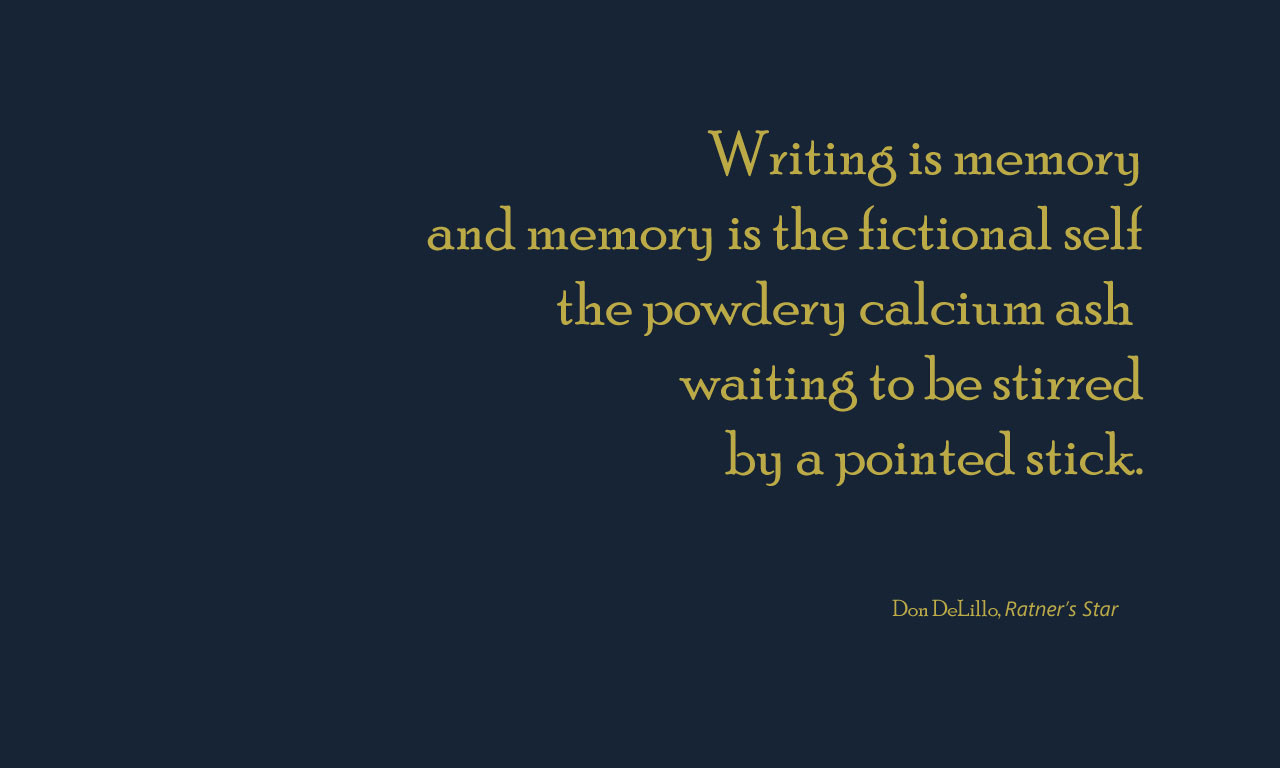
    Sunlight at my window wakes me. I sit then stand, feeling the blood bound through my body, familiar aches at my back, my shoulder. The floor is cold beneath me. I reach for a glass of water and see the notebook stark atop the white wood of the nightstand. I wonder why I remember the notebook but can’t remember my name.

    Writing began as an exercise last winter but quickly developed into something much different, the nature of which eludes me still. I never wrote much of anything up to that day in January when I happened on an empty notebook in my library and began, at a colleague’s recommendation, to write down my fondest memory. Thus what I remembered of the Trankworth’s unveiling in L.A. unfurled from my consciousness with immediacy, as if water poured from a bucket, and my memories, granular in detail, inundated the pages of the notebook.

    I wrote as I remembered, adding and supplanting for clarity, precise and meticulous with details so as to insure them, immortalize them, never again worry about chasing them through the narrowing corridors of memory.

    Next I turned my attention to other memories and attacked them with equal zeal and attention, starting with the most powerful and lucid, using the notebook as collector, curator, friend. I cursed myself for not having thought to catalog my memories earlier. Emotions overwhelmed me. Details obsessed me. My attention gradually shifted to language as I beheld a newfound appreciation for and devotion to its nuances, its capabilities. I broke it down to fragments to better understand and utilize it for my memories, my notebook.

    The project inspired in me a renewed sense of purpose after all had once seemed lost. I wrote with energy, violent when necessary, using the pages as scratchboard, bandage. Never before had I known the intimacy possible between man and page.

    In the kitchen I forget how I like my coffee and drink it black, writing about a dream from last night: I’d been commissioned as a young man to design and build a clock tower in Sweden in collaboration with a pair of renowned Swedes hired to build the clock. Men were contracted and materials were purchased and the project proceeded on time and budget until the Swedes abruptly bailed near completion, leaving me to either complete the tower without the clock or try and build the clock myself.

    Rather than proceed sensibly I chose instead to try building the clock, attacking it with more passion than I placed in the tower, working all day and deep into nights with the gears and levers of the clock until a system emerged. The tower’s public unveiling approached and I wasn’t near completion, insisting the tower be opened without fanfare or celebration while I continued to solve the riddle of the clock. At dream’s end I’d become an old man still living on a small mattress in the top of the tower, working tirelessly at his obsession, and later, just a rumor or vapor on the neck of someone tasked with cleaning out the abandoned tower where that sad man once lived.

    Sunlight fades at the kitchen window and I rub the pain from my hand, scanning my mind for memories to transcribe. I contemplate everything I’ve forgotten and finish the coffee, ready to begin the day. In the library a meager wooden shelf supports the notebooks. I think of all the duplicated memories written inside them, wondering if it’s just the same few repeated over and over. Why continue this kaleidoscopic mockery of the past if not to lose myself deeper in the labyrinth?

    Days are casual. Dusk signals pensive marathons by candlelight. Time is the anti-rhythm of scratching on pages as if scratching at the earth, but to uncover what?
  • Convalescence

    Convalescence

    If you’re reading this, it’s February third, or at least the nurse told me it’s February third, and since I’ve got no other choice than to believe her, it must indeed be February third. I’ve been in a clinic for the past several hours, lying supine in an uncomfortable bed with fluorescent lights stitching the ceiling, casting the room in violent unnatural white. An electric glow washes over everything, casting out all darkness. They’ve removed a bullet from my right shoulder, or fragments of a bullet. I am not hurt badly. According to the nurse I am lucky to be alive, and perhaps she wasn’t speaking about the bullet but more or less life in a broader sense. You’re lucky to be alive, she said, but then again that’s a relative statement, something a person would say when they don’t know you. If I am lucky to be alive, then what does that say about luck?

    I’m leaving the clinic in two days, they say, which will make it February fifth. If you’re reading this. I feel fine, if a bit sore. Please don’t worry about me, I’ll recover and will be on the road again soon, delivering parcels and scratching in this notebook. The pain medication has me drowsy. I’m getting older, Jennifer. But then so are you. But you’re not reading this.

    *

    Through the battered rectangular doorway three security police walk the hall of the clinic with their authority on display. Hush precedes and lags behind them. The uniformed men have sidearms looped in their belts, standard-issue black hats snug atop heads shielding eyes that scan the halls and peer suspiciously into rooms. They’re looking for someone. The clinic seems at capacity. I lie watching and wonder what they know about me, if anything, what they’ve heard through the wire, because we’ve all had our name sung upon that current at one point or another. We have all been targeted at least once.

    I need to get back on the road. One of the bullet parts embedded an inch into my deltoid muscle. A deep, dull pain pulses through my right side as I move the pen across the page. The nurse has stated her displeasure at my insistence to write. I’m going to need to rebuild my strength, one word, one line at a time.

  • two worlds

    already_dead

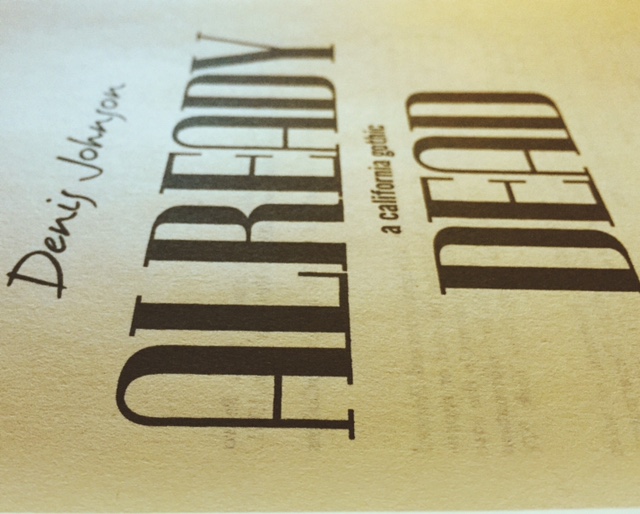
    From Denis Johnson’s Already Dead:

    “…[she] had given him the Emerson book. He’d been fascinated with her when they met, because she read such things and seemed to live in two worlds at once—the world of her life, and the world of books in which she found her life explained. Eventually the two worlds came together somewhere inside of her and made for tremendous strength when it came to making large decisions, as, for instance, the decision to turn her back on her husband.”

  • Revisiting themes

    Circumnavigation

    I read the words of thinkers and sometimes I read Shakespeare’s tragedies, namely Hamlet. I read Hamlet during respite from the words of thinkers and the ideas in my own mind. I don’t read fiction or the histories, which are largely the same. I’d rather read the words of pure thinkers, for thought is a condition of itself and only itself whereas fiction and history are conditions of the surrounding narrative that outlives them. Stories live forever in one form or another but pure thought is fleeting and demands to be captured. Descartes, for example, laid in his bed staring at the ceiling and its junction of two walls, stricken at once by candlelight with an idea he simply had to write down, an idea that had nothing to do with narrative, nothing whatever to do with the world he lived in, the political and religious turmoil, civil strife, disease and natural cataclysms, his own agonizing chronic pain, no, his walls and his ceiling spoke to him in coded heresy and mathematical jargon and he rose, wraithlike, hobbling to the desk by candlelight in his robe to compose an unprecedented system of geometric coordinates, timeless and practical, the system rich in—what seemed to him—a veiled utility.

    This is of course not to say there’s no merit in narrative or fiction or history, especially the great works, no, but I prefer to cultivate the garden in my mind with the purest of the pure, the foundations of all thought, a trail that of course leads to culture, innovation, social hierarchy, paradigm, transcendence, what have you. Ideas that form the building blocks of all culture and sociography. But Shakespeare is different. I am haunted by Hamlet, for reasons I know not. I’m connected to the text without having seen the great tragedy performed, without having a friend like Horatio, without a father living or dead to honor.

  • From the notebooks of [name redacted]

    Tentacles - Pinkcropped

    And so, legend says, one cold night the boy sat down at his bedroom desk to write his way through that labyrinth of mystery. There was an empty composition notebook and he opened it before him to begin writing the state of his perusals, composing into language the likeness of his whirling mental tapestries. He soon discovered how natural it was for him, the act of writing. He wrote about his fears, the crippling panic whenever he was around strangers, whenever he thought of something particularly troublesome, perhaps a situation that forced his heart into a sprint. He wrote about the effects of that anxiety, it’s force not only upon his mind but also his body, which he hoped would lead him invariably to the source, what he considered to be the progenitor of his sickness, and he wrote about time and refracted light and he scribbled mathematical equations into the notebook and then his mind delicately eased him onto the path of the state of the world, the collective fear amid the global socioeconomic hardship, the widespread warfare, disease, the suffering in the wake of poor leadership and representation. Ever-present spiritual decay and fragmentation. He wrote about the governing policies and the political world as entropy or as a crutch for the modern, post-quake people of the world. He wrote about prolonged and sustained damage and he wrote about the social norms that would need to change in order for the world to be a more peaceful, more practical place for everyone to live cooperatively, contributively, equally, and before he knew it he had composed a very detailed (and very long) treatise on radical social theory unlike anything since the quake.

    The translator and I watched the woman. She seemed more confident than before, as if opening this doorway into her history or our history she’d found the courage she’d needed. She tossed the butt on the ground and watched a string of smoke rise into the air, a flame of smoke braided and torn, twisted and folded back upon itself.

    So who is this person, this prodigy child? I asked her.

    These are stories, she said, waving at the air with a gesture of dismissal. They are just stories. Nobody knows if they are true.

    Where are these writings? I asked her.

    The woman looked at me and smiled.

  • Fate of the profane

    ratner

    In the child’s fifth year it fully memorized all five of the sacred texts and decided to destroy them. While the rearing mother was beyond the hut tending to matters of the village the child tore the pages from the sacred texts and left the books spineless, then ripping the lifeless pages even further so that the floor of the hut was littered with small bits of paper like shaved ice. The rearing mother arrived to find the child seated on the floor amid heaps of paper scraps, a sullen look on the child’s face. The rearing mother didn’t understand what had happened until her eyes fell upon the disconnected spines of the texts, whereupon her eyes metamorphosed into a darkness deeper than night and she rushed over to the child, beating it with her open fists, screaming that the child was a devil, nothing but a devil, a devil all along, the child unconscious after the first ten or twelve blows to the head, and it wasn’t until an adolescent male villager outside the hut overheard the violence within and opened the hut door to find the holy child’s rearing mother astride the bloodied and motionless body of the pale king. The young man separated the rearing mother from the child and set her outside to face the fate of the profane while inside he tended to the child to ensure it was alive, it was still breathing and moving.

    As the child’s broken bones healed and its wounds became scars the people in the village removed the rearing mother’s head with a machete and impaled it on a stick to parade about the woods with torches of fire guiding the horde in the night. The people of the village sang and howled, they celebrated the holy death of the heretic, and they returned to the village to find the child of god huddled by candlelight over its papers. With age the human intellect activates, and the child, for reasons unknown to this omniscient narrator, had finally become convinced that the words it had been writing so feverishly were indeed words or the pictures of words delivered directly from god, messages for the people, for the future and for all time from the heavenly king himself. Everyone had been right, the child thought. I am god incarnate.

    An electric current slid though the child, intoxicating and rapturous.

  • Straight outta Boise

    IMG_0740

    From his front porch near the crest overlooking town he watched the parade of vehicles leave at first light. Off in the west the sky was dark and nebulous, veined with snatches of pink and white. Coffee steamed from the mug in his hand and he knew he’d leave with them, trucks and vans and cars of all types with campers tugging boats and trailers behind them. He’d leave Boise for the first time since his wife died and he was surprised how easy it was for him. Sunlight shattered the sky in the east, and it was not a broken sun but vibrant and full of life and he turned from the endless stream of vehicles crawling from south Boise to check his rig once more. And then, moments later, as he pulled away from his house on Mackinaw Road for the final time he did not even look back nor did he feel sadness or guilt but rather romance and faint excitement despite his age at the novelty of uprooting and diving headlong into the unpredictable and enchanting world.

    Hitchers lined both shoulders of I-84 outside of Boise with packs stacked on their backs like mules. His wife would have told him to stop for one of them and so he picked out the most vulnerable looking one and slowed down. The girl found an empty place in the backseat of the rig to set her pack and then hopped up front, smiling, her cheeks the color of blood, talking in rapid bursts and thanking him for stopping.

    I’ve been walkin all night, she said. Thank god. I can’t believe you stopped.

    Where you headed? he said.

    Denver, I think.

    I can take you into Utah, if that’s okay, he said.

    That’s fine, she said. I’m Corine, and she talked fast while he drove down through the valley. The sun rose up into the world, intense and warm. She talked so much that he almost regretted picking her up. By the time they rode down through Mountain Home he noticed she’d stopped talking, slumped against the window with her mouth shut quiet despite the sun on her face.

    She was young. He didn’t know how young because long ago he’d stopped paying attention to young people. He guessed she was in her early twenties or thereabouts. It was her hair, dirty blond and bunched up playfully in the back of her head, or maybe it was her skin, ruddy and smooth, her cheeks with that soft unused look. Piercings in her ears and nose and a black loop in one eyebrow. She was short and thin, perhaps too slight to carry the size of pack she had with her. He turned down the radio and let the news reports die so the girl could rest.

    He drove I-84 alongside the Snake River toward Heyburn with nothing to see but sun-washed grassland and trees breathing in the distant morning glow. Neglected farm equipment hunched in the haze with farmers milling about like skeletons, quiet and remote. There were hitchers on both sides of the freeway and every mile or so there’d be a van or truck slung onto the shoulder with a tent fastened to the ground near the vehicle. The man looked over at the sleeping girl and wondered what she was doing out here alone, a drop in the world’s bucket of caprice. He figured he would protect her if he had to, and he didn’t know why. He could feel the road beneath the SUV skipping past and he thought of his wife, he conversed with her in his head as he was wont to do in solitary moments, just a man alone in a house or upon the asphalt that happens to connect us all with the past, with each other. For our experience in life is not relegated solely to the physical, though it is the physical that we have before us, it is the physical that we have to draw from or compare to, and though his wife was there with him in spirit she was obviously not there in the physical form, which is to say that he could neither verbally address her nor reach out and touch her. At times he forgot this caveat just as he often forgot the small details, the minutiae that escaped him and then returned to memory when he least expected, randomly. He’d forget about her scars and moles and imperfections unknown to everyone save the two of them, and then those details would return to him arbitrarily, often at night, he with a book in his easy chair by lamplight, suddenly present and engaged with the contours of her neck, the bones in her back just beneath the skin, her scent lingering on his tongue.

  • Daily affirmation

    IMG_1314

    Hush blankets the world after the storm, it conceals the chaos and the strain, the turmoil and the truth of the world. Everything sets in the silence to renew again. What few leaves remain on branches bob in the breeze. The sun shines slanting downward in the late afternoon and colors explode everywhere, softly, in delighted whisper. There is only calm and reflection, controlled anticipation as white and lucid as the environment itself. Even the insects take respite. Without moments like this, life on Earth might be unbearable, oppressive. We heal after digging free of the storm, we move forward, ready for anything.

    I wear a light jacket and walk through the morning glow gathering wood as if I belonged here. Nothing belongs. We’re all itinerants. Man can make no claim here. The only moral obligation is survival. Voices up the hill weave through days intermittently and I spy them over the rifle barrel. In spring I collect roses and wildflowers and put them in glass jars of water because it makes me feel normal.

    There are no hobbies. Every moment of the day is spent doing what must be done. If there’s any time to spare beyond that, I’m doing something wrong. Laundry, hunting, water from the well. Cleaning, cooking. I find peace in the daily routine of necessary tasks. Every now and then a quiet cup of coffee at the window. Clean the guns and grease them up. Walk the grounds, check the traps. Sweep the floor. I trick myself into thinking I hear voices and I investigate. The air is cold, it sharpens the mind.

    The baby cries in the night and the woman rouses me. She’s tired of seeing to the child. I can’t blame her. I put on my robe and the woman’s red hair spreads over her pillow like tapestry. In the sitting room the baby shouts for something, for someone. I pick the baby girl up out of her crib and hold her, telling her everything’s okay, hush, everything’s going to be okay.