Tag: nonfiction

  • Sun and Skull, by Roberto Bolaño

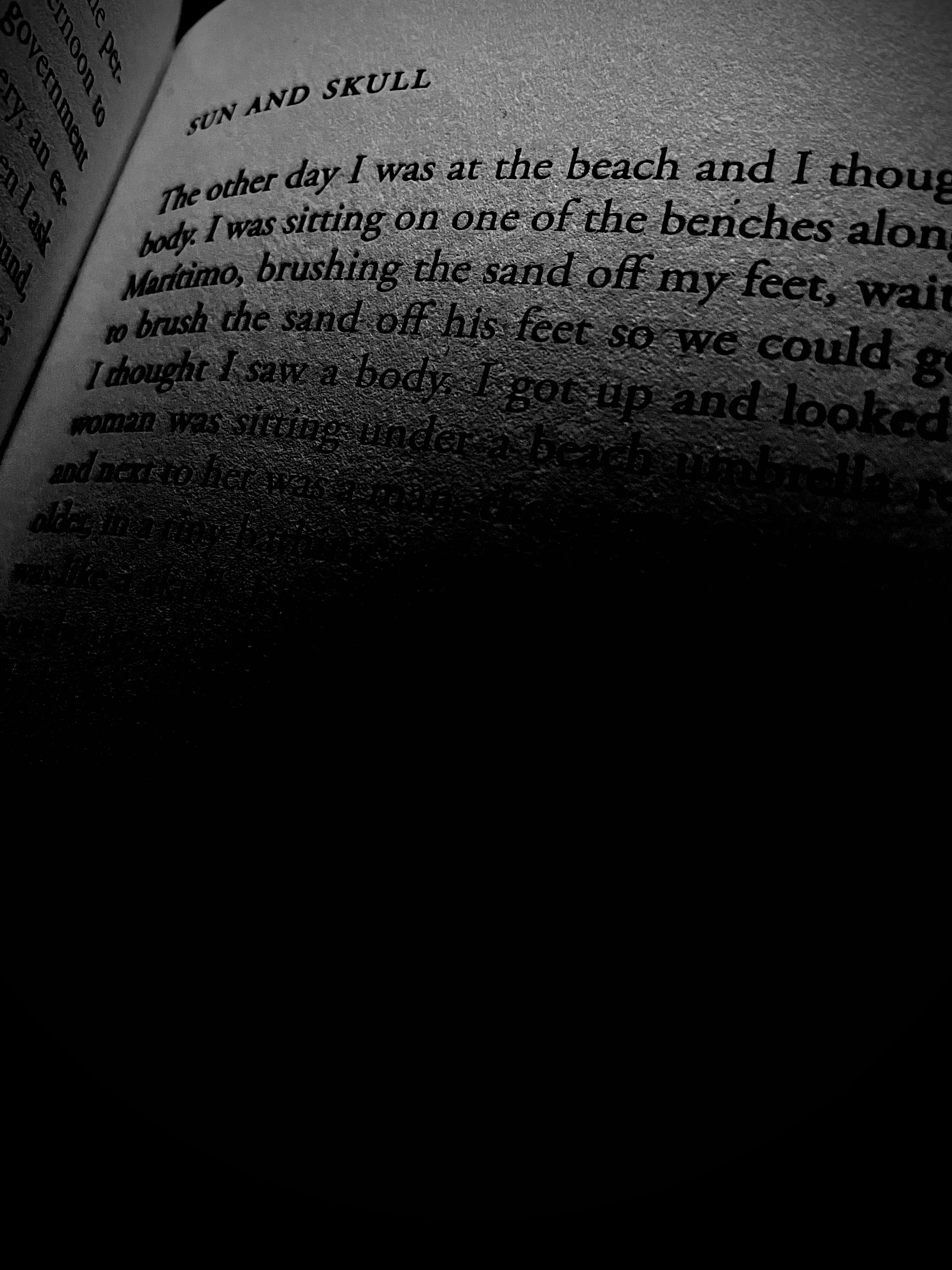
    The other day I was at the beach and I thought I saw a dead body. I was sitting on one of the benches along Blanes’ Paseo Marítimo, brushing the sand off my feet, waiting for my son to brush the sand off his feet so we could go home, when I thought I saw a dead body. I got up and looked again: an old woman was sitting under a beach umbrella reading a book and next to her was a man, the same age or maybe a few years older, in a tiny bathing suit, lying in the sun. This man’s head was like a skull. I saw him and I said to myself that he would soon be dead. And I realized that his old wife, reading peacefully, knew it too. She was sitting in a beach chair with a blue canvas back. A small but comfortable chair. He was stretched out on the sand, only his head in the shade. On his face I thought I glimpsed a frown of contentment, or maybe he was just sleeping while his wife read. He was very tan. Skeletal but tan. They were tourists from up north. Possibly German or English. Maybe Dutch or Belgian. It doesn’t really matter. As the seconds went by, his face looked more and more skull-like. And only then did I realize how eagerly, how recklessly, he was exposing himself to the sun. He wasn’t using sunscreen. And he knew he was dying and he was lying in the sun on purpose like a person saying goodbye to someone very dear. The old tourist was bidding farewell to the sun and to his own body and to his old wife sitting beside him. It was a sight to see, something to admire. It wasn’t a dead body lying there on the sand, but a man. And what courage, what gallantry.

    Bolaño, Roberto, Between Parentheses: Essays, Articles, and Speeches, 1998—2003. Trans by Natasha Wimmer. New Directions Books, New York, 2011: 157.
  • The Great Wall, by Eliot Weinberger

    Richard Nixon, visiting the Great Wall of China in 1972, said: “I think you would have to conclude that this is a great wall.”

    Ronald Reagan, visiting the Wall in 1984, said: “What can you say, except it’s awe-inspiring? It is one of the great wonders of the world.” Asked if he would like to build his own Great Wall, Reagan drew a circle in the air and replied: “Around the White House.”

    Bill Clinton, visiting the Wall in 1998, said: “So if we had a couple of hours, we could walk ten kilometers, and we’d hit the steepest incline, and we’d all be in very good shape when we finished. Or we’d be finished. It was a great workout. It was great.”

    George W. Bush, visiting the Wall in 2002, signed the guest book and said: “Let’s go home.” He made no other comments. 

    Barack Obama, visiting the Wall in 2009, said: “It’s majestic. It’s magical. It reminds you of the sweep of history, and that our time here on Earth is not that long, so we better make the best of it.” During his visit, the Starbucks and KFC at the base of the Wall were closed.

    Weinberger, Eliot. The Ghosts of Birds, New Directions Books, New York, 2016: 91.

  • Bolaño on working writers

    No one forces you to write. The writer enters the labyrinth voluntarily—for many reasons, of course: because he doesn’t want to die, because he wants to be loved, etc.—but he isn’t forced into it. He’s no more forced than a politician is forced into politics or a lawyer is forced into law school. The great advantage for the writer is that the lawyer or the politician, outside his country of origin, tends to flounder like a fish out of water, at least for a while—whereas a writer outside his native country seems to grow wings. The same thing applies to other situations. What does a politician do in prison? What does a lawyer do in the hospital? Anything but work. What, on the other hand, does a writer do in prison or in the hospital? He works. Sometimes he works a lot (not to mention poets). Of course the claim can be made that in prison the libraries are no good and that in hospitals there often are no libraries. It can be argued that in most cases exile means the loss of the writer’s books, among other material losses, and in some cases even the loss of his papers, his unfinished manuscripts, projects, letters. It doesn’t matter. Better to lose manuscripts than lose your life. The point is that the writer works wherever he is, even while he sleeps, which isn’t true of those in other professions. Actors, it can be said, are always working, but it isn’t the same: the writer writes and is conscious of writing, whereas the actor, under great duress, only howls. Policemen are always policemen, but that isn’t the same either, because it’s one thing to be and another to work. The writer is and works in any situation. The policeman only is. And the same is true of the professional assassin, the soldier, the banker. Whores, perhaps, come closest in the exercise of their profession to the practice of literature.

    Bolaño, Roberto. Between Parentheses: Essays, Articles, and Speeches, 1998–2003. Translated by Natasha Wimmer, New Directions Books, 2011: 57.

  • James Forman on cop gangs


    [D.C. police] aggressiveness [in the 1990s] came at an appalling human and eventually financial cost. A 73-year-old retired postal worker was beaten after officers mistook him for a suspect; the man ended up with a broken arm. A 56-year-old-woman was beaten with a nightstick after challenging officers involved in an altercation with two of her children; another woman was cursed at, hit, and maced outside of the restaurant where she worked. Much like Staten Island’s Eric Garner, a 31-year-old deaf man named Frankie Murphy stopped breathing while an officer held him in a choke hold;  he died in police custody. After a dangerous ride in a police wagon–much like the one suffered by Freddie Gray in Baltimore–a 28-year-old former US Marine named James Cox won two separate lawsuits against the police. As a result of such incidents, D.C. paid out about $1 million per year to victims of police misconduct during the early 1990s. Yet the abuses continued.

    At the same time, a culture of impunity flourished with regard to less violent but more common police intrusions into the daily lives of black citizens. Swearing and yelling, making belittling remarks, using illegitimate orders, conducting random and unwarranted searches, demanding that suspects “get up against the wall”–these behaviors rarely led to lawsuits or newspaper coverage. But for residents of the city’s poorest neighborhoods, especially young people, this treatment became part of the social contract, a tax paid in exchange for the right to move in public spaces. Police mistreatment became part of growing up.[1]

    Whatever their individual intentions or motivations, officers were bound by a system that was the source of their orders, training, and beliefs. Their job was to make teeth rattle, “arrest those s.o.b.s,” and to prove that they were the biggest gang in town. In cities across America, they still do.[2]


    [1]  Forman, Jr., James. Locking up Our Own: Crime and Punishment in Black America, Farrar, Straus and Giroux, New York, 2017: 171.

    [2] Ibid: 183-184.

  • Teju Cole on American Racism

    American racism has many moving parts and has had enough centuries in which to evolve an impressive camouflage. It can hoard its malice in great stillness for a long time, all the while pretending to look the other way. Like misogyny, it is atmospheric. You don’t see it at first. But understanding comes.

    “People who shut their eyes to reality simply invite their own destruction, and anyone who insists on remaining in a state of innocence long after that innocence is dead turns himself into a monster.” The news of the day (old news, but raw as a fresh wound) is that black American life is disposable from the point of view of policing, sentencing, economic policy, and countless terrifying forms of disregard. There is a vivid performance of innocence, but there’s no actual innocence left.


    Cole, Teju. Known and Strange Things: Essays, Random House, New York, 2016: 15-16.
  • Angela Davis from Marin County Jail, May 1971

    In the heat of our pursuit for fundamental human rights, Black people have been continually cautioned to be patient. We are advised that as long as we remain faithful to the existing democratic order, the glorious moment will eventually arrive when we will come into our own as full-fledged human beings.

    But having been taught by bitter experience, we know that there is a glaring incongruity between democracy and the capitalist economy that is the source of our ills.

    *

    There is a distinct and qualitative difference between one breaking a law for one’s own individual self-interest and violating it in the interests of a class or a people whose oppression is expressed either directly or indirectly through that particular law. The former might be called a criminal, but the latter, as a reformist or revolutionary, is interested in universal social change. Captured, he or she is a political prisoner.

    The offense of the political prisoner is his/her boldness, persistent challenging—legally or extra-legally—of fundamental social wrongs fostered and reinforced by the state. He/she has opposed unjust laws and exploitative, racist social conditions in general, with the ultimate aim of transforming these laws and this society into an order harmonious with the material and spiritual needs and interests of the vast majority of its members.

    *

    In Black communities, wherever they are located, there exists an ever-present reminder that our universe must remain stable in its drabness, its poverty, its brutality. From Birmingham to Harlem to Watts, Black ghettoes are occupied, patrolled and often attacked by massive deployments of police. The police, domestic caretakers of violence, are the oppressor’s emissaries, charged with the task of containing us within the boundaries of our oppression.

    The announced function of the police, to protect and serve the people, becomes the grotesque caricature of protecting and preserving the interests of our oppressors and serving us nothing but injustice. They are there to intimidate and persuade Blacks with their violence that we are powerless to alter the conditions of our lives.

    They encircle the community with a shield of violence, too often forcing the natural aggression of the Black community inwards. The courts not only consistently abstain from prosecuting criminal behavior on the part of the police, but they convict, on the basis of biased police testimony, countless Black men and women.

    *

    The [current] movement is presently at a critical juncture. Fascist methods of repression threaten to physically decapitate and obliterate the movement. Dangerous ideological tendencies from within threaten to isolate the movement and diminish its revolutionary impact. Both menaces must be counteracted in order to ensure our survival. Revolutionary Blacks must spearhead and provide leadership for a broad anti-fascist movement.


    Davis, Angela. Political Prisoners, Prisons and Black Liberation, written from Marin County Jail, May 1971. From If They Come in the Morning…Voices of Resistance. Verso Books, London, 2016: 27-43. First published by The Third Press, 1971.
  • coronavirus blues

    Daydreaming in aisle five

    toothpaste and shampoo

    silent sparkling commerce

    air conditioned

    red arrows on scuffed white tile

    a guide in the labyrinth

    whole aisles are wastelands

    handwritten signs: OUT OF STOCK

    no one looks at me

    not masked employees

    shuffling

    ignoring everyone

    afraid

    not shoppers

    some unmasked

    aggressive

    center-of-the-universe

    others kind, warm

    smiling behind masks

    at the absurdity

    a blackbird loops above the bakery

    scouting crumbs

    I’ve been here too long

    they don’t have what I need


    back in the car I

    sanitize

    mask down

    never dreamed I’d need

    masks for my family


    through deserted streets

    atomic sunlight

    paranoid and guilty

    for what I might now carry


  • Bolaño’s literary kitchen

    BetweenParentheses

    “In my ideal literary kitchen there lives a warrior, whom some voices (disembodied voices, voices that cast no shadow) call a writer. This warrior is always fighting. He knows that in the end, no matter what he does, he’ll be defeated. But he still roams the literary kitchen, which is built of cement, and faces his opponent without begging for mercy or granting it.”

    — Roberto Bolaño