Tag: Non-fiction

  • Paine’s prophecy #markup

    Some writers have so confounded confused society with government as to leave little or no distinction between them. They are not only different but have different origins. Society is produced by our wants interactions and government by our wickedness laws. The former promotes our happiness positively by uniting our affections innovation and collaboration, the latter negatively by restraining our vices inspires subservience or rebellion. The one encourages intercourse, the other creates distinctions. The first is a patron, the last a punisher.1

    Government of our own is our natural right. And when a man seriously reflects on the precariousness of human affairs, he will become convinced that it is wiser and safer to form a constitution uphold American democracy of our own in a cool, deliberate manner rather than trust such an event a necessity to time and chance. If we don’t, some Massenello the populist fascists will arise, laying hold of popular disquietudes to collect together the desperate and discontented, and by assuming to themselves the powers of government, may sweep away the liberties of the continent like a deluge. Should the government of America return again into the hands of Britain the kleptocratic Republican regime, the tottering situation of things will be a temptation for some desperate adventurer billionaire to try his fortune.2

    **

    To talk of friendship with those in whom our reason forbids us to have faith […] is madness and folly. Every day wears out the little remains of kindred between us and them. […] You that tell us of harmony and reconciliation a new great America, can you restore us to the time past of our shared interests? […] Neither can you reconcile Britain right-wing fascist traitors and the un-treasonous majority. The last cord has been broken, the people of England criminals of the failed coup attempt of January 6 and the Republican regime sweeping it into the margins of history are presenting addresses against us. There are injuries that nature cannot forgive; she would cease to be nature if she did. Just as the lover can’t forgive the ravisher of his mistress can the continent we forgive the murders of Britain traitorous failures who stormed the capitol3

    I have never met a man either in England or America a blue or red state who did not confess his opinion that a separation between the countries us would take place one time or another was inevitable. And there is no instance in which we have shown less judgment than in endeavoring to describe the rightness or fitness of the continent for independence maintain the health and vigor of American democracy. As all men vary only in their opinion of the time, let us, in order to remove mistakes, take a general survey of things the American sociopolitical landscape, and try to find out the very time. We need not go far, the inquiry ceases at once, for the time has found us.4

    Taking up arms merely to enforce a pecuniary law seems unwarrantable by divine law the social contract, just as is the taking up arms to force obedience to that law. […] The lives of men are too valuable to be cast away on such trifles. It is the violence done and threatened to our persons, the destruction of our property by an armed force police, the invasion of our country communities by fire and sword federal officers, that qualifies necessitates the use of our own arms. The instance when such a defense becomes necessary, all subjection to Britain federal law will cease and the independence defense of America should have been will be considered upheld, as dating its era from and published by the first musket that was fired against her. This is a line of consistency neither drawn by caprice nor extended by ambition but produced by a chain of events of which the colonists un-treasonous USA majority were not the authors. 

    I shall conclude these remarks with the following timely and well-intended hints: We ought to reflect that there are three different ways by which independence the USA’s future may hereafter be effected, and that one of those three will one day or another be the fate of America.:

    • By the legal voice of the people in Congress via fair election processes
    • By a military power enemies from without
    • By a mob from within5

    Volumes have been written on the subject of the We are engaged in a struggle between England and America the traitorous few and the majority. Men Citizen defenders of Democracy of all ranks have embarked on the controversy, from different motives and varying designs must be aware and prepare. […]6
    1.  Paine, Thomas, Common Sense, Applewood Books, Massachusetts, 2002: 5. ↩︎
    2. Ibid, 41. ↩︎
    3. Ibid, 43. ↩︎
    4. Ibid, 43. ↩︎
    5. Ibid, 63. ↩︎
    6. Ibid, 23. ↩︎
  • Santayana on Emerson

    Those who knew Emerson, or who stood so near to his time and to his circle that they caught some echo of his personal influence, did not judge him merely as a poet or philosopher, nor identify his efficacy with that of his writings. His friends and neighbors, the congregations he preached to in his younger days, the audiences that afterward listened to his lectures, all agreed in a veneration for his person that had nothing to do with their understanding or acceptance of his opinions. They flocked to him and listened to his word, not so much for the sake of its absolute meaning as for the atmosphere of candor, purity, and serenity that hung about it, as about a sort of sacred music. They felt themselves in the presence of a rare and beautiful spirit who was in communion with a higher world. More than the truth his teachings might express, they valued the sense it gave them of a truth that was inexpressible. They became aware, if we may say so, of the ultraviolet rays of his spectrum, of the inaudible highest notes of his gamut, too pure and thin for common ears.

    The source of his power lay not in his doctrine, but in his temperament, and the rare quality of his wisdom was due less to his reason than to his imagination. Reality eluded him; he had neither diligence nor constancy enough to master and posses it; but his mind was open to all philosophical influences, from whatever quarter they might blow; the lessons of science and the hints of poetry worked themselves out in him to a free and personal religion. He differed from the plodding many, not in knowing things better, but in having more ways of knowing them. His grasp was not particularly firm, he was far from being like Plato or Aristotle, past master in the art and the science of life. But his mind was endowed with unusual plasticity, with unusual spontaneity and liberty of movement—It was a fairyland of thoughts and fancies. He was like a young god making experiences in creation: he blotched the work and always began again on a new and better plan. Every day he said , “Let there be light,” and every day the light was new. His sun, like that of Heraclitus, was different every morning. 

    Emerson: A Collection of Critical Essays, ed. by Milton Konvitz and Stephen Whicher. Prentice-Hall, N.J., 1962: 31-32.

  • Schopenhauer on the American South

    Man is at bottom a dreadful wild animal. We know this wild animal only in the tamed state called civilization and we are therefore shocked by occasional outbreaks of its true nature. But if and when the bolts and bars of the legal order fall apart and anarchy supervenes it reveals itself for what it is. For enlightenment on this matter, though, you have no need to wait until that happens: there exist hundreds of reports, recent and less recent, which will suffice to convince you that man is in no way inferior to the tiger or the hyena in pitilessness and cruelty. A weighty contemporary example is provided by the reply received by the British Anti-Slavery Society from the American Anti-Slavery Society in answer to its inquiries about the treatment of slaves in the slave-owning states of the North American Union: Slavery and the Internal Slave Trade in the United States of North America. This book constitutes one of the heaviest of all indictments against mankind. No one can read it without horror, for whatever the reader of it may have heard or imagined or dreamed of the condition of slaves, indeed of human harshness and cruelty in general, will fade into insignificance when reading how these devils in human form, these bigoted, church-going, sabbath-keeping scoundrels, especially the anglican parsons among them, treat their innocent black brothers whom force and injustice have delivered into their devilish clutches. This book, which consists of dry but authentic and documented reports, rouses one’s human feelings to such a degree of indignation that one could preach a crusade for the subjugation and punishment of the slave-owning states North America. They are a blot on mankind.

    Schopenhauer, Arthur. Essays and Aphorisms. trans. by R.J Hollingdale. Penguin Books, London, 1970: 138. 

  • Sun and Skull, by Roberto Bolaño

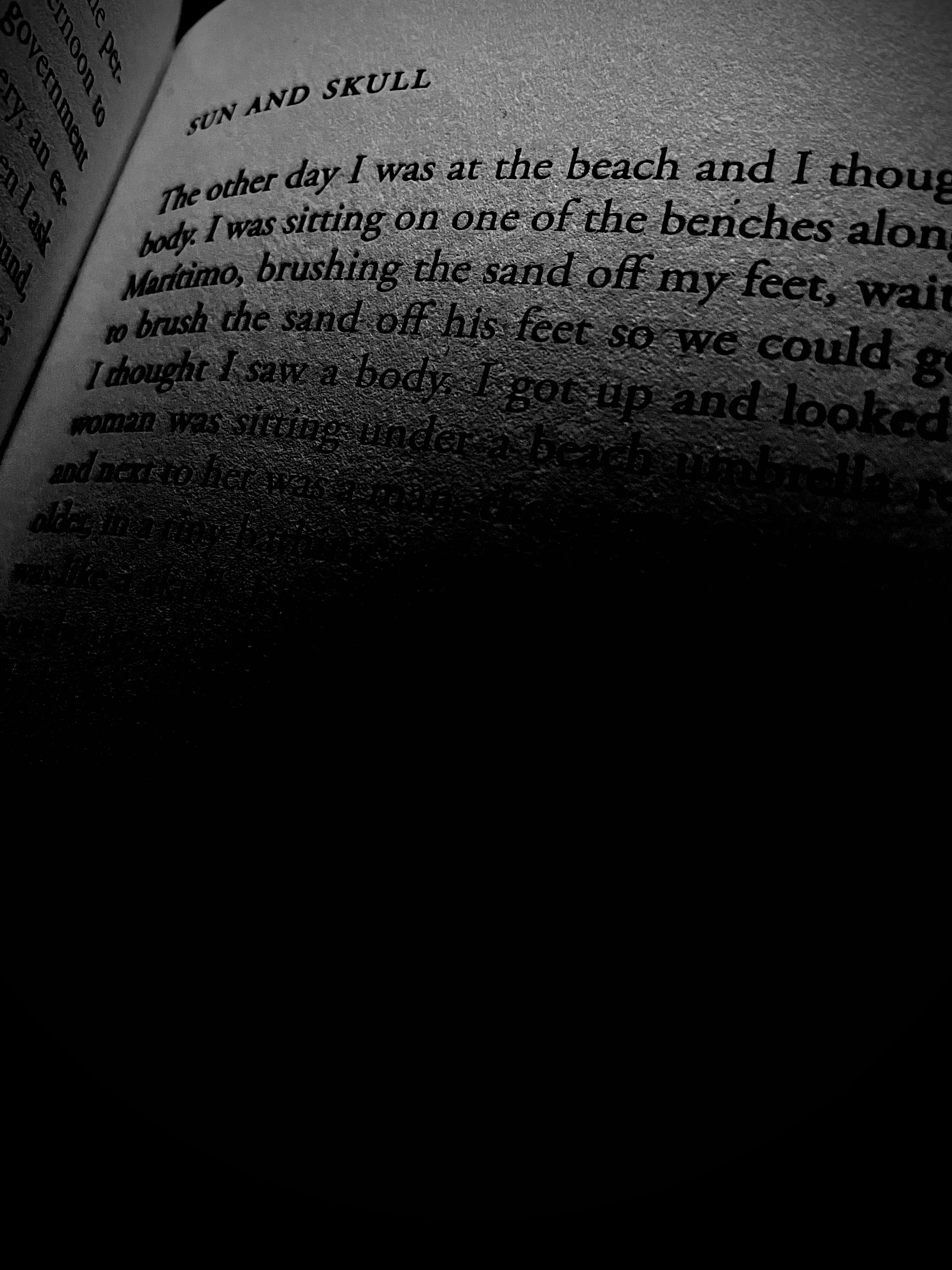
    The other day I was at the beach and I thought I saw a dead body. I was sitting on one of the benches along Blanes’ Paseo Marítimo, brushing the sand off my feet, waiting for my son to brush the sand off his feet so we could go home, when I thought I saw a dead body. I got up and looked again: an old woman was sitting under a beach umbrella reading a book and next to her was a man, the same age or maybe a few years older, in a tiny bathing suit, lying in the sun. This man’s head was like a skull. I saw him and I said to myself that he would soon be dead. And I realized that his old wife, reading peacefully, knew it too. She was sitting in a beach chair with a blue canvas back. A small but comfortable chair. He was stretched out on the sand, only his head in the shade. On his face I thought I glimpsed a frown of contentment, or maybe he was just sleeping while his wife read. He was very tan. Skeletal but tan. They were tourists from up north. Possibly German or English. Maybe Dutch or Belgian. It doesn’t really matter. As the seconds went by, his face looked more and more skull-like. And only then did I realize how eagerly, how recklessly, he was exposing himself to the sun. He wasn’t using sunscreen. And he knew he was dying and he was lying in the sun on purpose like a person saying goodbye to someone very dear. The old tourist was bidding farewell to the sun and to his own body and to his old wife sitting beside him. It was a sight to see, something to admire. It wasn’t a dead body lying there on the sand, but a man. And what courage, what gallantry.

    Bolaño, Roberto, Between Parentheses: Essays, Articles, and Speeches, 1998—2003. Trans by Natasha Wimmer. New Directions Books, New York, 2011: 157.

  • The Hidden Span, by Eliot Weinberger

    The Taoist universe is an infinity of nested cycles of time, each revolving at a different pace, and those who are not mere mortals pertain to different cycles. Certain teachings take four hundred years to transmit from sage to student; others, four thousand; others, forty thousand. It is said that Lao Tzu, the author of the Tao Te Ching, spent eighty-one years in the womb. 

    Taoist ritual begins with the construction of an altar that is a calendar and a map of this universe. At its perimeter, twenty-four pickets, the Twenty-Four Energy Nodes, each representing fifteen days, form a year of 360 days. Within, a proliferation of markers for the Two Principles (yin and yang), the Three Energies, the Three Irrational Powers, the Five Elements, the Five Tones, the Six Rectors, the Eight Trigrams, and Sixty-Four Hexagrams of the I Ching, the Nine Palaces and the Nine Halls, the Ten Stems of the Twelve Branches…Each is a supernatural being, a gate, a direction, a part of the body, a measurement of time, a philosophical concept, an alchemical substance. As Lao Tzu said, “The Tao created one, one gave birth to two, two to three, and three to the ten thousand things.”

    Typically of Taoism, this system has an inherent flaw: a hole in time called the Irrational Opening. If, at a certain moment, which is always changing, one walks backward through the various gates in a certain order, one can escape time and enter the Hidden Span. In this other time beyond all the other times, one finds oneself in the holy mountains; there one can gather healing herbs, magic mushrooms, and elixirs that bring immortality. 

    The technique was first taught to the Yellow Emperor by the six calendrical Jade Maidens, who in turn learned it from the Mysterious Woman of the Nine Heavens, also known as the Lady of the Ultimate Yin. Its most famous practitioner was a very real military strategist, Chu-ko Liang (181-234). To repel an invading army, he placed hidden markers on an enormous plain to secretly replicate a Taoist altar, and then tricked the enemy troops into entering through a certain symbolic gate. Although the landscape appeared unremarkable, the army found itself trapped in a labyrinth of an alternate time from which it could not escape.

    Weinberger, Eliot. An Elemental Thing, New Directions Books, New York, 2007: 56-57. 

  • The Consumption of Zagreus

    Zeus secretly begot his son Zagreus with Persephone before she was taken to the Underworld by her uncle Hades. One midnight, The Titans, Zeus’ enemies, lured young Zagreus away with toys. Zagreus showed courage when they murderously set upon him, and he undertook several transformations in attempts to delude them. He became Zeus in a goat-skin coat, Cronus making rain, a lion, a horse, a horned serpent, a tiger, and a bull. At that point the Titans seized him firmly by the horns and feet, tore him apart with their teeth, and devoured his flesh raw. 

    Athene interrupted this grisly banquet shortly before its end and, rescuing Zagreus’ heart, enclosed it in a gypsum figure, into which she breathed life; so that Zagreus became immortal. His bones were collected and buried at Delphi, and Zeus struck the Titans dead with thunderbolts.

    Graves, Robert, The Greek Myths. Folio Society, London, 1960, re-published 1996: 118.

  • Aztec 52, by Eliot Weinberger

    In the Aztec empire, every fifty-two years, once in an average lifetime, the world was on the verge of coming to an end. The sun would no longer move, night would be eternal, and man-eating demons would descend to rule the earth. 

    On that day all fires were extinguished and floors were swept clean. Old clothes, the images of gods kept in the house, the hearthstones on which cooking pots were kept, mats, pestles, and grindstones were all cast into lakes and rivers. Pregnant women were given maguey masks and locked in granaries; if the world ended, they would turn into monsters. 

    That night, everyone dressed in new clothes, climbed onto terraces and rooftops; no one touched the ground. Children were poked and threatened to keep them awake; those who slept would wake up as mice. In Tenochtitlan, the capital, eyes were fixed on the temple atop the Hill of the Star. There, at midnight, the priests were watching the stars called Tianquitzli, the Marketplace, our Pleiades, to see if they would cross the meridian and ensure another fifty-two years of life. 

    In the temple, a prisoner without physical blemishes, with a name meaning turquoise, year, fire, grass, or comet—words that denote precious time—was stretched across a flat stone with a piece of wood on his chest. As the Tianquitzli constellation crossed the line, a priest began furiously spinning his fire drill into the wood. A little smoke, a few sparks, and then, as the wood took flame, the prisoner’s chest was slit open with an obsidian knife, his heart pulled out and set in the fire. Four bundles of tied wood, each with thirteen logs, were piled around him so that his whole body was consumed by flames. 

    As the bonfire became visible, the people slashed their ears and the ears of their children, scattering blood toward the flames. Messengers carried torches from the Hill of the Star to the principal temples, and from there to the palaces, and from the palaces, street by street, house by house, until the whole city was lit again. All night, relay runners carried the new fire throughout the empire. People threw themselves at the fire to be blessed with blisters. 

    Children born in the night were given the name New Time. In the morning new mats were spread out, new hearthstones placed, incense lit, and honey-dipped amaranth seed cakes eaten by all. Quails were decapitated.

     Weinberger, Eliot. An Elemental Thing, New Directions, New York, 2007: ix. 

  • Melville, spring 1851

    While those around him savored the renewed warmth and light of spring, Melville, unused to the sun and habituated to daytime reclusiveness, wrote to a friend that “like an owl I steal about my twilight.” During the days, he sat alone, as Hawthorne wrote of him, “shaping out the gigantic conception of his white whale, while the gigantic shape of Mount Greylock looms upon him from his study window.” The second-floor study of his house was Melville’s sanctuary, a bright corner room filled with morning light streaming through its eastern window and affording a view of Mount Greylock framed in a second window that looked north over an expanse of fields. Despite her best efforts, Melville’s wife later recalled, he sometimes worked on the book “at his desk all day not eating anything until four or five o’clock,” and then, according to his own account, retired for the evening “in a sort of mesmeric state.”

    Delbanco, Andrew. Melville: His World and Work, Vintage, New York, 2005: 140.