Tag: Books

  • Schopenhauer on the American South

    Man is at bottom a dreadful wild animal. We know this wild animal only in the tamed state called civilization and we are therefore shocked by occasional outbreaks of its true nature. But if and when the bolts and bars of the legal order fall apart and anarchy supervenes it reveals itself for what it is. For enlightenment on this matter, though, you have no need to wait until that happens: there exist hundreds of reports, recent and less recent, which will suffice to convince you that man is in no way inferior to the tiger or the hyena in pitilessness and cruelty. A weighty contemporary example is provided by the reply received by the British Anti-Slavery Society from the American Anti-Slavery Society in answer to its inquiries about the treatment of slaves in the slave-owning states of the North American Union: Slavery and the Internal Slave Trade in the United States of North America. This book constitutes one of the heaviest of all indictments against mankind. No one can read it without horror, for whatever the reader of it may have heard or imagined or dreamed of the condition of slaves, indeed of human harshness and cruelty in general, will fade into insignificance when reading how these devils in human form, these bigoted, church-going, sabbath-keeping scoundrels, especially the anglican parsons among them, treat their innocent black brothers whom force and injustice have delivered into their devilish clutches. This book, which consists of dry but authentic and documented reports, rouses one’s human feelings to such a degree of indignation that one could preach a crusade for the subjugation and punishment of the slave-owning states North America. They are a blot on mankind.

    Schopenhauer, Arthur. Essays and Aphorisms. trans. by R.J Hollingdale. Penguin Books, London, 1970: 138. 

  • Glitch

    High shutter rate—a hundred replicas captured instantly. A hundred and one replicas. How many photos have you taken in your life? asked a voice. I couldn’t fathom. Even a non-photographer snaps a million photos. What would be more impressive is how many words I’ve read. * I woke on the floor in a janitor’s closet. I didn’t remember going into the closet or even the building. My artificial hip hurt from laying there. I had no idea what day or time it was. The place smelled of mop solution. I stood and pissed into the mop bucket. The door was heavy and I slipped out to the hallway beyond, shrinking from the fluorescent light. A school? White tile, cool air conditioning, darkness at the door windows down the hall. My camera smelled like disinfectant. It could be a dream, I thought. My reflection in the door windows defined and absolute as I approached. Total dark beyond. Heat and humidity outside like steam. I texted my desk editor and looked for my vehicle. 

  • Schopenhauer’s research

    Man is at bottom a dreadful wild animal. We know this wild animal only in the tamed state called civilization and we are therefore shocked by occasional outbreaks of its true nature. But if and when the bolts and bars of the legal order fall apart and anarchy supervenes it reveals itself for what it is. For enlightenment on this matter, though, you have no need to wait until that happens: there exist hundreds of reports, recent and less recent, which will suffice to convince you that man is in no way inferior to the tiger or the hyena in pitilessness and cruelty. A weighty contemporary example is provided by the reply received by the British Anti-Slavery Society from the American Anti-Slavery Society in answer to its inquiries about the treatment of slaves in the slave-owning states of the North American Union: Slavery and the Internal Slave Trade in the United States of North America. This book constitutes one of the heaviest of all indictments against mankind. No one can read it without horror, for whatever the reader of it may have heard or imagined or dreamed of the condition of slaves, indeed of human harshness and cruelty in general, will fade into insignificance when reading how these devils in human form, these bigoted, church-going, sabbath-keeping scoundrels, especially the anglican parsons among them, treat their innocent black brothers whom force and injustice have delivered into their devilish clutches. This book, which consists of dry but authentic and documented reports, rouses one’s human feelings to such a degree of indignation that one could preach a crusade for the subjugation and punishment of the slave-owning states North America. They are a blot on mankind.

     Schopenhauer, Arthur, trans. by R.J Hollingdale, Essays and Aphorisms, Penguin Books, London, 1970: 138. 
  • Harry recovers

    Harry lay in the hospital for two days waiting for his brother the attorney to visit. A young woman arrived instead, unannounced in the afternoon, rushed and terse. 

    My brother sent a lackey, Harry said. 

    Your brother is very busy and it’s Sunday, she said. I’m Elizabeth. 

    I remember you, Harry said. He invited me to your wedding a few years ago. I couldn’t make it. 

    Couldn’t or didn’t want to?

    Didn’t want to. 

    She reached into her shoulder bag and ruffled papers, extracting one. 

    This is from your brother, she said.

    Elizabeth read: The Premier Grande Hotel in New York City is in the process of filing a lawsuit against you for extensive damages to the property. They knew to notify me from your previous outburst there. I am currently trying to negotiate with them on your behalf. 

    My behalf!

    Elizabeth read: The hotel states that you will no longer be welcome on its property. Two destructive incidents in the last two years have forced them into this position. 

    Fuck them! [cough]

    Elizabeth read: To quote the hotel’s general manager, “For the safety of our guests and our staff, Mr. Gannett is no longer allowed on or near hotel grounds.”

    Harry shifted his weight on the hospital bed and winced. 

    Elizabeth read: I am concerned for you, Harry. I’ve done everything I can for you up to this point. It’s time for you to pull yourself together and get the help you need. 

    Harry looked up at the ceiling. Checkered panels, air vents, fluorescent light tubes. Uninspiring and disgusting, all of it, he thought.

    Elizabeth tucked the paper neatly into her bag and sighed, looking at Harry.

    Your brother wants to know if you need anything, she said.

    My brother wants to bury me, he said.

    That’s not true. 

    We want to bury each other. It’s a race to the shovel.

    Stop it, Harry. 

    Listen to me, dummy, he said. 

    How dare you. 

    I’ve known you just a few minutes and I already hate you.

    Your brother wants you to call him. 

    Tell him to come make me. 

    Grow up, Harry. 

    I bet you’re already divorced.

    What?

    Thanks for stopping by, Amanda.

    Fuck you, Harry. 

    Pardon me, said a nurse. 

    Elizabeth turned toward the doorway and looked at the nurse. 

    Please don’t speak like that to the patient, said the nurse. 

    Elizabeth stammered and reddened. 

    Are you related to this patient, ma’am? asked the nurse. 

    I’m out of here, Elizabeth said, and walked past the nurse out the door.

    Harry smiled and coughed.

    Are you okay, young man? asked the nurse.

  • Renzi on translations

    A detective novel is always good for the first twenty pages because that is where the author presents the world in which the intrigue will develop: for example, let’s say, the Japanese laundromats in Buenos Aires. […] One wonders why it is that the Japanese population in Buenos Aires opens laundromats. After that question is answered, a crime appears, and, from that point onward, the bad novels respond to the mystery with predictable schemes. Only the best writers are able to add something extra to the construction of the intrigue, going beyond simple suspense or simple solutions to the problem. A writer who is able to write something beyond the simple plot is one who achieves a novel that is worthy of translation. 

    Piglia, Ricardo, trans. by Robert Croll. The Diaries of Emilio Renzi: The Happy Years. Restless Books, New York, 2018: 185.

  • Sun and Skull, by Roberto Bolaño

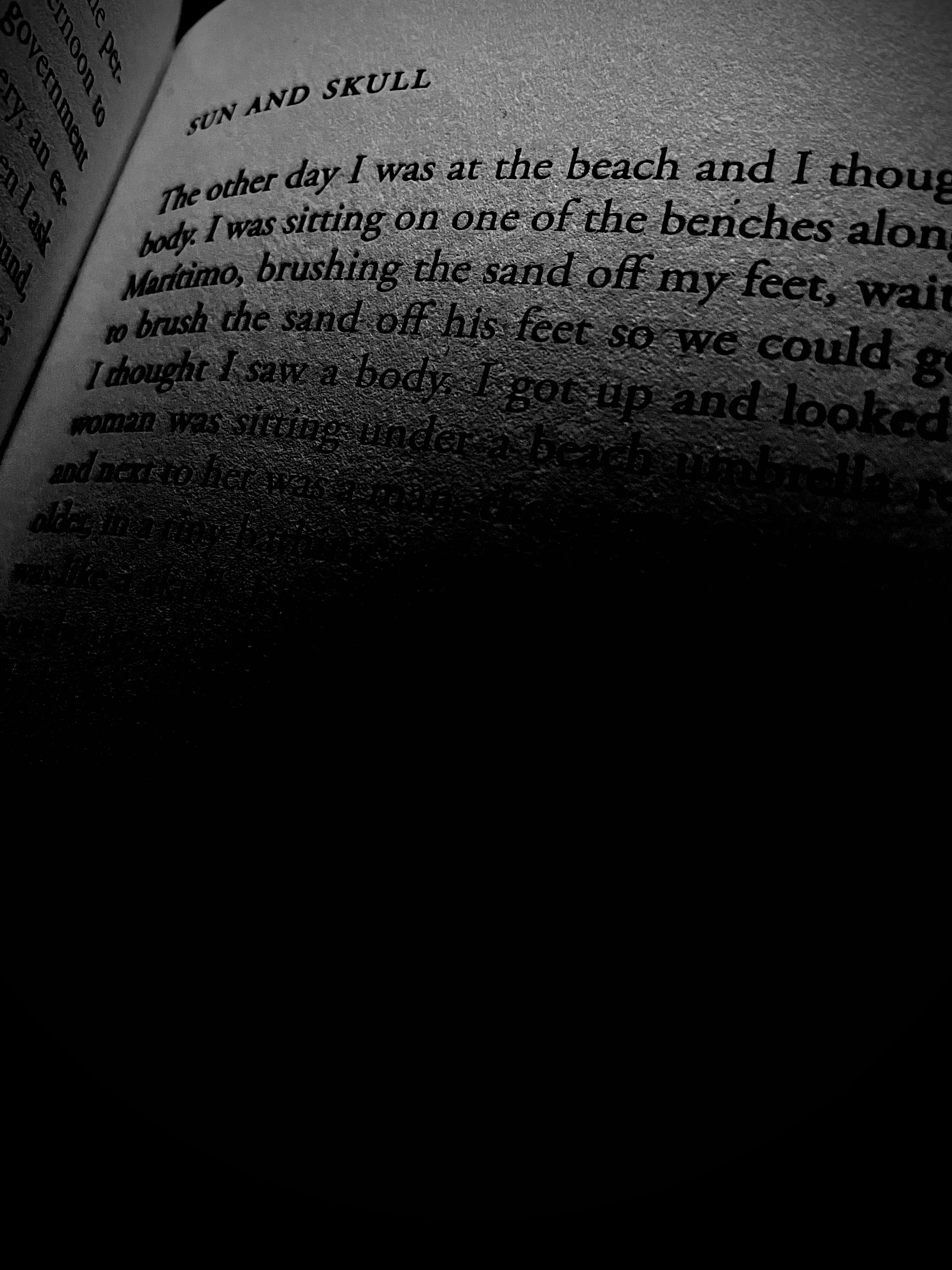
    The other day I was at the beach and I thought I saw a dead body. I was sitting on one of the benches along Blanes’ Paseo Marítimo, brushing the sand off my feet, waiting for my son to brush the sand off his feet so we could go home, when I thought I saw a dead body. I got up and looked again: an old woman was sitting under a beach umbrella reading a book and next to her was a man, the same age or maybe a few years older, in a tiny bathing suit, lying in the sun. This man’s head was like a skull. I saw him and I said to myself that he would soon be dead. And I realized that his old wife, reading peacefully, knew it too. She was sitting in a beach chair with a blue canvas back. A small but comfortable chair. He was stretched out on the sand, only his head in the shade. On his face I thought I glimpsed a frown of contentment, or maybe he was just sleeping while his wife read. He was very tan. Skeletal but tan. They were tourists from up north. Possibly German or English. Maybe Dutch or Belgian. It doesn’t really matter. As the seconds went by, his face looked more and more skull-like. And only then did I realize how eagerly, how recklessly, he was exposing himself to the sun. He wasn’t using sunscreen. And he knew he was dying and he was lying in the sun on purpose like a person saying goodbye to someone very dear. The old tourist was bidding farewell to the sun and to his own body and to his old wife sitting beside him. It was a sight to see, something to admire. It wasn’t a dead body lying there on the sand, but a man. And what courage, what gallantry.

    Bolaño, Roberto, Between Parentheses: Essays, Articles, and Speeches, 1998—2003. Trans by Natasha Wimmer. New Directions Books, New York, 2011: 157.

  • The Hidden Span, by Eliot Weinberger

    The Taoist universe is an infinity of nested cycles of time, each revolving at a different pace, and those who are not mere mortals pertain to different cycles. Certain teachings take four hundred years to transmit from sage to student; others, four thousand; others, forty thousand. It is said that Lao Tzu, the author of the Tao Te Ching, spent eighty-one years in the womb. 

    Taoist ritual begins with the construction of an altar that is a calendar and a map of this universe. At its perimeter, twenty-four pickets, the Twenty-Four Energy Nodes, each representing fifteen days, form a year of 360 days. Within, a proliferation of markers for the Two Principles (yin and yang), the Three Energies, the Three Irrational Powers, the Five Elements, the Five Tones, the Six Rectors, the Eight Trigrams, and Sixty-Four Hexagrams of the I Ching, the Nine Palaces and the Nine Halls, the Ten Stems of the Twelve Branches…Each is a supernatural being, a gate, a direction, a part of the body, a measurement of time, a philosophical concept, an alchemical substance. As Lao Tzu said, “The Tao created one, one gave birth to two, two to three, and three to the ten thousand things.”

    Typically of Taoism, this system has an inherent flaw: a hole in time called the Irrational Opening. If, at a certain moment, which is always changing, one walks backward through the various gates in a certain order, one can escape time and enter the Hidden Span. In this other time beyond all the other times, one finds oneself in the holy mountains; there one can gather healing herbs, magic mushrooms, and elixirs that bring immortality. 

    The technique was first taught to the Yellow Emperor by the six calendrical Jade Maidens, who in turn learned it from the Mysterious Woman of the Nine Heavens, also known as the Lady of the Ultimate Yin. Its most famous practitioner was a very real military strategist, Chu-ko Liang (181-234). To repel an invading army, he placed hidden markers on an enormous plain to secretly replicate a Taoist altar, and then tricked the enemy troops into entering through a certain symbolic gate. Although the landscape appeared unremarkable, the army found itself trapped in a labyrinth of an alternate time from which it could not escape.

    Weinberger, Eliot. An Elemental Thing, New Directions Books, New York, 2007: 56-57. 

  • three sevens

    Vacancy. Room 18 is still vacant. Everyone knows about it but nobody sets foot inside. I don’t think anyone can. Why don’t they tear it down? Folks come from around the world just to see the door. The town’s never been the same since that night, what, seven, eight years ago now? Still seems like last year. I remember the cameras from the news stations. Suited people from all over, moving a thousand miles an hour. I’d go get a coffee and there’d be a crew of them, hostile with one another but pleasant, like siblings who hate but love each other. They were indifferent to us locals, mobilizing to yet another place where something terrible had just happened. A routine day at the office. Make no mistake—those people are hunters, packs of wolves. At night you see their eyes glow in the distance, then a minute later they’ve surrounded you, camera lights like suns. They are tireless. And then they are gone, the sated beast shuffling away in the dark.

    Fleeing. Home he fled at age seven. He remembered the vividness of the dead person in some bushes near the busy avenue. He thought it a strange place for someone to sleep but upon closer inspection saw the man’s eyes were open and drained of life, insects all over him. He returned home frightened and changed. He didn’t know where he was running to, anyway, guided only by an internal voice that told him to leave. He withdrew from family after that, told his mother he didn’t want to see her. She laughed but acknowledged the seriousness of the situation after he locked himself in his bedroom all day and night. She went to console him or offer her apologies but his indifference shook her. The next morning she found him dead in the basement, an apparent falling accident. Toxicology results indicated he’d consumed bleach from a bottle spilled nearby. It was a terrible tragedy, by all accounts. No one dared to ask aloud why the child would do such a thing. 

    Relics. Ornamental blades lined the old man’s walls. His house was a relic and he was a relic, old and retired so long that he retired twice more. Then he retired from life. His daughter spoke at his remembrance, she herself old. My father never meant to hurt anyone, she said. He outlived everyone he knew and angered everyone else. Ha ha. But he had a good heart, he was misunderstood. The daughter looked out to the seven people assembled in the front yard of the old man’s house. She held a hand at her brow to block the morning sunlight. Her dress was handmade. Thank you all for coming, she said. Then everyone shook her hand and departed but the daughter remained, beginning the momentous task of leafing through the house’s cabinets and boxes, crates of paper, closets, bookshelves. She found a note her father wrote to her when she was a child and a pair of her dead mother’s diamond earrings. She found sandwich baggies with locks of hair, children’s teeth, personal letters, old photos. She found tucked in a kitchen drawer an oversized envelope filled with 20 thousand dollars cash.