Zeus secretly begot his son Zagreus with Persephone before she was taken to the Underworld by her uncle Hades. One midnight, The Titans, Zeus’ enemies, lured young Zagreus away with toys. Zagreus showed courage when they murderously set upon him, and he undertook several transformations in attempts to delude them. He became Zeus in a goat-skin coat, Cronus making rain, a lion, a horse, a horned serpent, a tiger, and a bull. At that point the Titans seized him firmly by the horns and feet, tore him apart with their teeth, and devoured his flesh raw.
Athene interrupted this grisly banquet shortly before its end and, rescuing Zagreus’ heart, enclosed it in a gypsum figure, into which she breathed life; so that Zagreus became immortal. His bones were collected and buried at Delphi, and Zeus struck the Titans dead with thunderbolts.
I met him in the mountains, in a small town where few people live save during the summer months. I was walking at night and I saw him, in his garden, digging. My dog crawled under the bushes, ran towards him in the dark, a short white flash in the moonlight. The man bent over, rubbed my dog’s head, went down on one knee as she offered her belly. I apologized, he said it was okay, that he loved dogs. I asked him if he was gardening at night. “Yes,” he said, “it’s the best time for it. The plants are asleep and they don’t feel as much, they suffer less when moved around, like a patient etherized. We should be wary of plants.” When he was a boy, there was a giant oak of which he had always been afraid. His grandmother hanged herself from one of its branches. Back then, he told me, it had been a healthy tree, strong and vigorous, while now, some sixty years later, its huge bulk was was ridden with parasites and rotting from the inside, so much so that he knew it would soon have to be removed, as it towered above his house and threatened to crush it if it came down. And yet he could not bring himself to fell the gargantuan thing, for it was one of the few remaining specimens of what used to be an old-growth forest that covered the land where his house and the whole town now stood, dark, foreboding and beautiful. He pointed at the tree, but in the dark I could see nothing save its massive shadow.
It was half dead, he said, rotten, yet still alive and growing. Bats nested inside its trunk and hummingbirds fed on the ruby red flowers of the parasitic plant that crowned its highest branches, the hermaphrodite Tristerix corymbosus, known locally as quintral, cutre or ñipe, which his grandmother used to cut back every year, only to see it regrow with stronger, denser blooms. “Why she killed herself I still don’t know. They never told me she had committed suicide, it was a family secret, I was young, no more than five or six at the time, but later, decades later, when my daughter was born, my nana, my nanny, the woman who raised me while my own mother went to work, told me, ‘Your grandmother,’ she said, ‘she hanged herself from that branch at night. It was awful, terrible, we could not cut her down until the police arrived, at least that is what they told us—“Don’t cut her down, leave her there”—but your father could not leave her hanging like that, he climbed the tree, higher and higher—no one understood how she had climbed so high—and removed the noose from her neck. She fell through the branches, landed with a thud. Your father started hacking away at the trunk with his axe, but his father, your granddaddy, would not let him. He said that she had loved that tree, she always had. She had seen it grow, tended and nurtured it, pruned and watered it, and fussed over every tiny detail. So it stayed there and it’s still here, though it’s going to have to come down, sooner rather than later.”
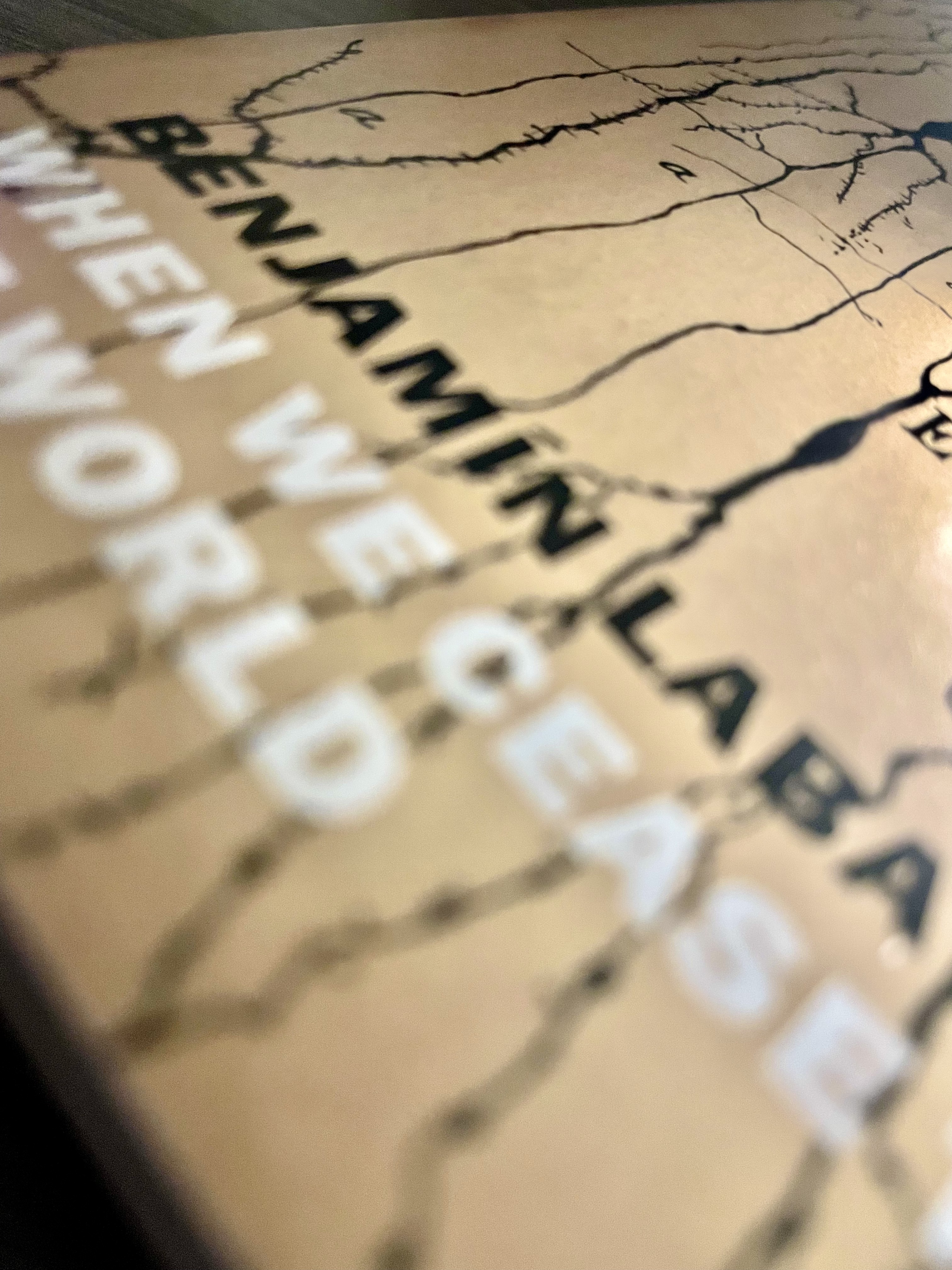
Labatut, Benjamín, from The Night Gardener, Part II, in When we Cease to Understand the World, trans. by Adrian Nathan West. The New York Review of Books, New York, 2020: 176.
In the Aztec empire, every fifty-two years, once in an average lifetime, the world was on the verge of coming to an end. The sun would no longer move, night would be eternal, and man-eating demons would descend to rule the earth.
On that day all fires were extinguished and floors were swept clean. Old clothes, the images of gods kept in the house, the hearthstones on which cooking pots were kept, mats, pestles, and grindstones were all cast into lakes and rivers. Pregnant women were given maguey masks and locked in granaries; if the world ended, they would turn into monsters.
That night, everyone dressed in new clothes, climbed onto terraces and rooftops; no one touched the ground. Children were poked and threatened to keep them awake; those who slept would wake up as mice. In Tenochtitlan, the capital, eyes were fixed on the temple atop the Hill of the Star. There, at midnight, the priests were watching the stars called Tianquitzli, the Marketplace, our Pleiades, to see if they would cross the meridian and ensure another fifty-two years of life.
In the temple, a prisoner without physical blemishes, with a name meaning turquoise, year, fire, grass, or comet—words that denote precious time—was stretched across a flat stone with a piece of wood on his chest. As the Tianquitzli constellation crossed the line, a priest began furiously spinning his fire drill into the wood. A little smoke, a few sparks, and then, as the wood took flame, the prisoner’s chest was slit open with an obsidian knife, his heart pulled out and set in the fire. Four bundles of tied wood, each with thirteen logs, were piled around him so that his whole body was consumed by flames.
As the bonfire became visible, the people slashed their ears and the ears of their children, scattering blood toward the flames. Messengers carried torches from the Hill of the Star to the principal temples, and from there to the palaces, and from the palaces, street by street, house by house, until the whole city was lit again. All night, relay runners carried the new fire throughout the empire. People threw themselves at the fire to be blessed with blisters.
Children born in the night were given the name New Time. In the morning new mats were spread out, new hearthstones placed, incense lit, and honey-dipped amaranth seed cakes eaten by all. Quails were decapitated.
Weinberger, Eliot. An Elemental Thing, New Directions, New York, 2007: ix.
After you’ve read tens of thousands of books, you can’t help but ask yourself: while I was doing that, where did my life go? You’ve gulped down the lives of others, which always lack a dimension in comparison to the world in which you exist, however amazing their tours of artistic force may be. You have seen colors of others and felt the bitterness and sweetness and potential and exasperation of other consciousnesses, to the point that they have eclipsed your own sensations and pushed them into the shadows. If only you could pass into the tactile space of beings other than you—but again and again you were only rolled between the fingertips of literature. Unceasingly, in a thousand voices, it promised you escape, while it robbed you of even the frozen crust of reality that you once had.
Cărtărescu, Mircea. SOLENOID, trans. by Seán Cotter, Deep Vellum Publishing, Dallas, 2022: 42.
Postpone everything. Never do today what you can put off until tomorrow. You don’t have to do anything today or tomorrow.
Never think about what you’re going to do. Simply don’t do it.
Live your life. Do not be lived by it. In truth and in error, in sickness and in health, be your own self. You can only achieve this by dreaming, because your real life, your human life, does not belong to you, but to others. Therefore, replace life with dreaming and take care to dream perfectly. In all your real-life actions, from the day you are born until the day you die, it is not you performing those actions; you do not live, you are merely lived.
Become an absurd sphinx in the eyes of others. Shut yourself up in your ivory tower, but without slamming the door, for your ivory tower is you.
And if anyone tells you this is false and absurd, don’t believe him. But don’t believe what I’m telling you either, because you shouldn’t believe anything.
Despise everything, but in such a way that despising feels quite normal. Do not think you’re superior when you despise others. Therein lies the noble art of despising.
Pessoa, Fernando. The Book of Disquiet, New Directions, New York, 2017: 46.
While those around him savored the renewed warmth and light of spring, Melville, unused to the sun and habituated to daytime reclusiveness, wrote to a friend that “like an owl I steal about my twilight.” During the days, he sat alone, as Hawthorne wrote of him, “shaping out the gigantic conception of his white whale, while the gigantic shape of Mount Greylock looms upon him from his study window.” The second-floor study of his house was Melville’s sanctuary, a bright corner room filled with morning light streaming through its eastern window and affording a view of Mount Greylock framed in a second window that looked north over an expanse of fields. Despite her best efforts, Melville’s wife later recalled, he sometimes worked on the book “at his desk all day not eating anything until four or five o’clock,” and then, according to his own account, retired for the evening “in a sort of mesmeric state.”
Delbanco, Andrew. Melville: His World and Work, Vintage, New York, 2005: 140.
Night is a ghost on wings. I write letters to myself and to friends who no longer exist, friends who are dead or friends with dead parents like me. I write letters from those friends to their dead parents and sometimes from the dead parents to their living children but I never send them, I keep the letters in a safe place to reread as I age. Aging is hard but not in ways my young self imagined. Aging is hard like remembering is hard, it is uncomfortable and strange, even as being in one’s body grows more familiar with time. Aging is the accrual of experience. I write letters to my future self about experience and accrual and pain. Perhaps one day I’ll read them. I write letters to my living friends and almost always send them. The letters contain recent anecdotes of irony, whimsy, severity. Perhaps someone should write me a letter, someone other than me. Write me in a language other than English. Write me a letter from my dead father, tell me about his recent bets, his meals, his whores.
On March 29,1832, 28-year-old Ralph Waldo Emerson visited the tomb of his young wife, Ellen, who had been buried a year and two months earlier. He was in the habit of walking from Boston out to her grave in Roxbury every day, but on this particular day he did more than commune with the spirit of the departed Ellen: he opened the coffin. Ellen had been young and pretty. She was 17 when they were engaged, 18 when married, and barely 20 when she died of advanced tuberculosis. They had made frantic efforts at a cure, including long open-air carriage rides and massive doses of country air. Their life together had been stained almost from the start by the bright blood of Ellen’s coughing.
Opening the coffin was not a grisly gothic gesture, not the wild aberration of an unhinged lover. What Emerson was doing was not unheard of. At least two of Emerson’s contemporaries did the same thing. […] Emerson opened not only the tomb or family vault but the coffin itself. The act was essential Emerson. He had to see for himself. Some part of him was not able to believe she was dead. He was still writing to her in his journals as though she was alive. Perhaps the very deadness of the body would help a belief in the life of the spirit. […] We do not know exactly what moved Emerson on this occasion, but we do know that he had a powerful craving for direct, personal, unmediated experience. This is what he meant when he insisted that one should strive for an original relation to the universe. Not a novel relation, just one’s own. […]
Emerson’s own journal entry from this March day was terse: “I visited Ellen’s tomb and opened the coffin.” They had been utterly in love, and for a moment, on September 30, 1829, their wedding day, the future had seemed clear. Notes and letters flew back and forth. They traveled and wrote verses together and laughed at the Shakers who tried to woo them to celibacy. She intended to be a poet, he a preacher. He had accepted a pulpit in Boston and they set up a home that became at once the center of the Emerson family, as both his mother and younger brother came to live with them. Now, a little more than a year after Ellen’s death, Emerson’s life was unraveling fast. Though he was a much-loved minister in an important Boston church, he was having trouble believing in personal immortality, trouble believing in the sacrament of communion, and trouble accepting the authority and historical accuracy of the Bible. The truth was that Emerson was in a fast-deepening crisis of vocation. He could not accept his ministerial role, he was unsure of his faith, and he felt bereft and empty. He was directionless.
At Ellen’s grave that day in Roxbury in 1832 Emerson was standing amidst the ruins of his own life. More than 10 years had passed since he left college. Love had died and his career was falling apart. He was not sure what he really believed, who he really was, or what he should be doing. […]
In the months immediately ahead he continued to walk to Ellen’s grave every day but now his concentration on death was broken and he reached a major watershed in his long struggle with religion. He would live no longer with the dead. “Let us express our astonishment,” he wrote in his journal in May, “before we are swallowed up in the yeast of the abyss.”
Before the year was out, Emerson had resigned his pulpit, moved his mother, sold his household furniture, and taken ship for Europe. He set out on Christmas Day, 1832. A northeast storm was on its way as the ship sailed from Boston, plunging into the grey expanse of the North Atlantic.
Emerson: The Mind on Fire, by Richardson, Robert D. University of California Press, Berkeley and Los Angeles, 1995: 3-5.





 truthfront