Man is at bottom a dreadful wild animal. We know this wild animal only in the tamed state called civilization and we are therefore shocked by occasional outbreaks of its true nature. But if and when the bolts and bars of the legal order fall apart and anarchy supervenes it reveals itself for what it is. For enlightenment on this matter, though, you have no need to wait until that happens: there exist hundreds of reports, recent and less recent, which will suffice to convince you that man is in no way inferior to the tiger or the hyena in pitilessness and cruelty. A weighty contemporary example is provided by the reply received by the British Anti-Slavery Society from the American Anti-Slavery Society in answer to its inquiries about the treatment of slaves in the slave-owning states of the North American Union: Slavery and the Internal Slave Trade in the United States of North America. This book constitutes one of the heaviest of all indictments against mankind. No one can read it without horror, for whatever the reader of it may have heard or imagined or dreamed of the condition of slaves, indeed of human harshness and cruelty in general, will fade into insignificance when reading how these devils in human form, these bigoted, church-going, sabbath-keeping scoundrels, especially the anglican parsons among them, treat their innocent black brothers whom force and injustice have delivered into their devilish clutches. This book, which consists of dry but authentic and documented reports, rouses one’s human feelings to such a degree of indignation that one could preach a crusade for the subjugation and punishment of the slave-owning states North America. They are a blot on mankind.
Schopenhauer, Arthur. Essays and Aphorisms. trans. by R.J Hollingdale. Penguin Books, London, 1970: 138.
Man is at bottom a dreadful wild animal. We know this wild animal only in the tamed state called civilization and we are therefore shocked by occasional outbreaks of its true nature. But if and when the bolts and bars of the legal order fall apart and anarchy supervenes it reveals itself for what it is. For enlightenment on this matter, though, you have no need to wait until that happens: there exist hundreds of reports, recent and less recent, which will suffice to convince you that man is in no way inferior to the tiger or the hyena in pitilessness and cruelty. A weighty contemporary example is provided by the reply received by the British Anti-Slavery Society from the American Anti-Slavery Society in answer to its inquiries about the treatment of slaves in the slave-owning states of the North American Union: Slavery and the Internal Slave Trade in the United States of North America. This book constitutes one of the heaviest of all indictments against mankind. No one can read it without horror, for whatever the reader of it may have heard or imagined or dreamed of the condition of slaves, indeed of human harshness and cruelty in general, will fade into insignificance when reading how these devils in human form, these bigoted, church-going, sabbath-keeping scoundrels, especially the anglican parsons among them, treat their innocent black brothers whom force and injustice have delivered into their devilish clutches. This book, which consists of dry but authentic and documented reports, rouses one’s human feelings to such a degree of indignation that one could preach a crusade for the subjugation and punishment of the slave-owning states North America. They are a blot on mankind.
Schopenhauer, Arthur, trans. by R.J Hollingdale, Essays and Aphorisms, Penguin Books, London, 1970: 138.
Harry lay in the hospital for two days waiting for his brother the attorney to visit. A young woman arrived instead, unannounced in the afternoon, rushed and terse.
My brother sent a lackey, Harry said.
Your brother is very busy and it’s Sunday, she said. I’m Elizabeth.
I remember you, Harry said. He invited me to your wedding a few years ago. I couldn’t make it.
Couldn’t or didn’t want to?
Didn’t want to.
She reached into her shoulder bag and ruffled papers, extracting one.
This is from your brother, she said.
Elizabeth read: The Premier Grande Hotel in New York City is in the process of filing a lawsuit against you for extensive damages to the property. They knew to notify me from your previous outburst there. I am currently trying to negotiate with them on your behalf.
My behalf!
Elizabeth read: The hotel states that you will no longer be welcome on its property. Two destructive incidents in the last two years have forced them into this position.
Fuck them! [cough]
Elizabeth read: To quote the hotel’s general manager, “For the safety of our guests and our staff, Mr. Gannett is no longer allowed on or near hotel grounds.”
Harry shifted his weight on the hospital bed and winced.
Elizabeth read: I am concerned for you, Harry. I’ve done everything I can for you up to this point. It’s time for you to pull yourself together and get the help you need.
Harry looked up at the ceiling. Checkered panels, air vents, fluorescent light tubes. Uninspiring and disgusting, all of it, he thought.
Elizabeth tucked the paper neatly into her bag and sighed, looking at Harry.
Your brother wants to know if you need anything, she said.
My brother wants to bury me, he said.
That’s not true.
We want to bury each other. It’s a race to the shovel.
Stop it, Harry.
Listen to me, dummy, he said.
How dare you.
I’ve known you just a few minutes and I already hate you.
Your brother wants you to call him.
Tell him to come make me.
Grow up, Harry.
I bet you’re already divorced.
What?
Thanks for stopping by, Amanda.
Fuck you, Harry.
Pardon me, said a nurse.
Elizabeth turned toward the doorway and looked at the nurse.
Please don’t speak like that to the patient, said the nurse.
Elizabeth stammered and reddened.
Are you related to this patient, ma’am? asked the nurse.
I’m out of here, Elizabeth said, and walked past the nurse out the door.
A detective novel is always good for the first twenty pages because that is where the author presents the world in which the intrigue will develop: for example, let’s say, the Japanese laundromats in Buenos Aires. […] One wonders why it is that the Japanese population in Buenos Aires opens laundromats. After that question is answered, a crime appears, and, from that point onward, the bad novels respond to the mystery with predictable schemes. Only the best writers are able to add something extra to the construction of the intrigue, going beyond simple suspense or simple solutions to the problem. A writer who is able to write something beyond the simple plot is one who achieves a novel that is worthy of translation.
Piglia, Ricardo, trans. by Robert Croll. The Diaries of Emilio Renzi: The Happy Years. Restless Books, New York, 2018: 185.
Strolling a city park at dusk amid adults waving flags. I absorb the gauntlet with the focus of their spectacle onstage behind me. I’m slapped and smacked by whipping fabric, then safely on the other side at an ornamental water fountain on a small lawn. I rinse my hands in the fountain, aware of people and birds. No interviewers with cameras ask how I was able to overcome the challenge.
Onto sidewalks soiled and grimy, down darkened alleys. Dripping pipes and huddled itinerants. Postcards still find this place. The mayor holds a candle and greets me. I’m just making the rounds, he says. I trade my iPhone for his candle, which I struggle to keep aflame as we walk. The bridge is a marvel and we cross it, gaining a retinue of locals in our aligned pursuit to conquer land and water.
Outdoor museums by moonlight on the tongues of ghosts. Traffic exhaust in our clothes. The cemeteries in this city vary widely by style. Buried dead in the east salvage no rest from the highway noise. Out west everyone’s dead and nothing can be done. Only away from here can one sleep peacefully, as with all places.
Dogs run wild at night. The people wish they were dogs. Bats dart soundlessly about tree canopies, disappearing into the moon. Somewhere the dead regain form and slither atop fallen autumn leaves toward fates unknown.
The young woman who found him in the bath would later be identified in the news as Rosalea Montero, 20, of Monterrey, Mexico. She waited one hour after check-out and knocked four times on the hotel room door, as always, each knock twenty seconds apart, before slowly entering and announcing herself. The suite was bright from window light and she wheeled her cart of supplies in to notice a chaotic mess.
It was the worst thing I’ve ever seen, she said to a reporter via translator.
Visibly distraught in the hotel lobby, trembling and hugging herself, she described room 3210 as littered with broken glass and furniture with blood on the walls and tile and blood on the hotel’s trademark white fur rugs. Instinct urged her to run before something terrible happened but instead she followed the blood trail tiptoeing into the sprawling bathroom where she found the man unmoving and unresponsive and almost fully submerged in a giant stone tub filled with pink-red water.
She screamed and notified hotel security, then sprinted from the room. Security confirmed what Rosalea told them and they contacted the police, who confirmed what security told them. The police requested paramedics, one of whom reached out a gloved hand to check the soaking man’s pulse at his neck, waking him. A moment of stunned silence hung about the room before the man screamed, wide-eyed and delirious, thrashing water at the group gathered in his hotel bathroom, all of them startled, the gloved paramedic slipping backward on the wet tile, injuring herself.
The authorities quickly identified the man as Harry Gannett, 33, of Middletown, New York. He’d been attacked with a knife and badly beaten, sustaining two broken ribs and a shattered left shoulder. Bruises covered his body. He slept deeply behind thin hospital curtains as police waited to speak to him.
*
Harry believed it all to be a dream. He last remembered lunging head-first over the second-floor railing onto the tile below and then crawling concussed and bleeding to the nearby elevator up to his suite on the 32nd floor.
How far back must be this instinct of survival to slither wormlike unto the next stupid moment, he thought.
*
Orange County — A local man is in serious condition after falling from an escalator at the Premier Grande Hotel in Manhattan’s Midtown yesterday afternoon, according to police.
Harry Gannett, son of the late media magnate Michael Gannett, was rushed to Mount Sinai Beth Israel Hospital on East 34th Street after police were called to investigate an unresponsive male in an upper-floor room.
“Officers were dispatched to the hotel where they found the patient in immediate distress,” said Sergeant Nathan Kapler, NYPD, Station 54.
“The patient had been injured and was transported to the hospital without any further harm or impact to the hotel guests or employees.”
Mr. Gannett, said a voice. Mr. Gannett. Mr. Gannett.
No name on this Earth matters or has mattered, he thought. No name will matter.
He wondered if he was dead and hoped he was. It didn’t seem like death but what is to seem? He hated what it meant to seem.
Mr. Gannett, can you hear me? Mr. Gannett?
No longer is any voice on this Earth recognizable, he thought. I’ve buried them all. I’ve buried the living and the dead and I’ve buried their gods and I will bury myself.
Mr. Gannett. Mr. Gannett.
He inhaled and said: Curse all of you in this room.
An audible gasp.
Oh, boy, said a voice.
[cough]
Mr. Gannett? Shit. Mr. Gannett. Mr. Gannett.
Curse your bodies and your morals.
[cough]
Mr. Gannett? Sir? Sir. Can you hear me?
[cough]
[1] Caffen, Willa. “Local Heir Plunges at Premier Grande, Will Survive.” New York Herald, Nov. 11, 2023, p. 1.
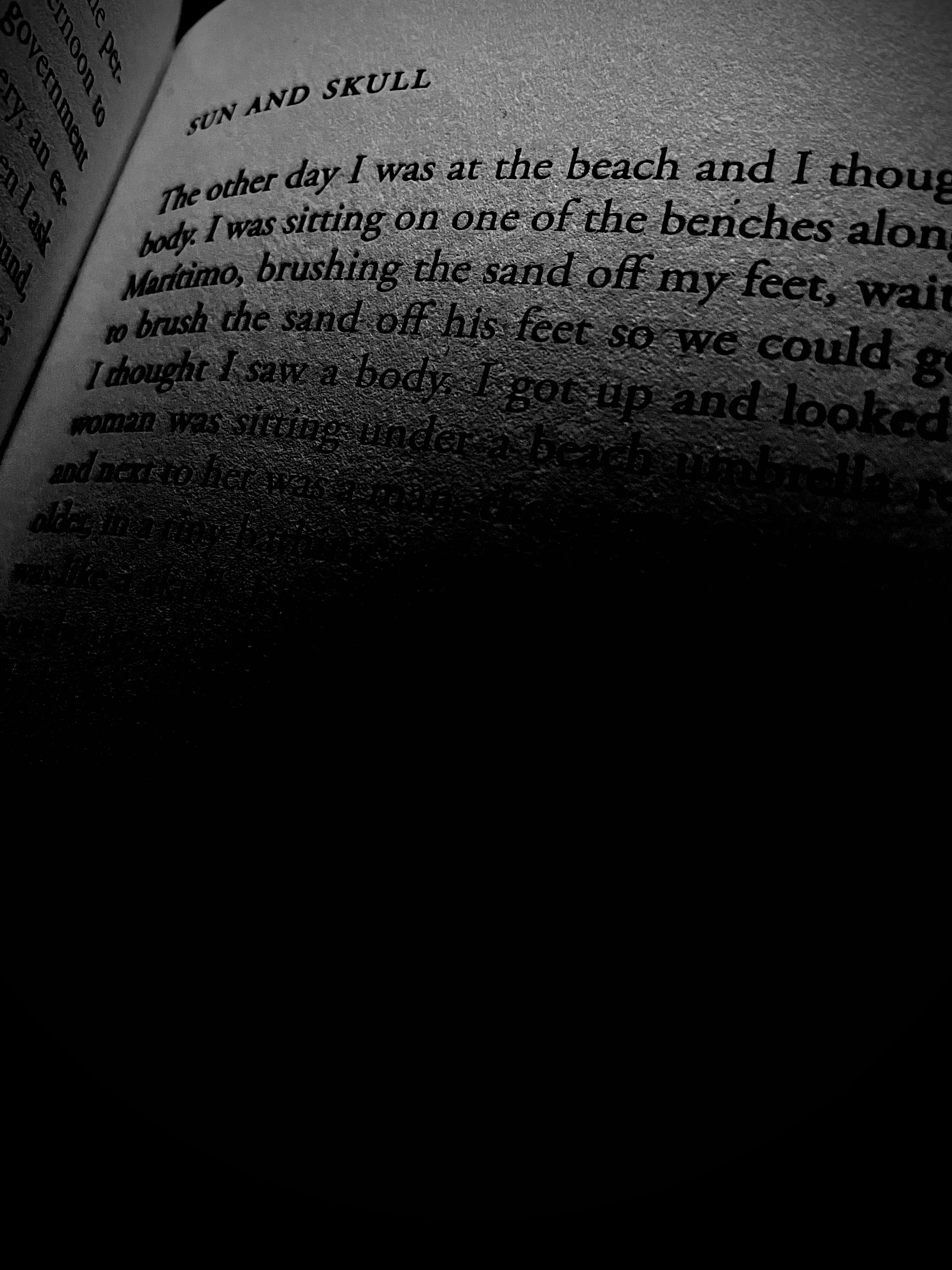
The other day I was at the beach and I thought I saw a dead body. I was sitting on one of the benches along Blanes’ Paseo Marítimo, brushing the sand off my feet, waiting for my son to brush the sand off his feet so we could go home, when I thought I saw a dead body. I got up and looked again: an old woman was sitting under a beach umbrella reading a book and next to her was a man, the same age or maybe a few years older, in a tiny bathing suit, lying in the sun. This man’s head was like a skull. I saw him and I said to myself that he would soon be dead. And I realized that his old wife, reading peacefully, knew it too. She was sitting in a beach chair with a blue canvas back. A small but comfortable chair. He was stretched out on the sand, only his head in the shade. On his face I thought I glimpsed a frown of contentment, or maybe he was just sleeping while his wife read. He was very tan. Skeletal but tan. They were tourists from up north. Possibly German or English. Maybe Dutch or Belgian. It doesn’t really matter. As the seconds went by, his face looked more and more skull-like. And only then did I realize how eagerly, how recklessly, he was exposing himself to the sun. He wasn’t using sunscreen. And he knew he was dying and he was lying in the sun on purpose like a person saying goodbye to someone very dear. The old tourist was bidding farewell to the sun and to his own body and to his old wife sitting beside him. It was a sight to see, something to admire. It wasn’t a dead body lying there on the sand, but a man. And what courage, what gallantry.
Bolaño, Roberto, Between Parentheses: Essays, Articles, and Speeches, 1998—2003. Trans by Natasha Wimmer. New Directions Books, New York, 2011: 157.
The Taoist universe is an infinity of nested cycles of time, each revolving at a different pace, and those who are not mere mortals pertain to different cycles. Certain teachings take four hundred years to transmit from sage to student; others, four thousand; others, forty thousand. It is said that Lao Tzu, the author of the Tao Te Ching, spent eighty-one years in the womb.
Taoist ritual begins with the construction of an altar that is a calendar and a map of this universe. At its perimeter, twenty-four pickets, the Twenty-Four Energy Nodes, each representing fifteen days, form a year of 360 days. Within, a proliferation of markers for the Two Principles (yin and yang), the Three Energies, the Three Irrational Powers, the Five Elements, the Five Tones, the Six Rectors, the Eight Trigrams, and Sixty-Four Hexagrams of the I Ching, the Nine Palaces and the Nine Halls, the Ten Stems of the Twelve Branches…Each is a supernatural being, a gate, a direction, a part of the body, a measurement of time, a philosophical concept, an alchemical substance. As Lao Tzu said, “The Tao created one, one gave birth to two, two to three, and three to the ten thousand things.”
Typically of Taoism, this system has an inherent flaw: a hole in time called the Irrational Opening. If, at a certain moment, which is always changing, one walks backward through the various gates in a certain order, one can escape time and enter the Hidden Span. In this other time beyond all the other times, one finds oneself in the holy mountains; there one can gather healing herbs, magic mushrooms, and elixirs that bring immortality.
The technique was first taught to the Yellow Emperor by the six calendrical Jade Maidens, who in turn learned it from the Mysterious Woman of the Nine Heavens, also known as the Lady of the Ultimate Yin. Its most famous practitioner was a very real military strategist, Chu-ko Liang (181-234). To repel an invading army, he placed hidden markers on an enormous plain to secretly replicate a Taoist altar, and then tricked the enemy troops into entering through a certain symbolic gate. Although the landscape appeared unremarkable, the army found itself trapped in a labyrinth of an alternate time from which it could not escape.
Weinberger, Eliot. An Elemental Thing, New Directions Books, New York, 2007: 56-57.







 truthfront