Author: TJ McAvoy
-
A visual journey to the inside of Silvino González
“The man’s body is sacred, and the woman’s body is sacred;
No matter who it is, it is sacred;
Is it a slave? Is it one of the dull-faced immigrants just landed on the wharf?
Each belongs here or anywhere, just as much as the well-off—just as much as you;
Each has his or her place in the procession.”Leaves of grass. I sing the body electric. Walt Whitman.


-
New direction: Staying the course
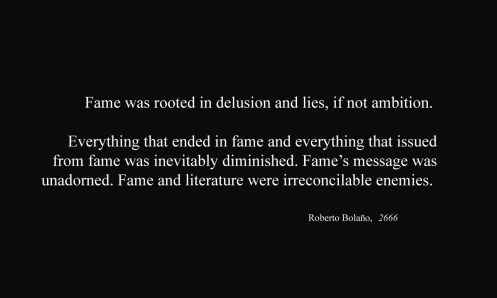
In the wake of meeting with my editor and receiving my manuscript back after nearly six months, it occurs to me that Truth Front may once again need a bit of a change.
My editor, in short, told me her edits are minimal. She heaps praise upon the manuscript, but tells me that, if I want to seek a wide readership, I need to make The Novel Paradox more accessible. In her words, I need to dumb it down.
Of course I respect and appreciate my editor and am very grateful to her for working on this as a freelance project, unpaid, out of friendship and sheer goodness of spirit and belief in literature. I wouldn’t have chosen anyone else to help guide me into the shark infested waters of the publishing world. We both believe in literature and will protect its sanctity with our lives and this is why I agree with her, I believe there are many parts of the novel that, to use my term, don’t need to be left to such deep interpretation.
Though I am not necessarily a Realist writer (what exactly is a Realist writer, anyway, and aren’t we all Realist writers, in a way?), I am more or less tethered as a man to the realization that my work is not tailored to a wide audience. I am not writing for the masses (nor anyone, for that matter). The text is deeply interactive with the reader; the reader has to roll up his or her sleeves a bit to fully enjoy the novel.
I write based upon four principles: 1. Sate the creative energy compelling me to write. 2. Write always, and when unable to write, sneak it, like a fox. 3. Write novels (or essays or whatever I’m writing) that I would enjoy reading, and thus, would exhort my own efforts for. 4. Pay homage to the masters that have laid the foundation beneath this crooked, awkward and beautiful structure that literature has become.
Therefore, I believe there is a middle ground I can reach with this thing. I can fill in some gaps, I can utilize the tools of subtlety to perhaps make the text more accessible. But the reader needs to work. That is the beauty of literature, more than any other form of art. I’m not talking about the extreme avant-garde or even highly experimental work. The reader’s interaction with the text is paramount, in my opinion, to realize full enjoyment of the work. The Novel Paradox is a novel about art, about time and madness, but is in many ways just a good-old mystery, and the reader is the investigative apparatus thrust into the middle of it.
I will not dumb the novel down to gain the widest readership possible. It’s not meant for that. The widest readership possible wouldn’t even finish the synopsis on the back cover before setting the novel back on the shelf. But I can make adjustments so that perhaps more people will read and enjoy the novel, and just maybe, more people will read in general.
Now I’m not the champion for literature, or reading in general. As a matter of fact, I’ve been working on a new project, which, auspiciously, appears to be another novel-in-the-making, albeit larger (and more accessible) than The Novel Paradox, a new project which tackles the very issue of reading and its importance. But this is another matter for another entry. Because there will be other entries.
What I’m trying to get at is—with the advent of this new project and with the maintenance and reconfiguration of the former (also current?) project, I’m going to devote less time to the entries of fiction on this page, and more upon the creative process itself, the random musings of an insufferably dedicated writer and reader. A couple of years previous I consciously directed Truth Front toward a fiction-only enterprise, needing that redirection to retain focus on my obsessions, which are writing literature, and the pursuit of knowledge.
But now I think it’s time to redirect the path again, to deepen the labyrinth, so to speak.
So for all the loyal readers of Truth Front (I love you, mom!), go ahead and read the recent pieces of short fiction, if you haven’t already (Kansas City, House of Mirrors, et al.), for soon I will abbreviate them from their entirety. And this is a good thing, because it signals that, indeed, a new project is underway.
-
Kansas City

We were in Kansas City five days when the skies turned.
Lake Michigan rose up foaming as if from the underworld and it breached the Iowa state line washing out everything in its path, so we knew it was time to head elsewhere. My husband and I packed our twin girls into the van and knowing we wouldn’t ever return we headed west on I-80 out of Iowa City. With everyone else doing the same thing the road was soon clogged and impassible with parked or stalled-out vehicles by the time we arrived in Des Moines.
There were hundreds of people walking on the highway shoulder. All of them out of the city and into the immense flatlands beneath the open blue sky and we too fell in line, carrying everything we could with us including two sidearms hidden in our waistbands, one for my husband and one for me. The girls were very frightened and on the verge of tears. Now and then I’d see a dead person in a ditch on the side of the road and I’d point in the other direction at nothing in particular and the girls would look over to where I pointed, their eyes straining past the endless fields and out to the circling birds and webs of clouds. A sky so high and neat and endless. I couldn’t tell if either of the girls had already seen the body. Everything was nothing. There were no airplanes in the air and without the roar of traffic the world was eerily quiet.
We were always thirsty and we often talked with others on the road, exchanging information with the ones that seemed decent and had kids of their own. People told us they’d heard the day after the quake a nuclear reactor in Pennsylvania had failed and was contaminating the air. This besides the explosion we all knew about in Washington state. Or where Washington state used to be, now slipped entire into the ocean. Secretly I wondered about the plutonium plants, not to mention the nuke bombs and missiles, wherever they might be. The government wasn’t saying anything but there had to be serious problems. There had to be warheads nestled somewhere deep in the Earth’s mantle, just sitting there where the ground had swallowed them up.
I asked my husband about it that first night on the road. Our legs were tired beyond belief and our nerves frayed. I missed home. The girls were asleep under the moonlight and with the stars brighter than I’d ever seen them I whispered to him, What would happen if there were nukes buried down in the Earth? What would happen if they went off?
My husband had fought in Afghanistan and he said that I shouldn’t worry about such things. He said he’d walked through miles and miles of mine fields before and the worst thing you could do was think about the mines.
The both of us slept badly and the sunshine woke the girls early in the morning. We set off again southbound on US-69 with a thin line of people both in front and behind us, a wasted group of ghosts. I felt as though we were the last wretched souls on Earth, slinking slowly from the damned. Or maybe we were the damned, walking into the mouth of our eternal anguish.
This is an abbreviated chapter.



 truthfront